Work & Study · Free printable
Free Context Clues Graphic Organizer Printable
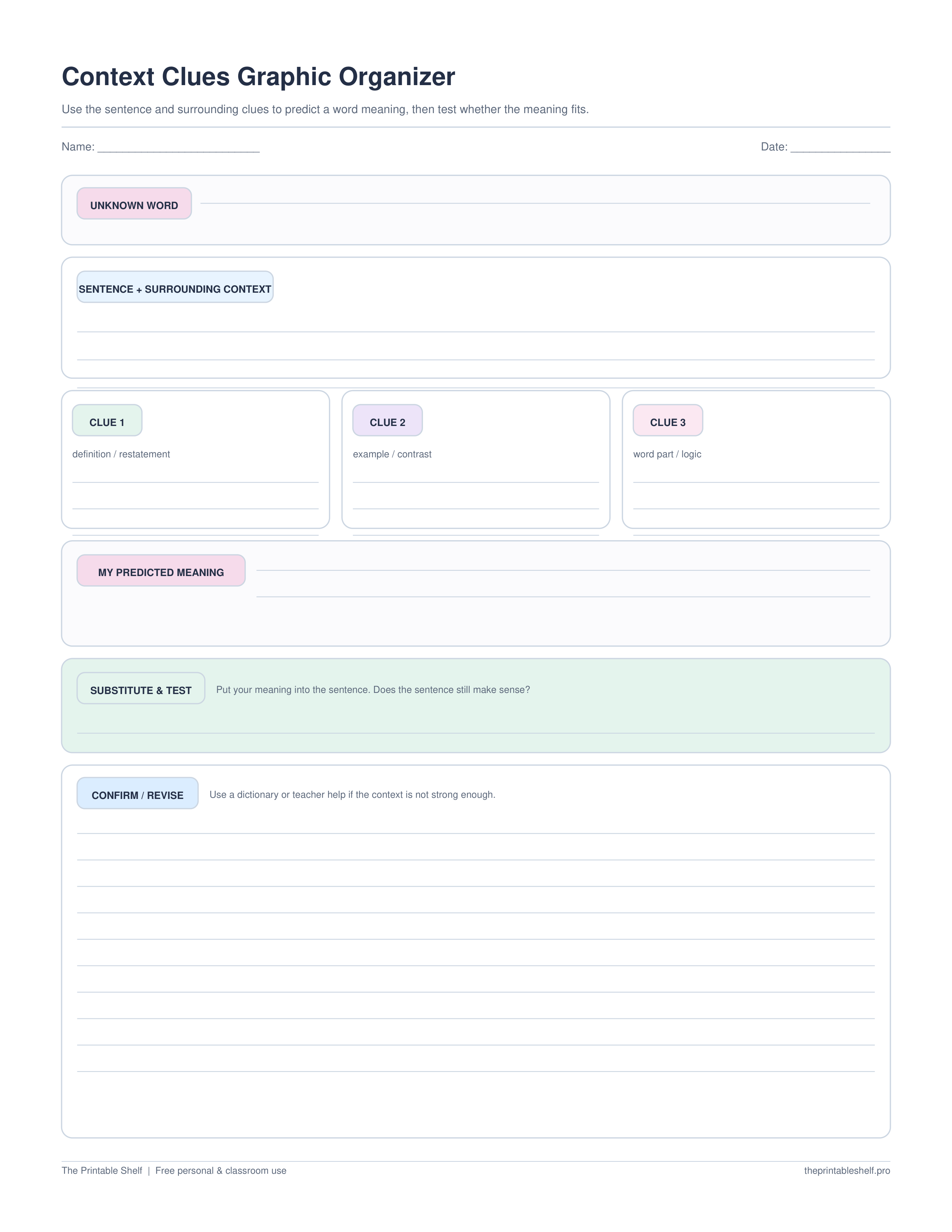
This free context clues organizer guides readers through an unknown word, the sentence and surrounding sentences, three possible clues, a predicted meaning, a substitution test, and a final confirmation or revision step. It makes the evidence for the word meaning visible instead of rewarding a quick guess.
Edited by Tessa Vaughn · Planning & Organization Editor
Free download
Choose your file size
Print at 100% / Actual Size for the cleanest margins. Pick the paper size your printer normally uses.
No sign-up required · personal/classroom use
What this printable is for
A vocabulary-in-context worksheet built around a simple evidence process rather than guessing from one nearby word. Readers gather clues from the sentence and surrounding text, propose a meaning, test it in the sentence, and use a reference source when the context does not provide enough information.
How to use it
Write the unfamiliar word and copy or briefly paraphrase the sentence where it appears. Read the entire sentence before circling a clue. The word next to the unfamiliar term may not be the useful clue; the author may define it later, contrast it with something familiar, give an example, or rely on logic across several sentences.
Use the three clue boxes for the strongest contextual evidence you can find, such as a definition or restatement, an example, a contrast, or logical information from the surrounding sentences. Word parts and grammar can provide additional word-analysis or syntactic support, but keep them conceptually separate from context clues in the narrow sense. Do not feel obligated to fill all three boxes or find three different clue types; record only evidence that genuinely narrows the possibilities.
Write a predicted meaning in your own words before opening a dictionary. Keep the meaning precise enough to test. A vague substitute such as 'something good' can seem to fit many sentences without demonstrating understanding. If several meanings are possible, write the one that best fits the way the word is being used in this passage.
Substitute your predicted meaning for the unfamiliar word and reread the sentence, adjusting wording or inflection when needed to fit the original grammar. Check whether the meaning still makes sense in the sentence and surrounding discussion. If the idea becomes illogical or conflicts with the wider context, revise the prediction rather than rejecting a sound meaning merely because its dictionary form needs grammatical adjustment.
Confirm the meaning with a dictionary, glossary, teacher, or another reliable source when the context is weak or ambiguous. Context does not always provide enough information. The useful skill is knowing how to use clues when they help and how to recognize when another resource is needed. After checking the definition, return to the sentence and explain which clue was genuinely useful; this keeps reference checking connected to reading rather than turning it into a separate vocabulary task.
Fill it online
Type directly into this organizer →
Your answers autosave only in this browser. Print or save the filled page as PDF, download a high-resolution PNG, or clear it and start again—no account required.
Customize instead
Need a different title, paper size, or orientation? →
Use the free Graphic Organizer Maker to build a custom Venn, KWL, Frayer, story map, T-chart, main-idea, sequence, or cause-and-effect page.
Also in a free pack
Download this organizer together with related pages when you want one reusable master PDF instead of separate files.
Choose the support level
Blank, guided, example, or fill online
Use the blank page when students already know the routine. Choose the guided version when they need short prompts inside the sections. A completed example is available when this template benefits from modeling, and the online version lets students type before printing.
Blank
Independent use →
The standard printable with open writing space and no embedded hints. Download the Letter PDF.
Guided
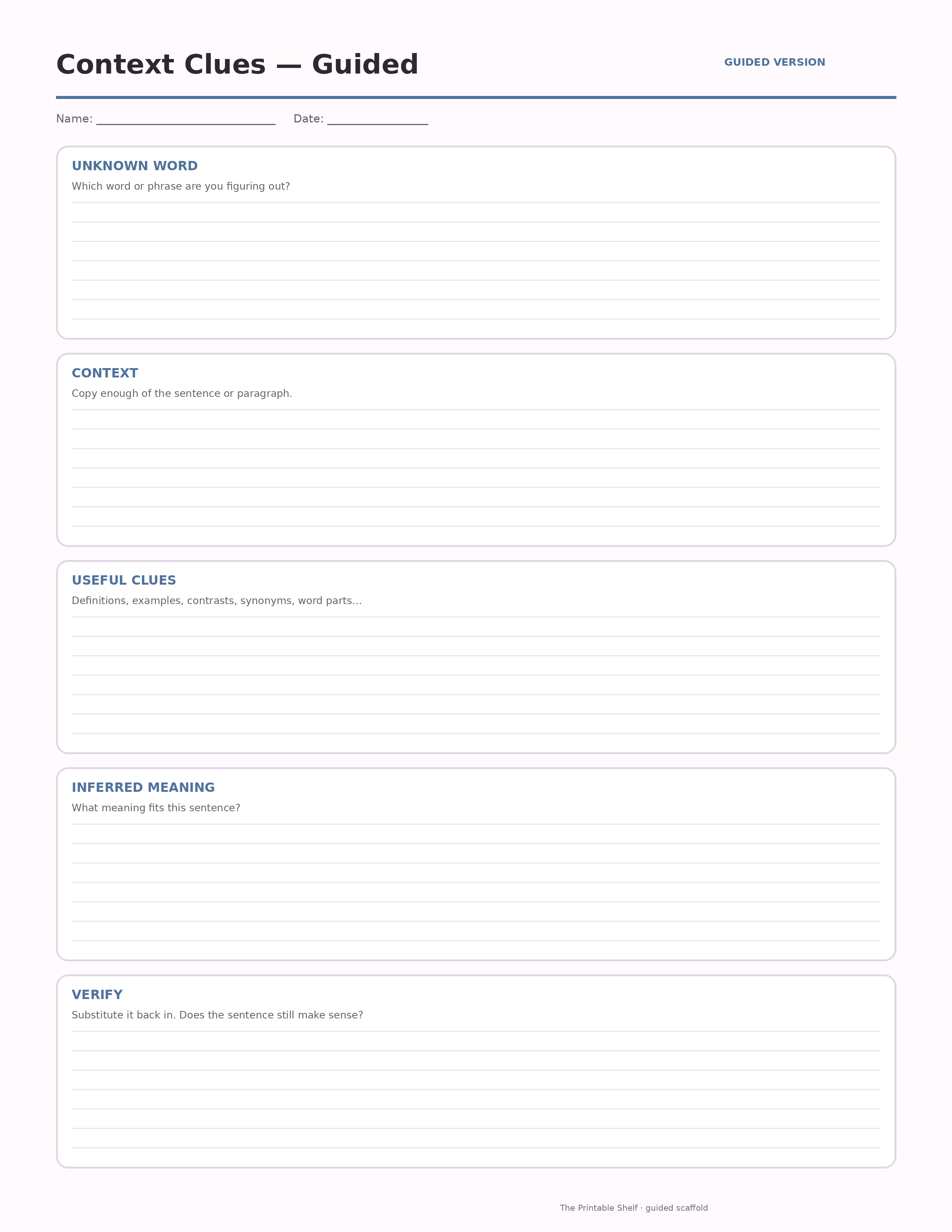
Prompted scaffold
A scaffolded version with short prompts inside each section to help students know what kind of evidence or thinking belongs there.
Model
Completed example ↓
Use the finished sample to model the thinking before students work independently.
Online
Type before printing →
Autosave locally, print/save as PDF, or export the filled organizer as PNG.
Teaching set · 3 pages
Blank + guided + completed example in one PDF
Print the model first, practice with prompts, then move to the blank page without downloading three separate files.
Completed example
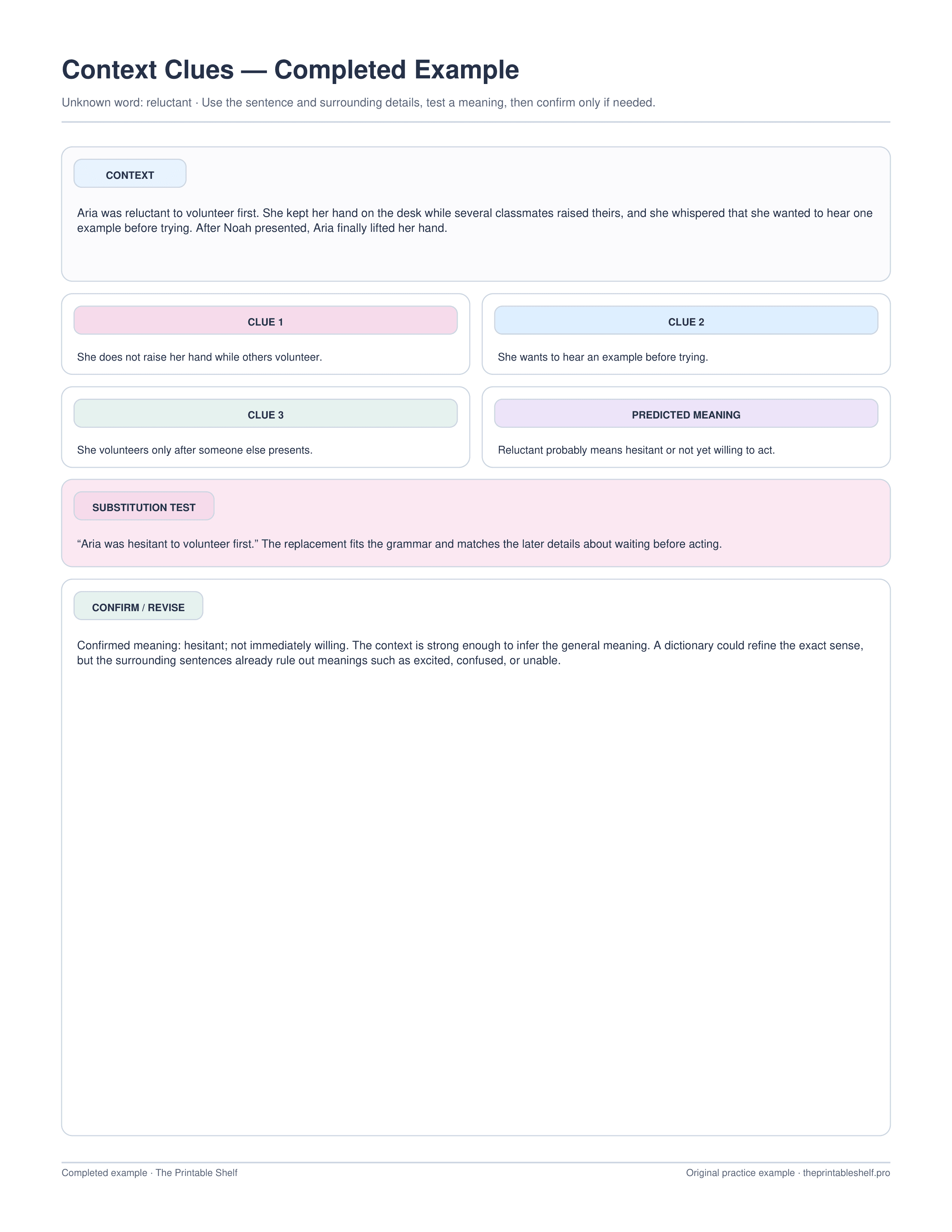
See how a finished page can look
This filled example shows a reader collecting several clues, proposing a meaning, substituting that meaning into the sentence, and deciding whether the context is strong enough before using a reference.
Best uses for this template
Ways to use it
Model a context-clue routine
Move from the unknown word to surrounding evidence, then make and test a meaning before confirming it.
Compare strong and weak clues
Record several possible clues and discuss which one actually narrows the word meaning instead of merely appearing nearby.
Build independent vocabulary habits
Use the final confirmation step to teach when context is enough and when a dictionary or other reference is still needed.
Common mistakes to avoid
Guessing from one nearby word
Read the full sentence and surrounding sentences before deciding which clues are useful.
Treating every context as sufficient
Confirm with a reference source when the passage leaves several meanings possible.
Writing a meaning that cannot be tested
Use a precise substitute and reread the sentence to see whether the meaning and grammar still fit.
Classroom fit
Suggested grades, use modes & standards
Suggested grade bands
These are practical use ranges, not hard limits. Text complexity and the amount of teacher modeling matter more than the worksheet alone.
Good fit for
Scaffold level: Standard.
Common Core crosswalk
- L.4.4a · Use context as a clue to word or phrase meaning
- L.5.4a · Use sentence and paragraph context to determine meaning
- L.6.4a · Use overall sentence or paragraph meaning and word position as clues
These codes are a practical crosswalk for skills this organizer can support. They are not a claim that the worksheet alone fully teaches or assesses the standard.
Frequently asked questions
What are context clues?
Context clues are hints in the words, phrases, sentences, and ideas surrounding an unfamiliar word that can help a reader infer its meaning.
Do context clues always reveal the exact meaning?
No. Some contexts are weak or compatible with several meanings. When the clues are not sufficient, confirm with a dictionary, glossary, or teacher.
What kinds of clues can I record?
Context clues may include definitions, restatements, examples, contrasts, or logical information from surrounding sentences. Word parts and grammar can also help, but they are better treated as supporting word-analysis or syntactic information rather than context clues in the narrow sense.
Helpful guides
See where this organizer fits, when a different layout works better, and how to turn the completed page into a useful next step.
Keep organizing
You might also like
Free printable
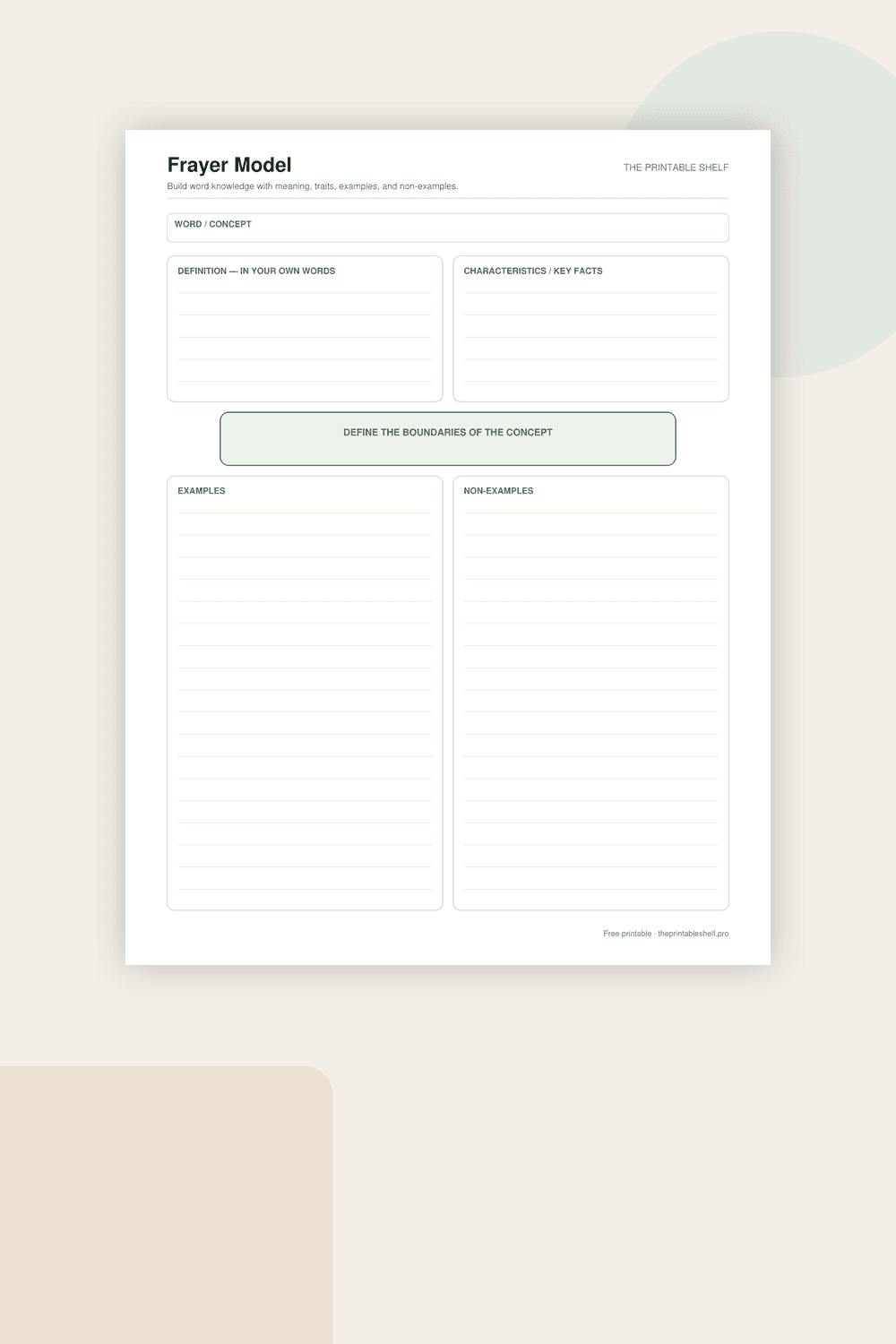
Printable Frayer Model Vocabulary Template
A classic four-part vocabulary and concept organizer upgraded from the site's older vocabulary map. Instead of stopping at a copied definition, the page asks for defining traits, clear examples, and deliberate non-examples, which helps learners distinguish what belongs to a concept from what only looks similar.
Free printable
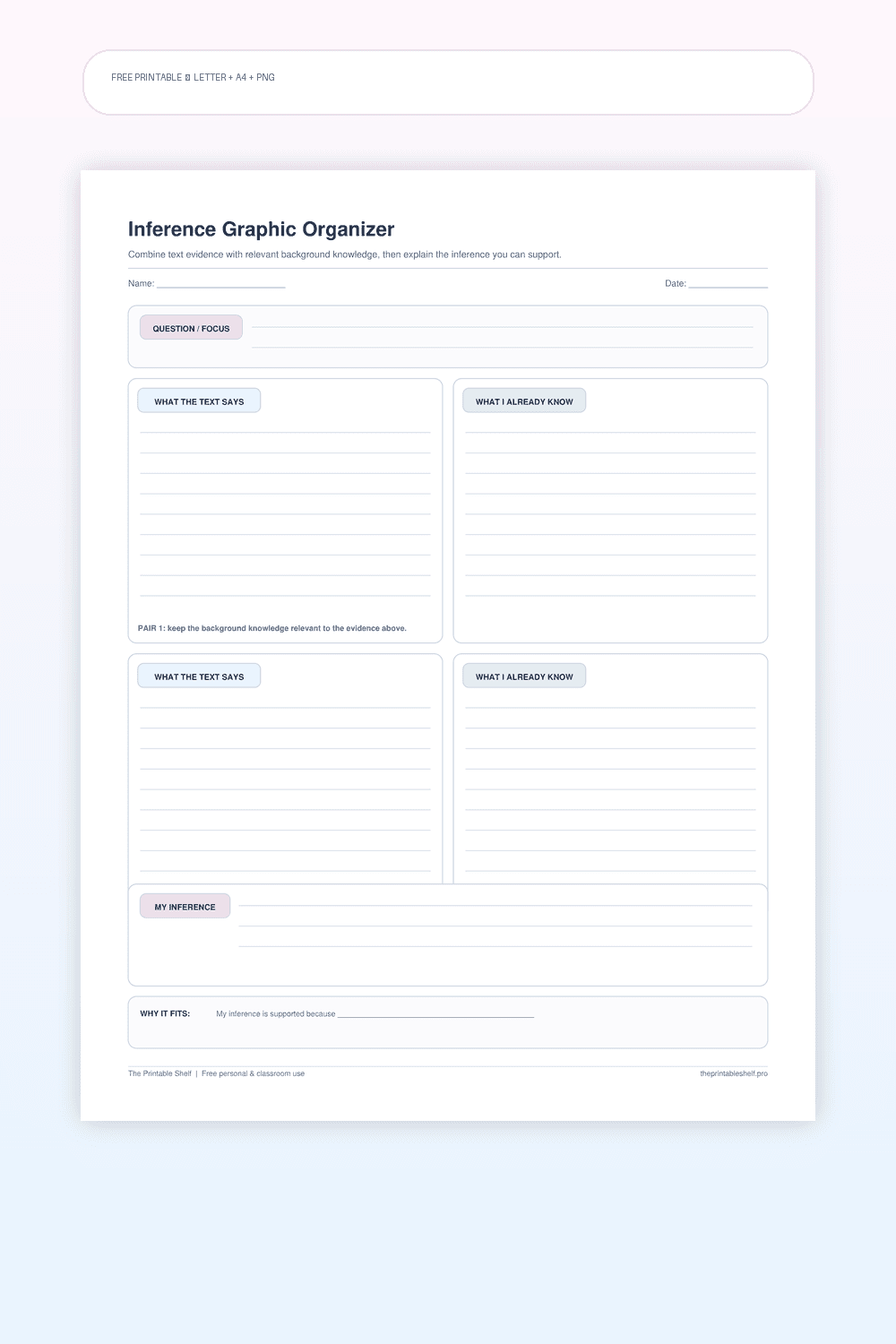
Inference Graphic Organizer
A reading-comprehension scaffold for conclusions that are implied rather than stated directly. The layout separates what the text actually provides from what the reader already knows, then asks for an inference supported by both. That distinction matters because an inference is not a guess or personal opinion; it should be a conclusion that remains accountable to textual clues and can be revised when new information changes the evidence.
Free printable
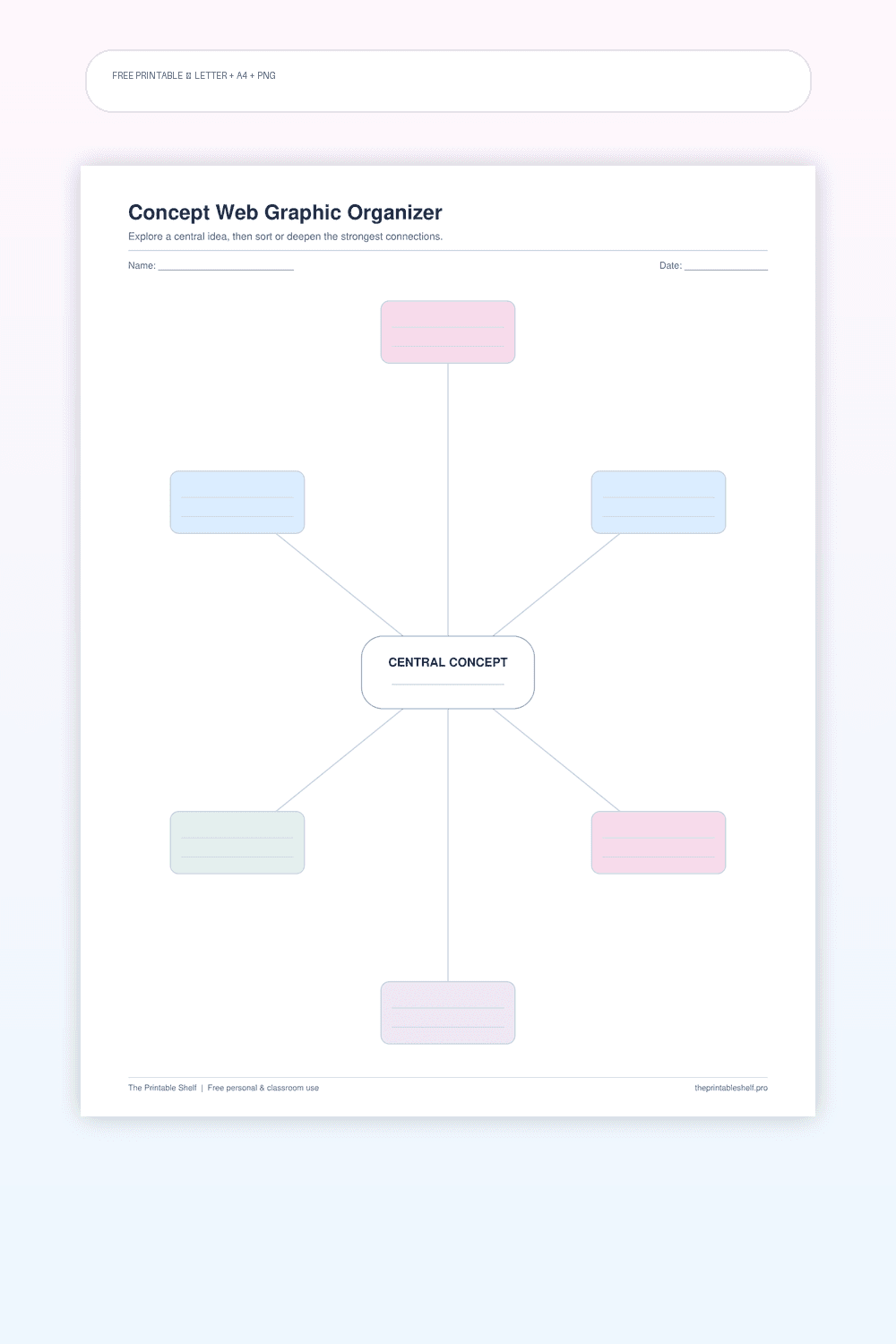
Concept Web Graphic Organizer
A radial organizer with one central concept and multiple surrounding branches. Unlike a main-idea-and-details sheet, the surrounding ideas do not all have to function as evidence for one sentence. The web is better for exploring a topic broadly, grouping associations, and making relationships visible before the user decides how the information should be ordered.