Focused printable collection
Free Writing Organizers & Paper
Free writing organizers for opinion, informational, narrative, essay outlining, source notes, paragraph planning, and Four-Square writing, plus printable paper.
A writing organizer is most useful before the draft, when a writer needs to choose a main point, sort supporting ideas, or decide what comes next. Different assignments need different structures: opinion writing needs a claim and reasons, informational writing needs a clear focus and grouped facts, narrative writing needs a meaningful sequence, and how-to writing needs steps that another person could actually follow.
This hub groups the planning pages separately from reading-comprehension organizers so writers can move from idea generation to a draft without hunting through the full library. The primary and story-writing paper pages are included as the next step after planning, not as substitutes for planning when the writer is still unsure what to say.
Do not require every box to contain the same amount of text. An organizer is a scaffold, not a final composition. Once the strongest ideas are visible, the writer should draft in sentences and paragraphs, add transitions where relationships need to be explicit, and revise the writing rather than polishing the worksheet itself.
14 free downloads
Printables in this collection
Free printable
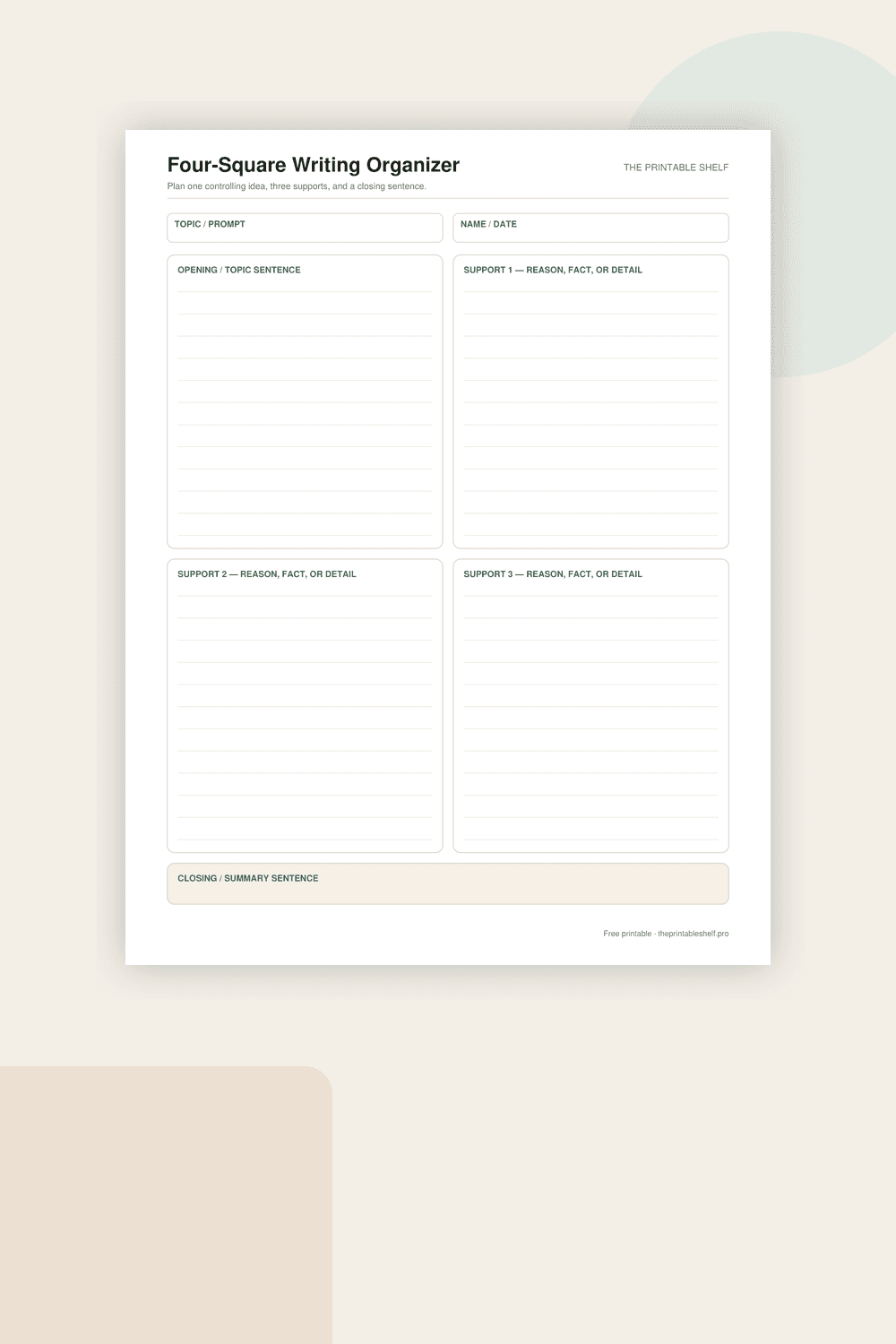
Four-Square Writing Organizer Printable
A practical four-box prewriting page based on the familiar four-square structure, simplified for clean one-page planning. The layout separates the controlling idea from three supporting points and adds a dedicated closing area so the writer can test whether the paragraph has a beginning, development, and purposeful ending before drafting.
Free printable
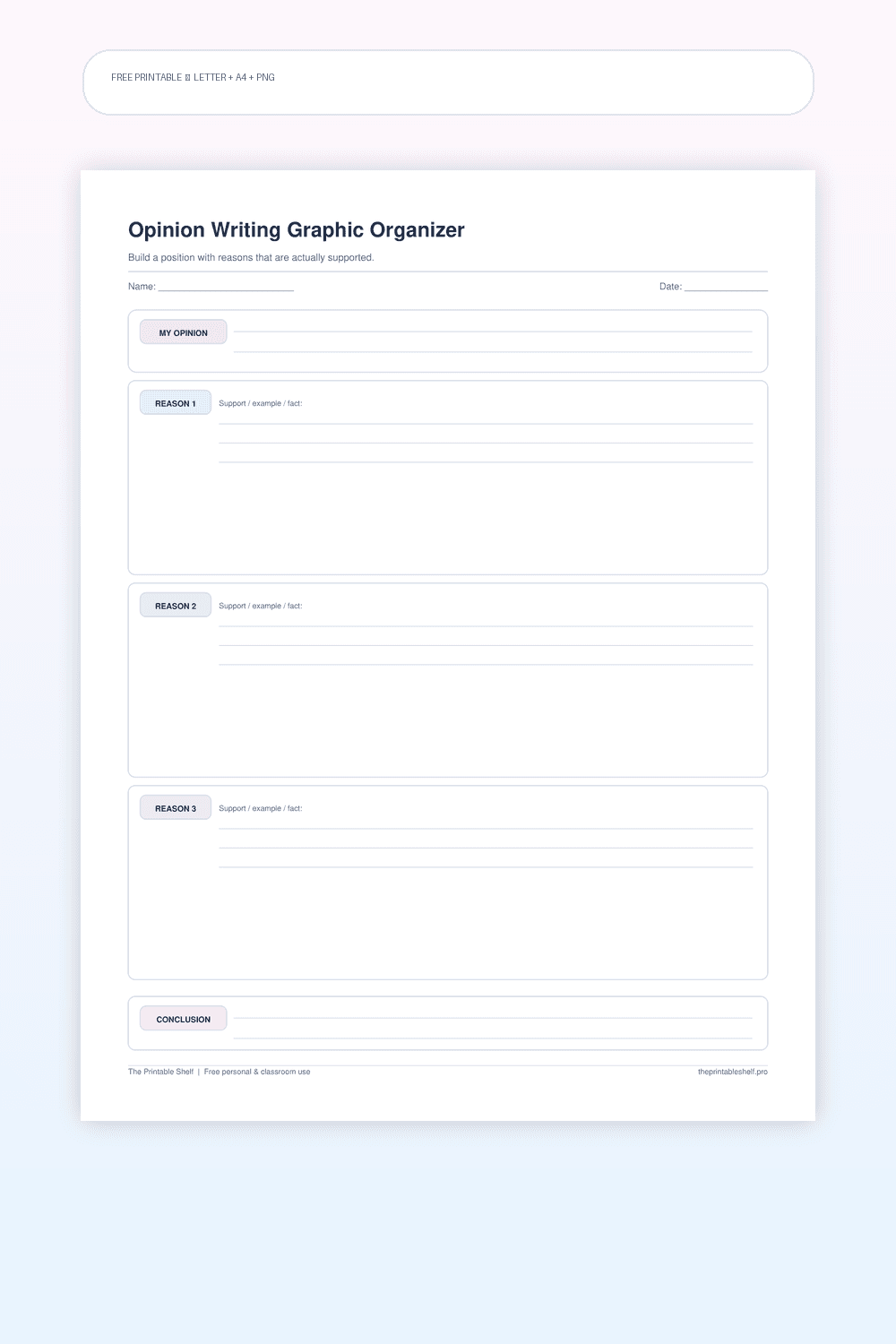
Opinion Writing Graphic Organizer
A structured prewriting page for opinion and early argument writing. It goes beyond the familiar opinion-plus-three-reasons worksheet by prompting the writer to support each reason and check whether every reason actually strengthens the same position. The result is a clearer bridge from brainstorming to a draft.
Free printable
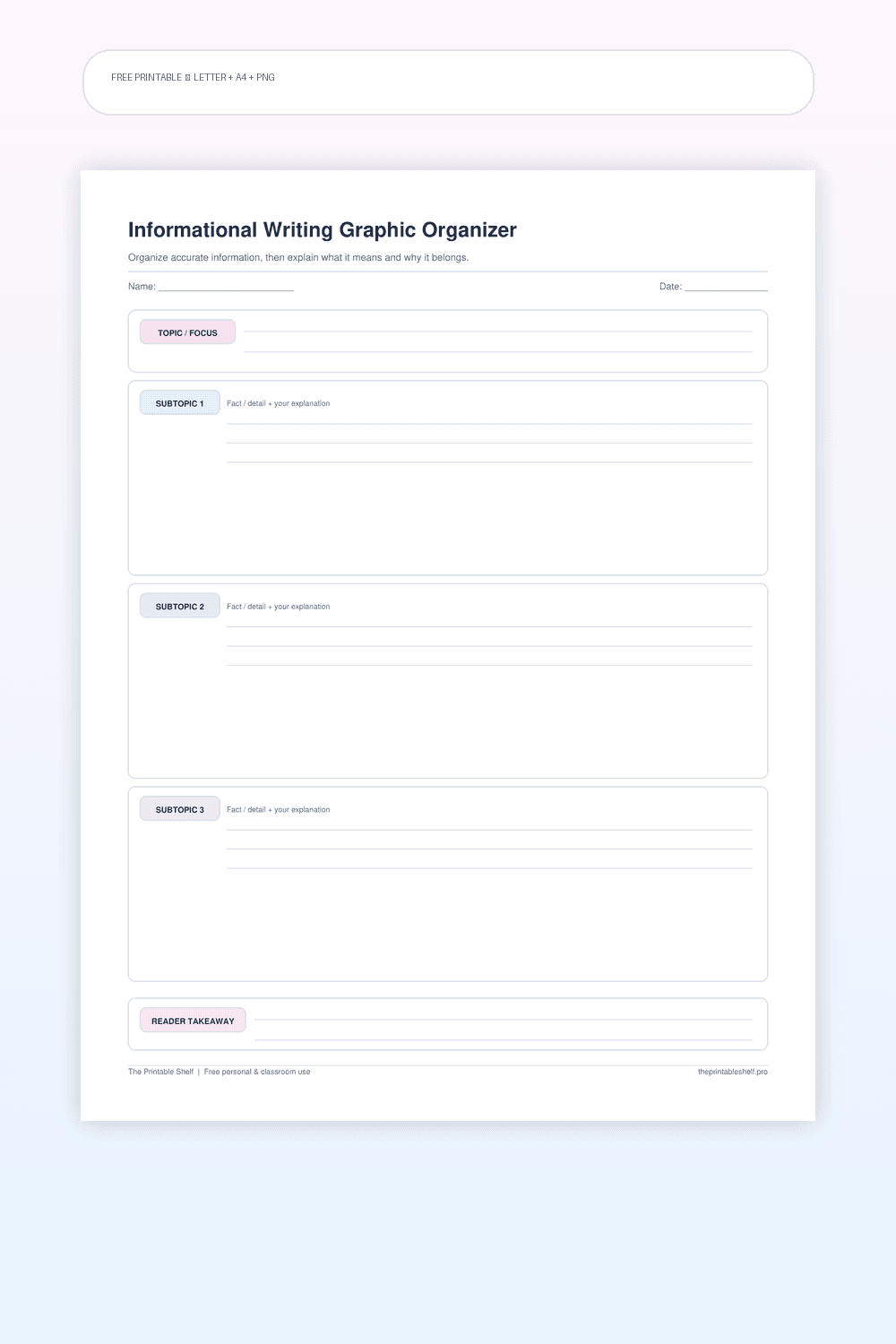
Informational Writing Graphic Organizer
A one-page planning sheet for explanatory and informational writing. It is designed to keep fact collection separate from explanation, because a strong informational paragraph does more than stack facts. The writer chooses a focused topic, groups the most useful information, and identifies the takeaway before drafting.
Free printable
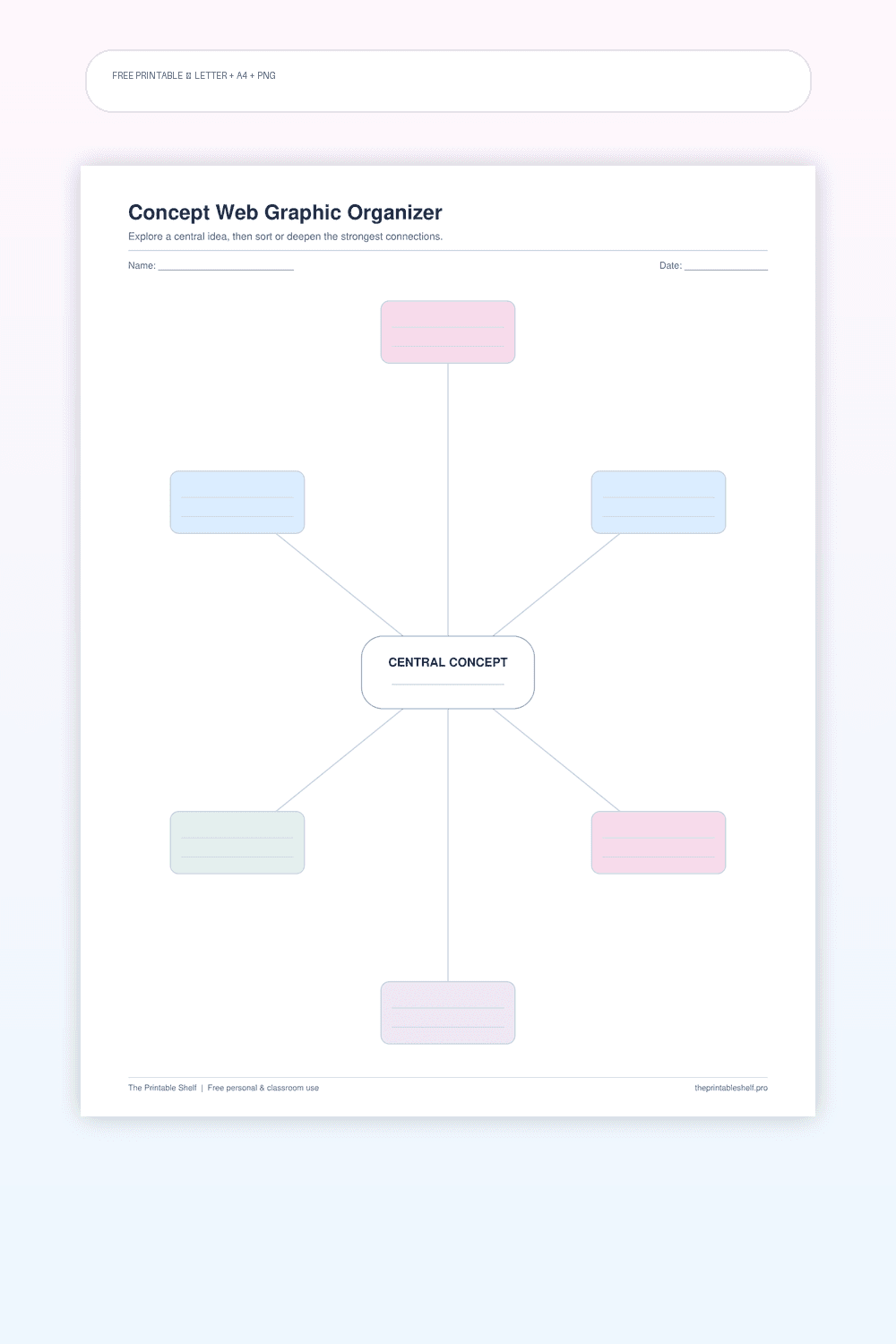
Concept Web Graphic Organizer
A radial organizer with one central concept and multiple surrounding branches. Unlike a main-idea-and-details sheet, the surrounding ideas do not all have to function as evidence for one sentence. The web is better for exploring a topic broadly, grouping associations, and making relationships visible before the user decides how the information should be ordered.
Free printable
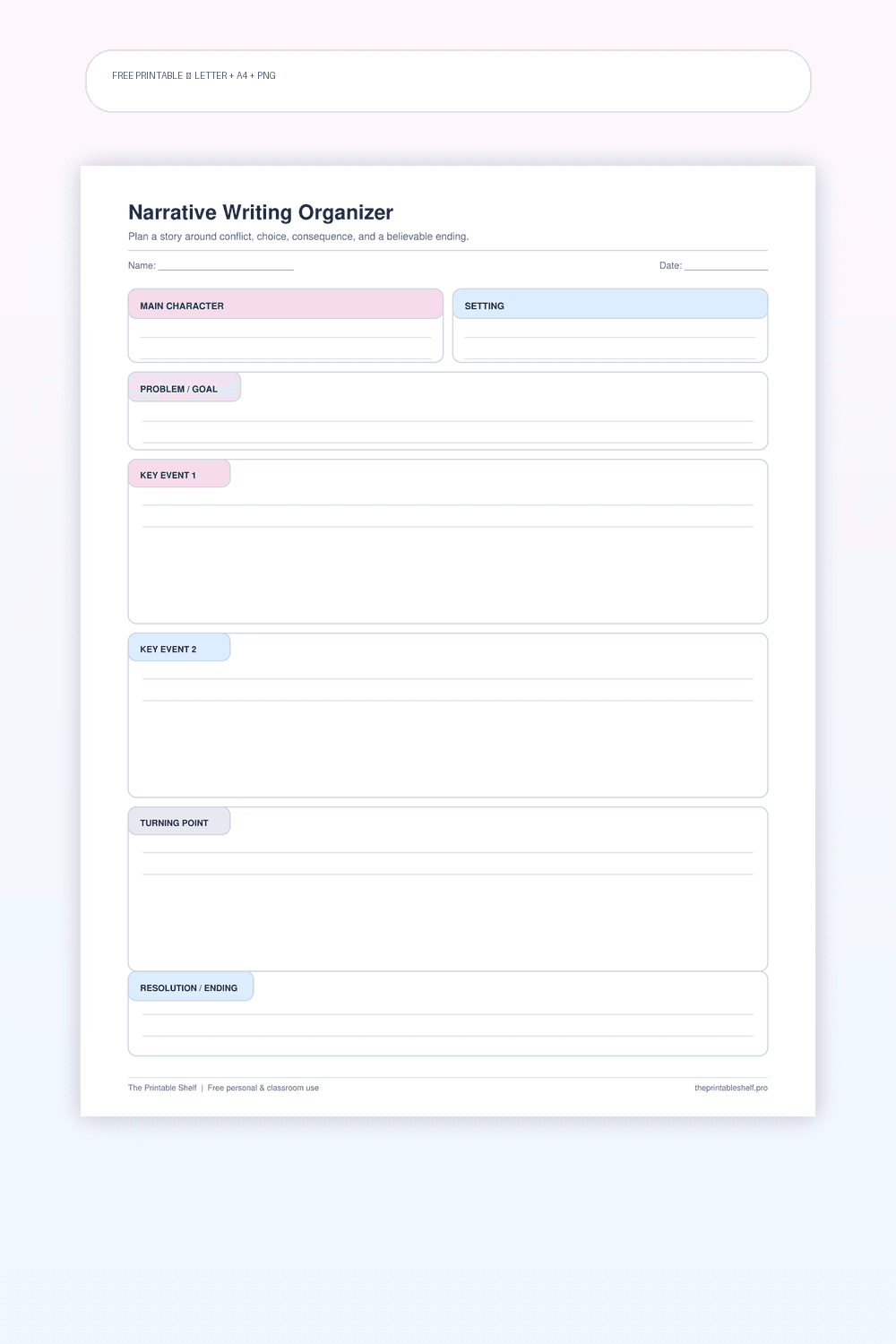
Narrative Writing Graphic Organizer
A one-page story-planning sheet for narrative and creative writing. It combines core story elements with a simple event path, giving writers more support than a blank beginning-middle-end page without turning the plan into a complicated plot diagram. The purpose is to make cause, choice, and consequence visible before the first draft begins.
Free printable
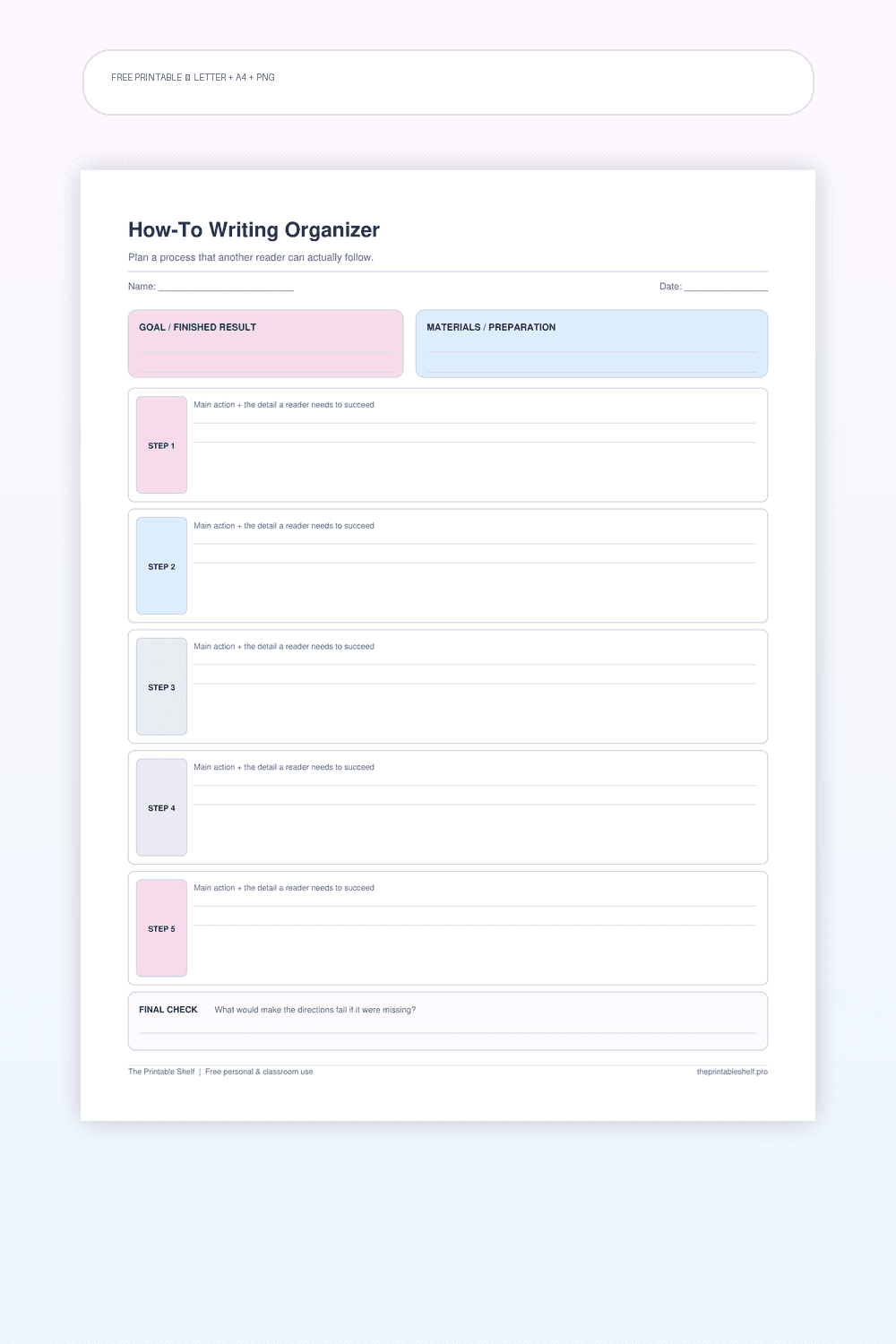
How-To Writing Graphic Organizer
A one-page procedural-writing planner built around the reader’s task rather than a generic sequence alone. It combines a clear outcome, preparation or materials, numbered steps, transition words, and a final check for hidden assumptions. That makes it useful for recipes, classroom procedures, simple experiments, crafts, game instructions, and any explanation of how to complete a repeatable process.
Free printable
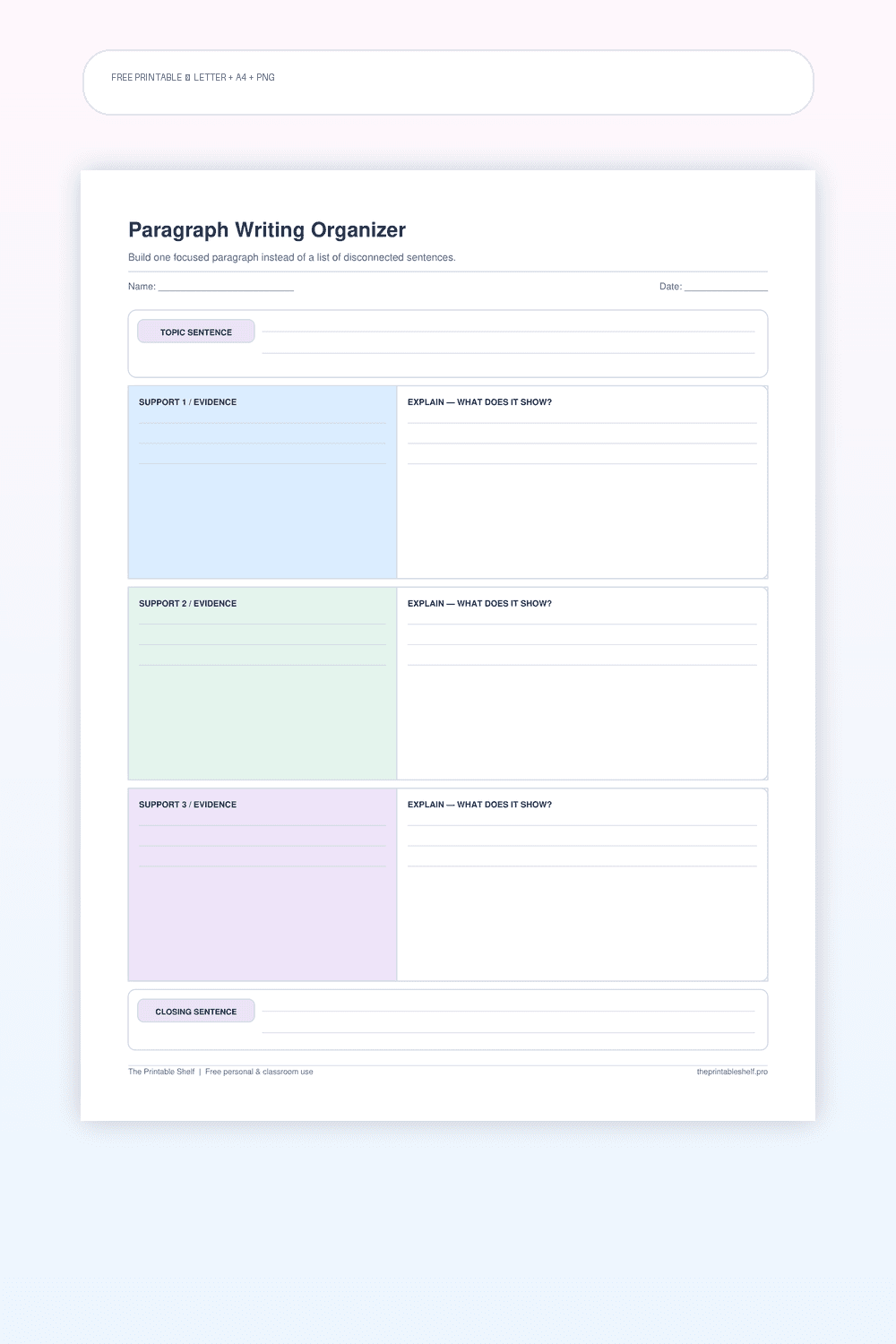
Paragraph Writing Graphic Organizer
A structured single-paragraph planner that separates the job of each sentence group: establish the controlling idea, support it with relevant points, explain those points, and close without introducing a new topic. The layout borrows the clarity of a hamburger-style organizer but avoids treating paragraph writing as a rigid five-sentence formula when a supporting idea needs more than one sentence.
Free printable
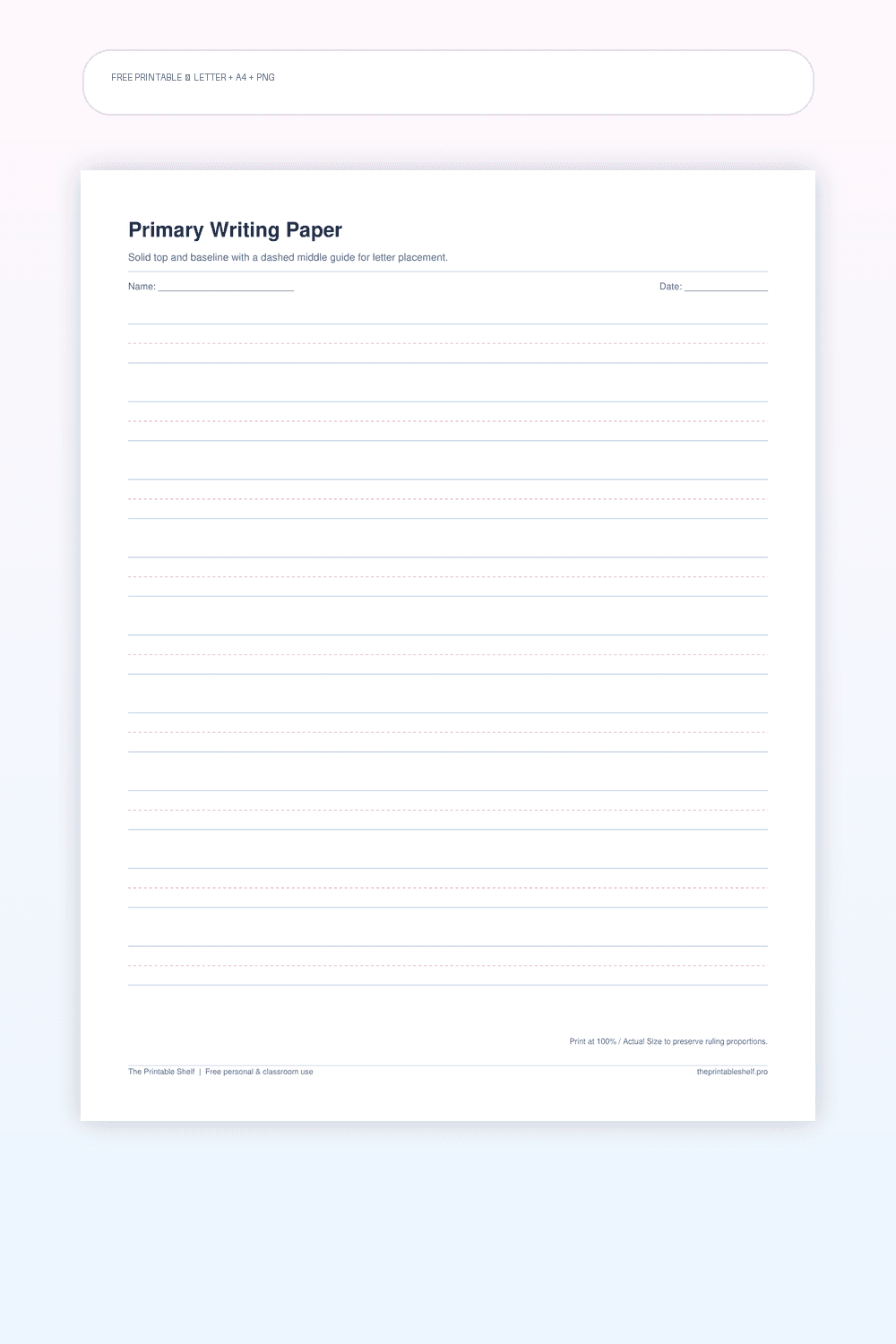
Printable Primary Writing Paper
A reusable writing-paper format for early elementary handwriting and composition, not a content worksheet. The key value is proportion and spacing: primary lines give children a visible baseline, top line, and middle guide for letter placement, while the included line-size variants let adults choose enough room for the writer’s current control instead of forcing every child onto the same ruling.
Free printable
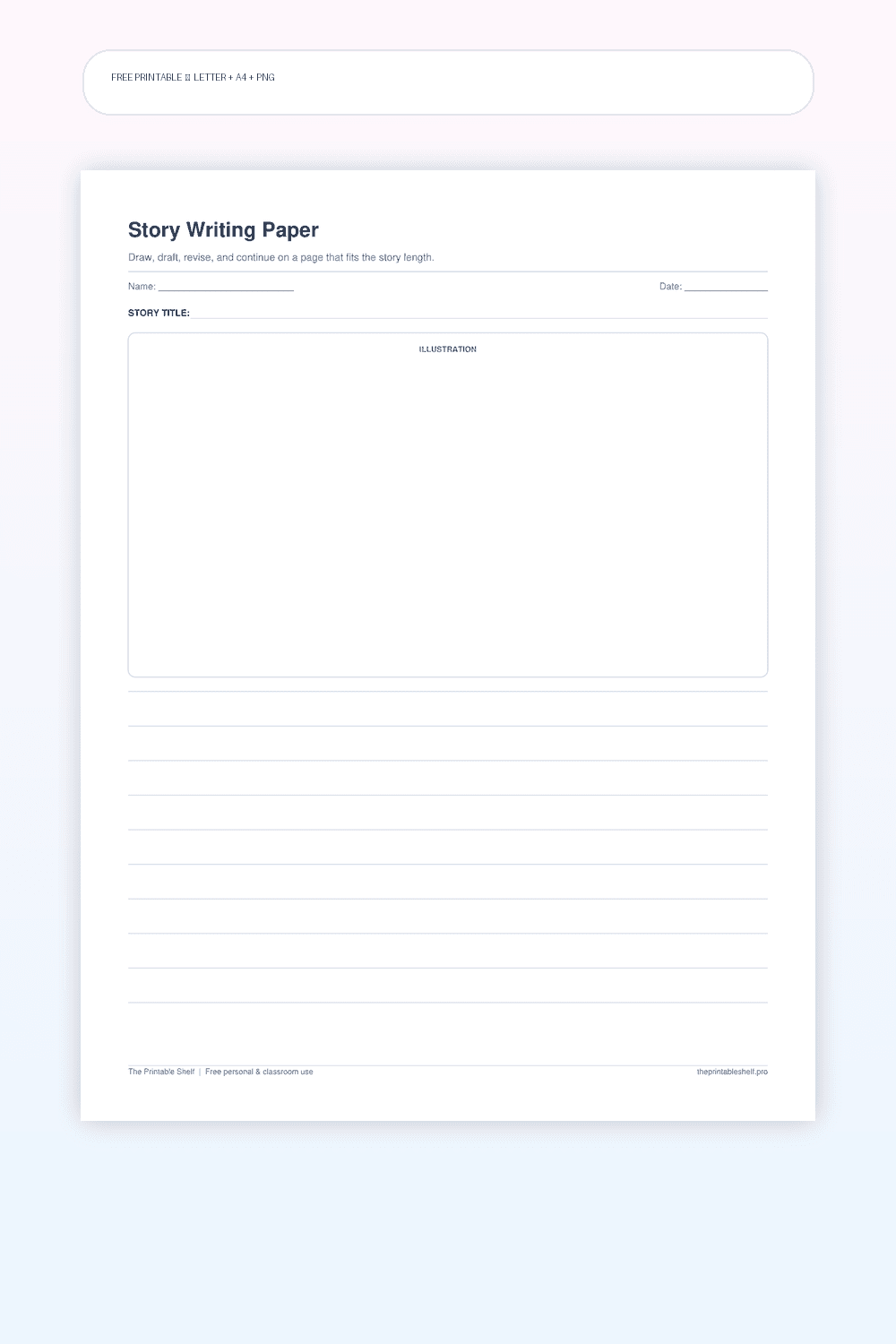
Printable Story Writing Paper
A simple narrative-writing page intended for drafting and presentation after ideas have already been planned. The design deliberately stays quieter than a story map or graphic organizer: it does not tell the writer what the characters or events should be. The included variants change the balance between illustration and writing space so the same resource can support short illustrated stories, continuation pages, or text-heavy drafts.
Free printable
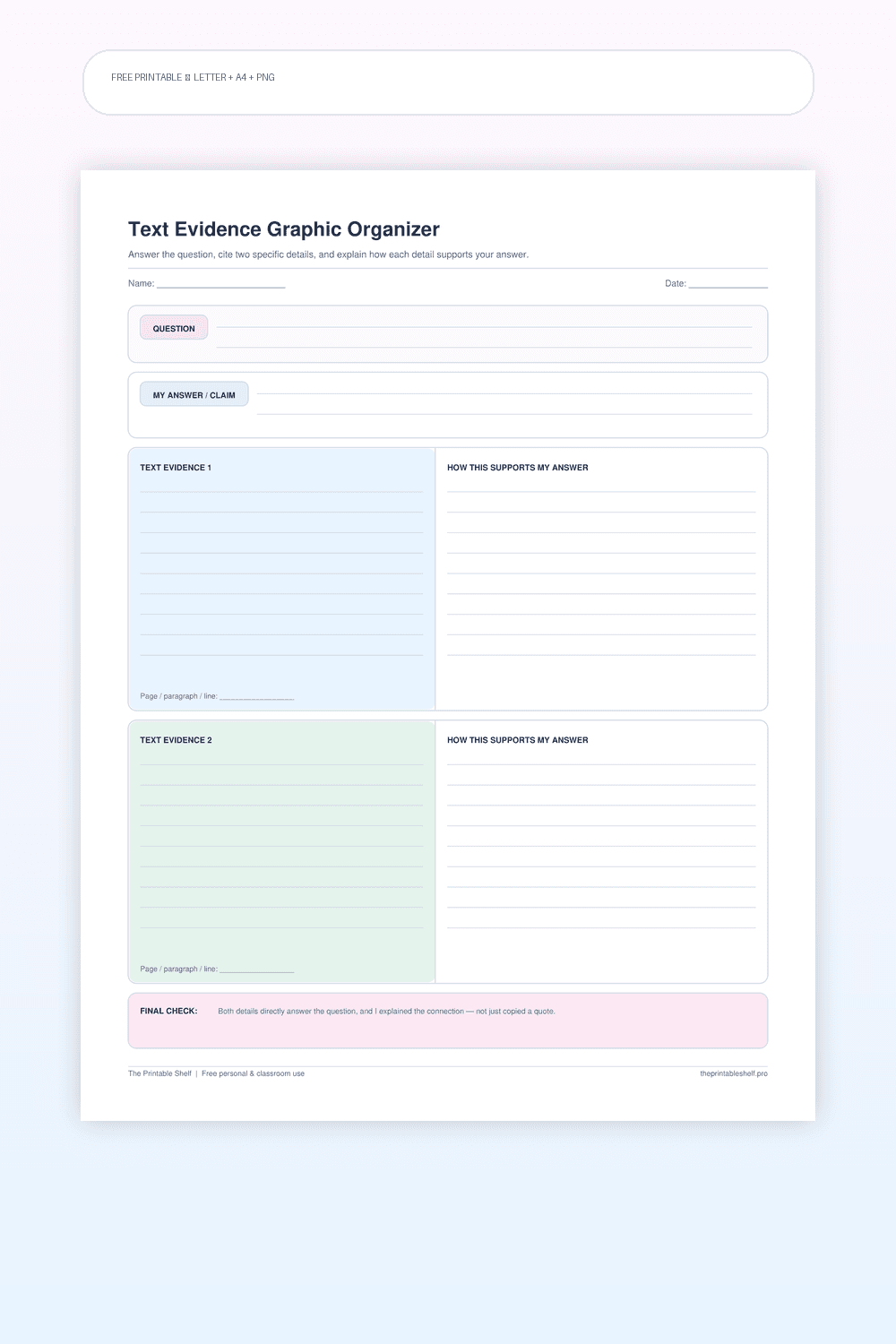
Text Evidence Graphic Organizer
A compact evidence-to-explanation organizer for reading responses and source-based writing. The page deliberately separates evidence from the explanation of evidence. That separation helps expose a common gap: a learner may copy a strong quotation or detail but never show why it supports the point being made. The organizer can be used with direct quotations, paraphrased details, page or paragraph references, and other text-specific evidence allowed by the assignment.
Free printable
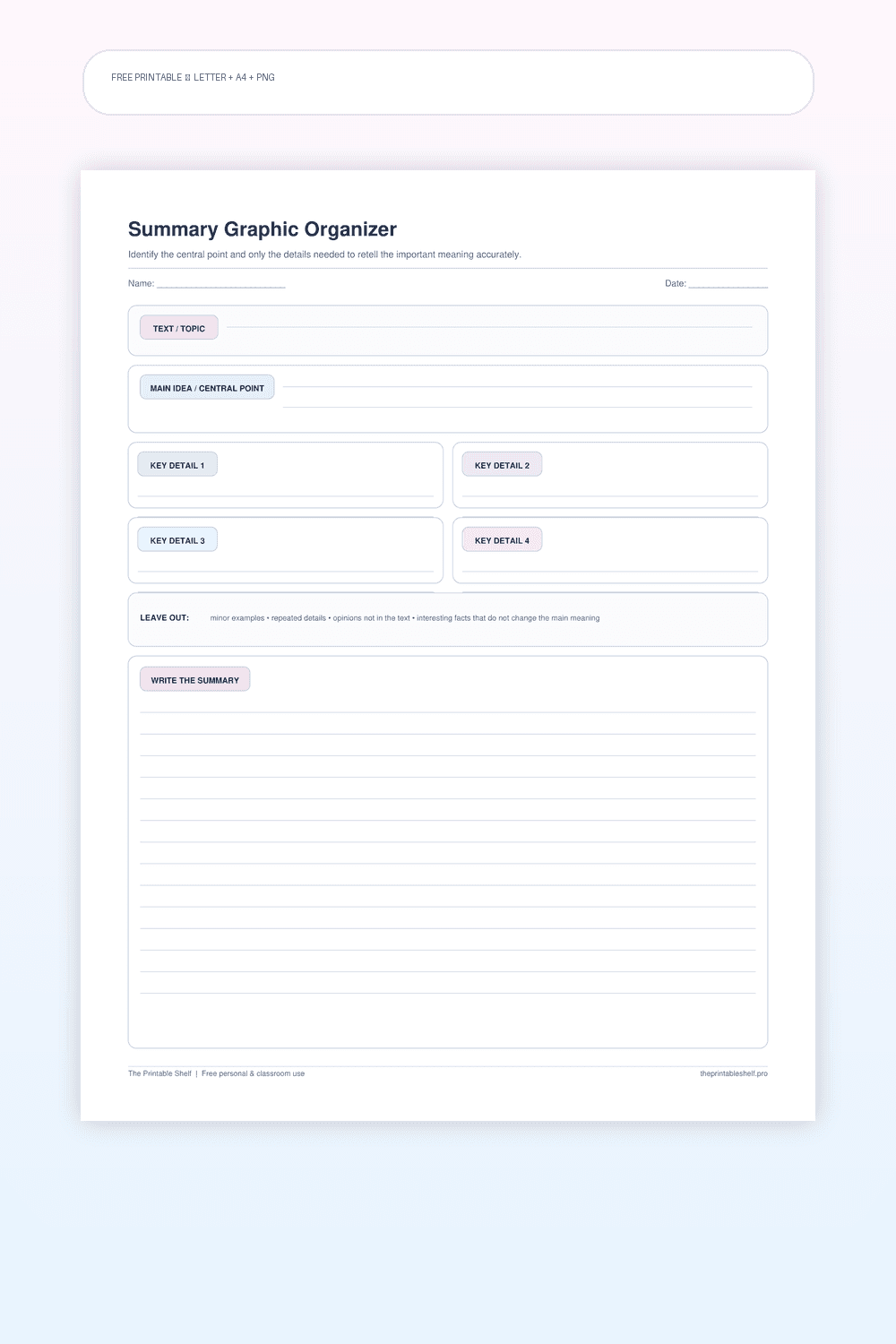
Summary Graphic Organizer
A reading-to-writing scaffold for compressing a text around its most important ideas. The page combines a main-idea box, a small set of key-detail slots, a deliberate 'leave out' check, and a final writing area. It is especially useful when learners can locate details but struggle to rank their importance. Unlike a beginning-middle-end retell, this organizer does not require every event to appear and can be used with nonfiction as well as narrative texts.
Free printable
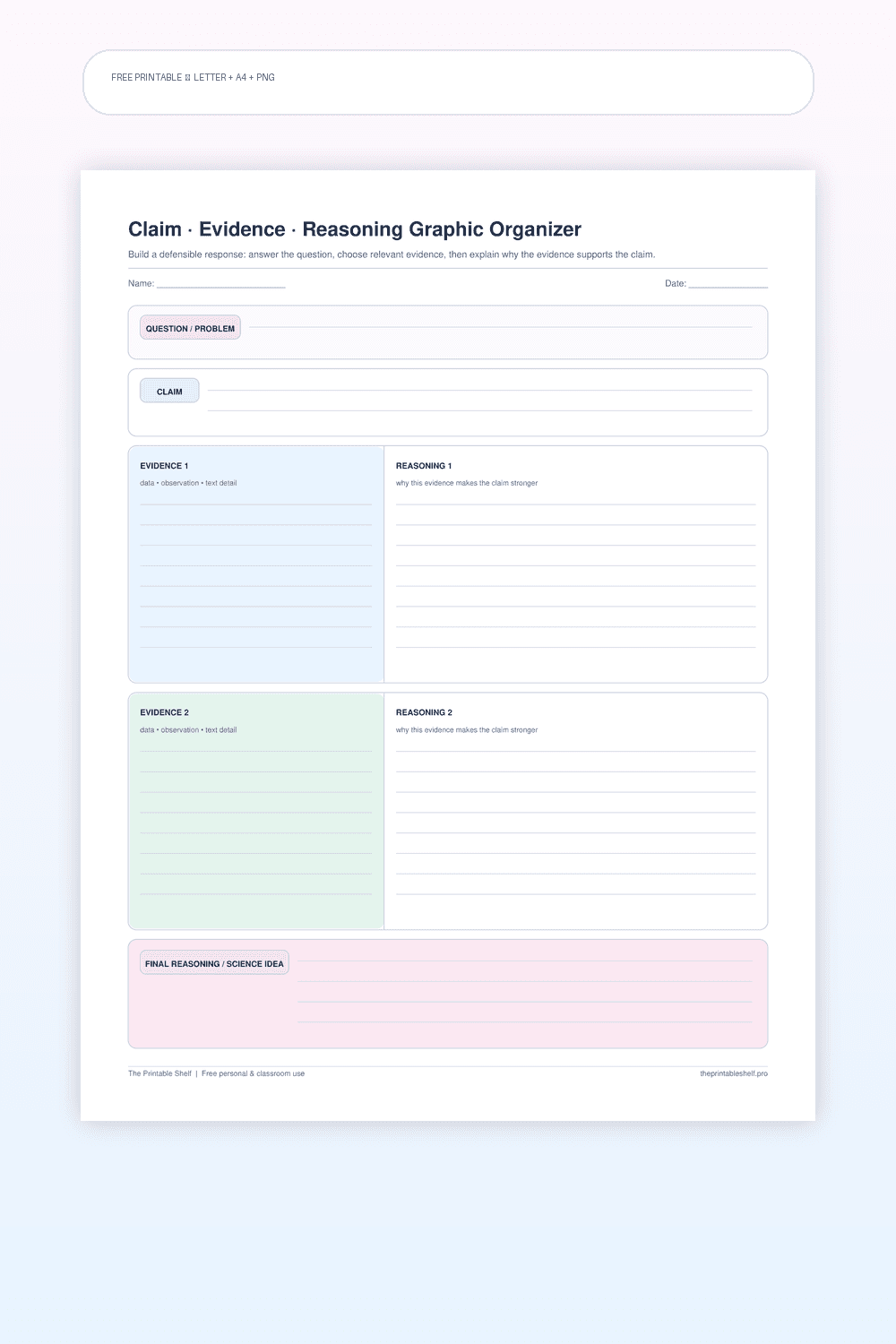
Claim Evidence Reasoning Graphic Organizer
A CER planning page for constructing evidence-based explanations, especially in science. The organizer keeps claim, evidence, and reasoning visually separate because they do different jobs: the claim answers the question, evidence provides appropriate observations or data, and reasoning links that evidence to the claim using relevant scientific ideas or principles. The layout can also support other evidence-based explanations when the teacher or assignment uses CER language.
Free printable
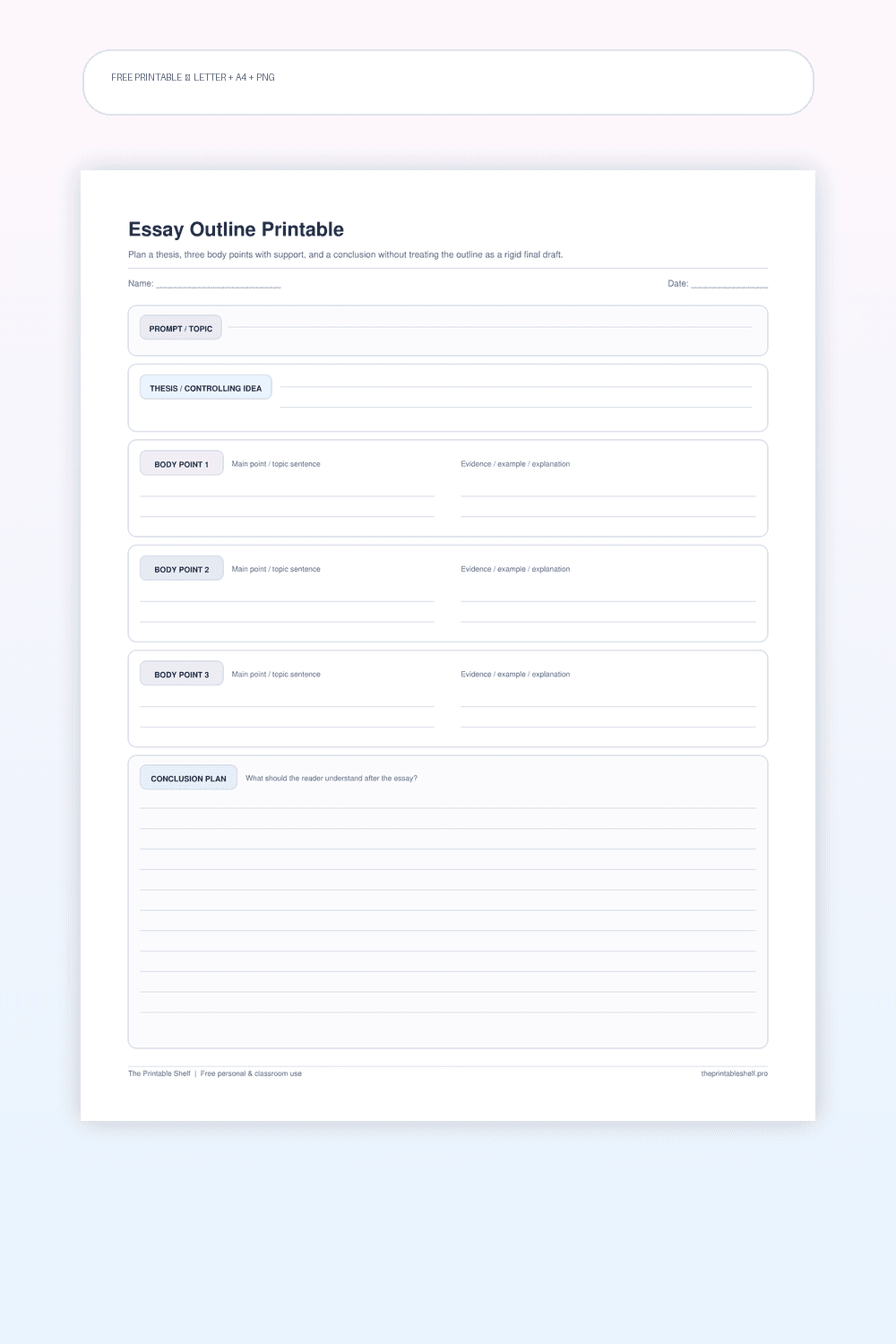
Essay Outline Printable
A one-page academic writing planner for essays that need a central claim or controlling idea and several developed supporting points. Each body section pairs the point with evidence, examples, or explanation so writers can test whether the outline contains development rather than only topic labels.
Free printable
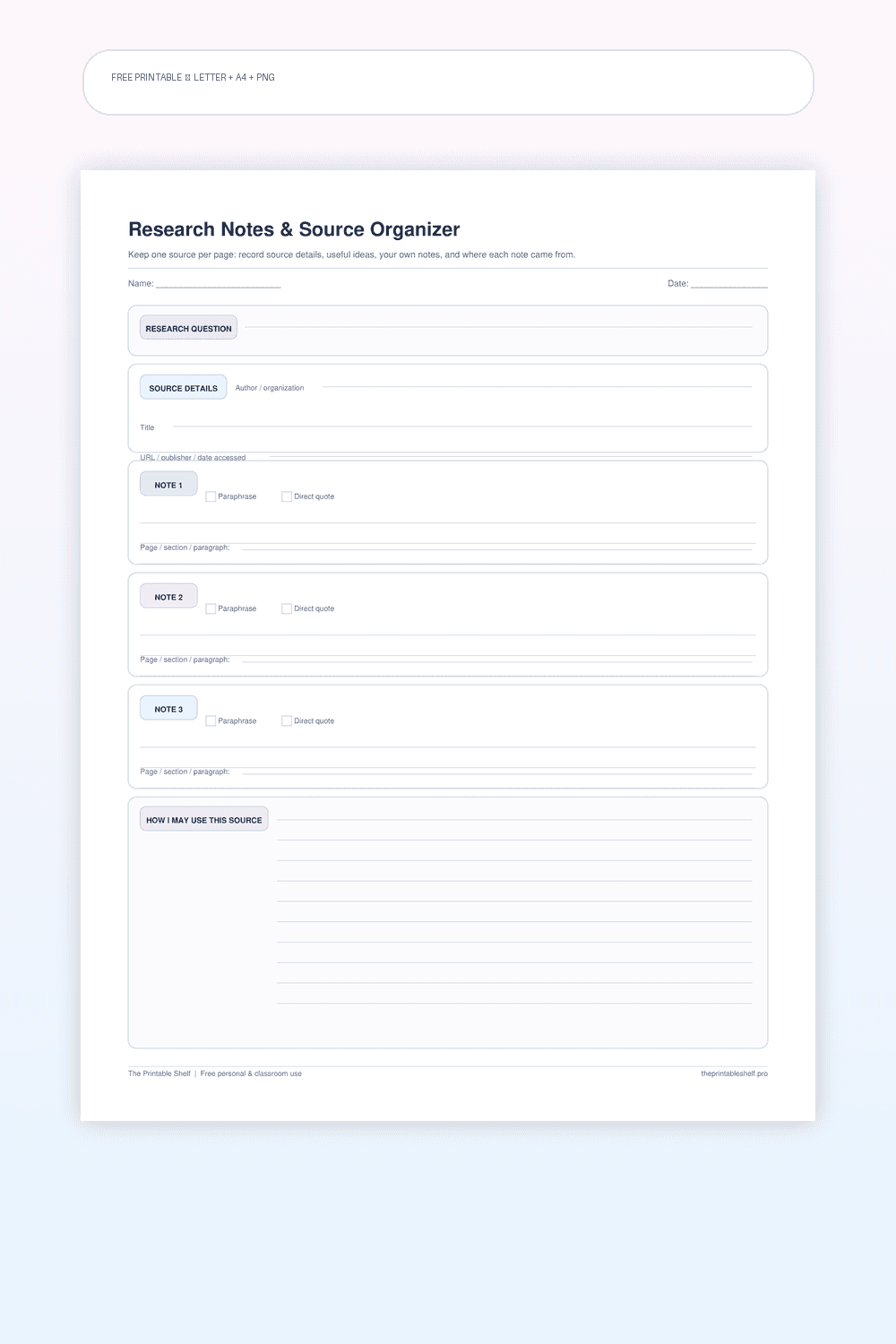
Research Notes and Source Organizer Printable
A source-based note-taking sheet for research projects. The layout is intentionally organized around one source at a time so writers can preserve where information came from while deciding which notes are useful. It is a planning aid, not an automatic citation generator or substitute for the citation style required by an assignment.
Use the templates well
Related guides
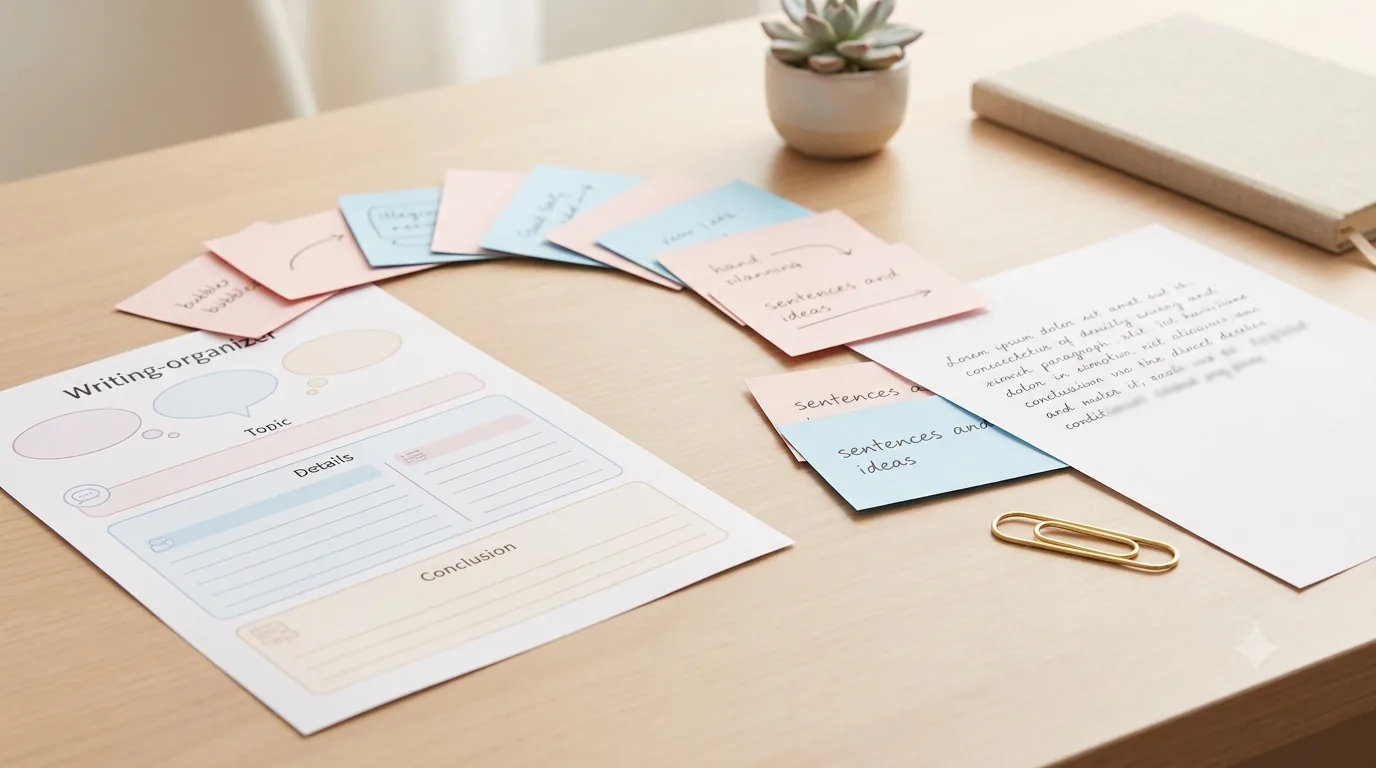
Free Writing Graphic Organizers: Which One to Use and When
Use free writing graphic organizers to plan ideas, structure paragraphs, compare evidence, sequence steps, and organize explanations before drafting.
Read guide →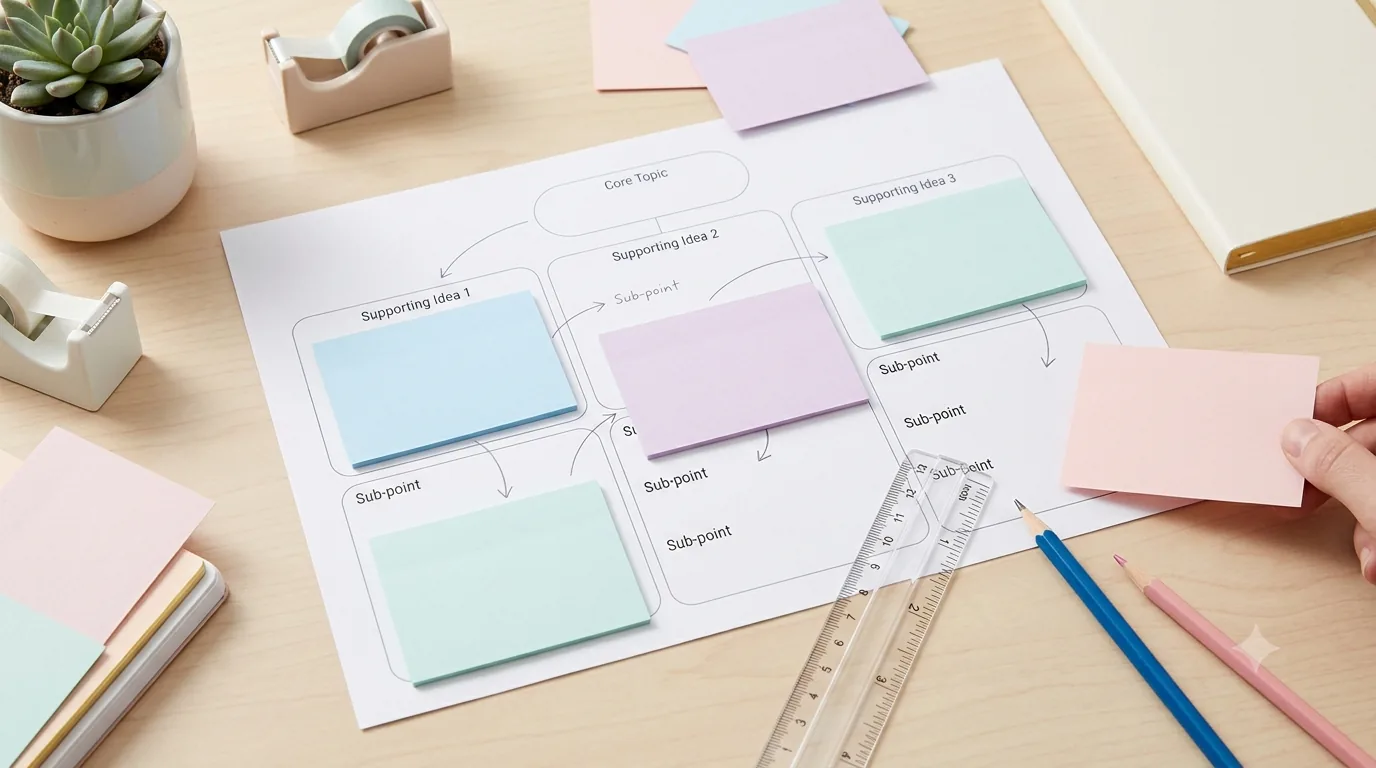
How to Use Graphic Organizers Effectively (Without Turning Them Into Busywork)
Learn how to choose, model, scaffold, and reuse graphic organizers so students think with them instead of simply filling in boxes.
Read guide →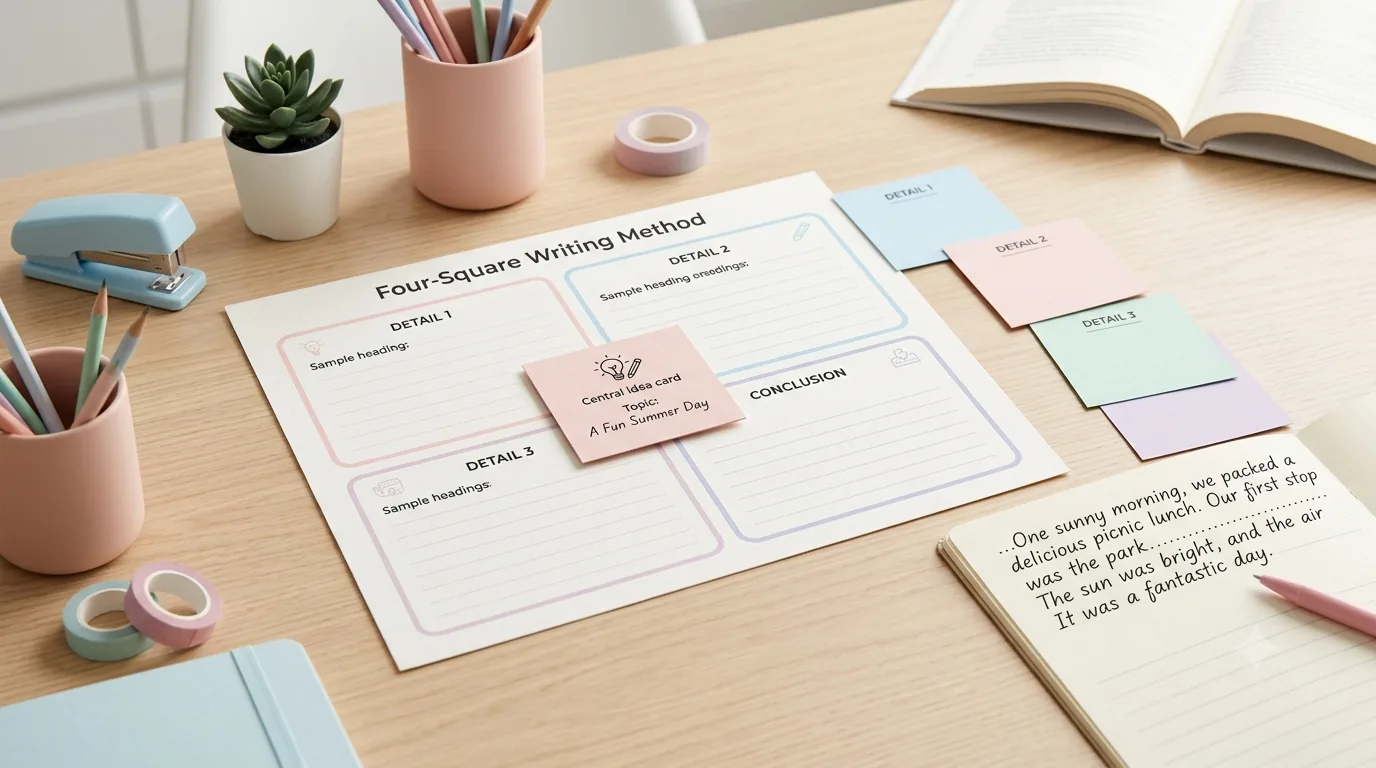
How to Use the Four-Square Writing Method to Plan a Paragraph
Learn how to use the four-square writing method to plan a focused paragraph, choose strong supports, and turn the organizer into a draft.
Read guide →How to Use Text Evidence in a Reading Response
Learn how to choose, cite, and explain text evidence in a reading response without quote dumping, with a worked example and free evidence organizer.
Read guide →How to Write Claim, Evidence, Reasoning (CER)
Learn how to write a claim-evidence-reasoning (CER) explanation, choose relevant data, connect evidence with science ideas, and revise a weak response.
Read guide →How to Outline an Essay Before You Draft
Learn how to outline an essay from prompt to working thesis, body points, evidence, order, and conclusion without forcing every paper into five paragraphs.
Read guide →