Work & Study · Free printable
Free Essay Outline Printable
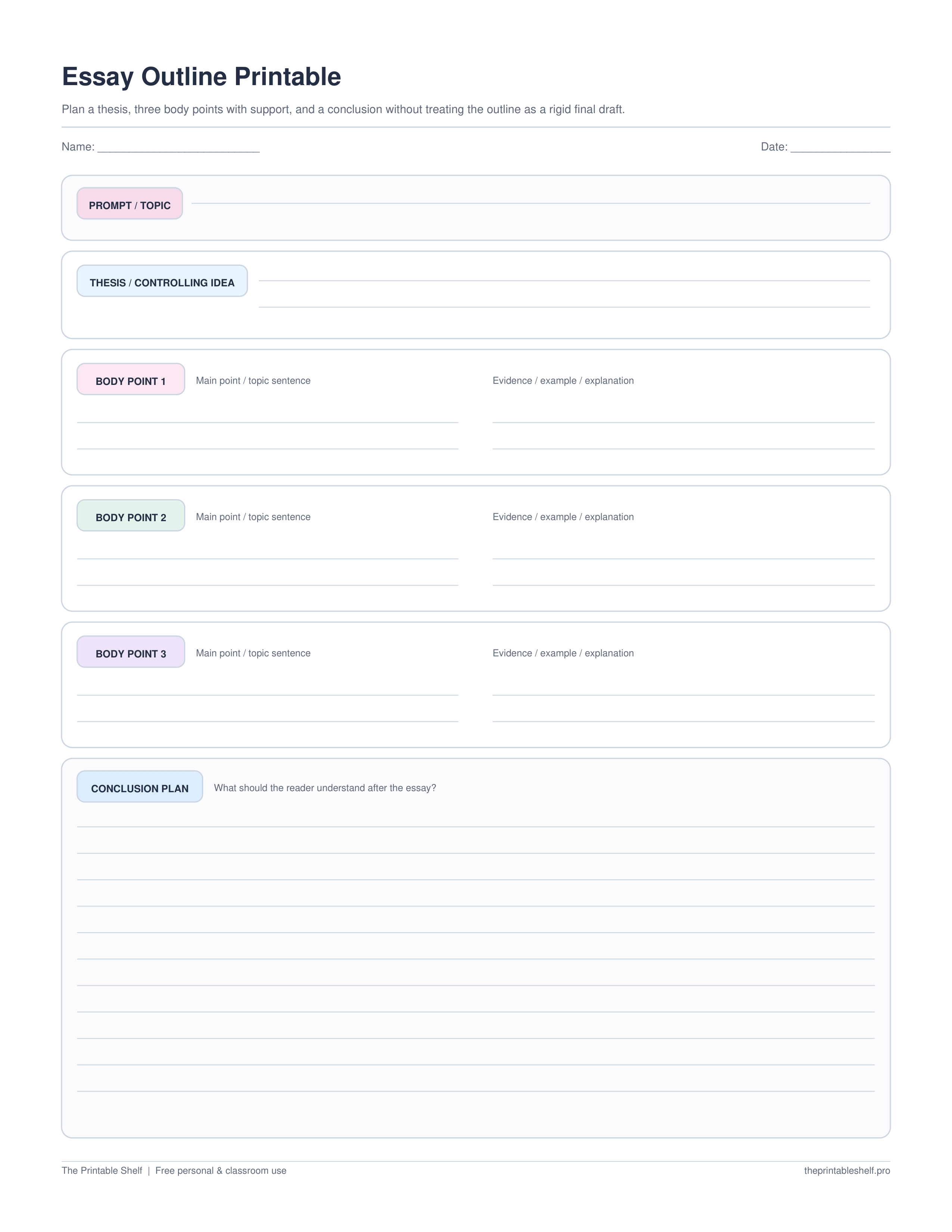
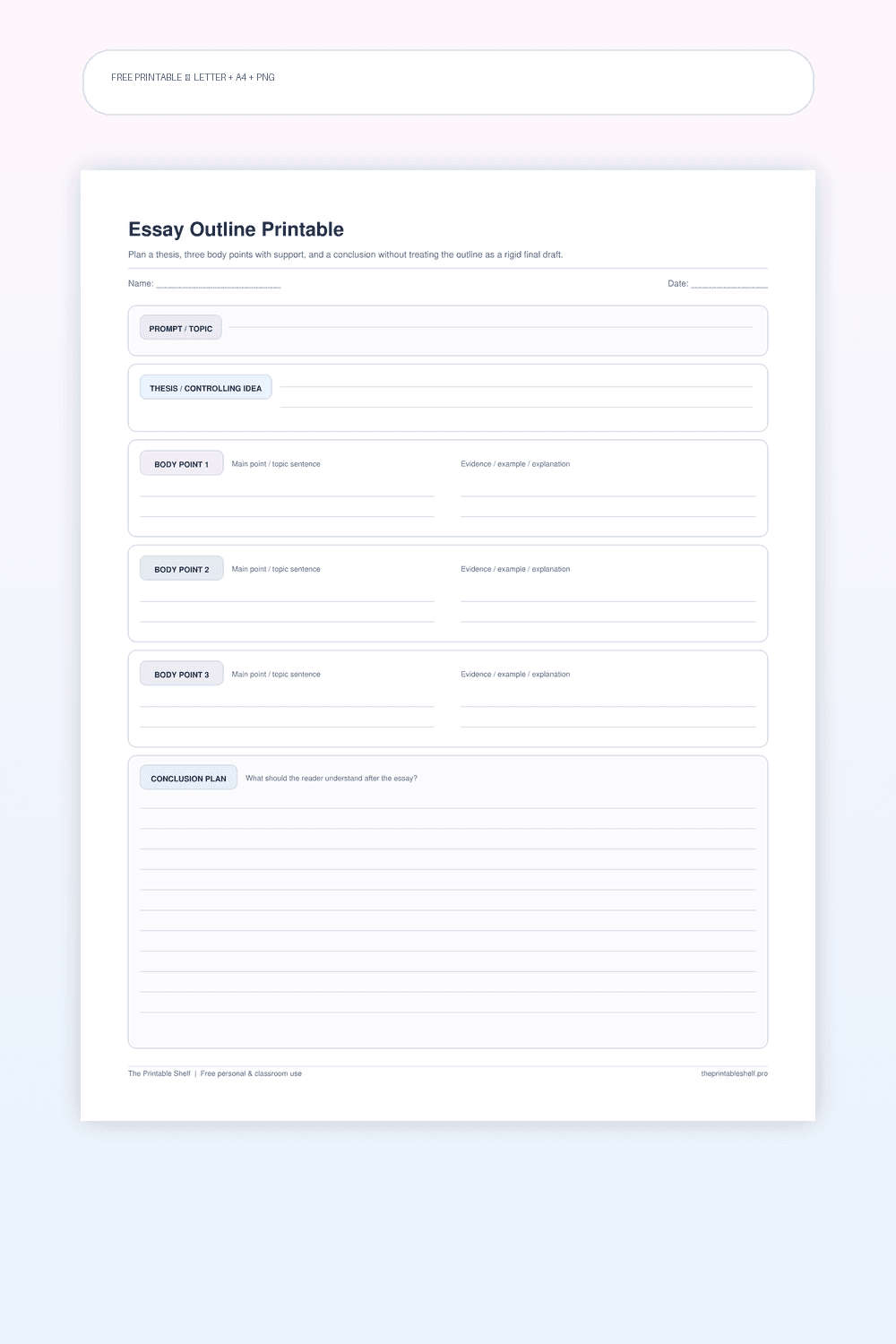
This free essay outline printable organizes a prompt, thesis or controlling idea, three body points with support, and a conclusion plan. It is a flexible prewriting scaffold, not a rule that every essay must contain exactly five paragraphs. Writers can adapt the body sections to match the assignment and argument.
Edited by Tessa Vaughn · Planning & Organization Editor
Free download
Choose your file size
Print at 100% / Actual Size for the cleanest margins. Pick the paper size your printer normally uses.
No sign-up required · personal/classroom use
What this printable is for
A one-page academic writing planner for essays that need a central claim or controlling idea and several developed supporting points. Each body section pairs the point with evidence, examples, or explanation so writers can test whether the outline contains development rather than only topic labels.
How to use it
Start by rewriting the prompt or topic in a short phrase so the page stays anchored to the assignment. Then draft a thesis or controlling idea that answers the prompt and gives the essay a direction. A working thesis can change during drafting; its purpose in the outline is to keep body points connected to one central argument or explanation.
Use each body section for one meaningful point, reason, subclaim, or part of the explanation. Write the point on the left and the evidence, example, detail, or explanation you expect to use on the right. If two body points repeat the same idea, combine them or revise one. If a point does not support the thesis, remove it even if it is interesting.
Do not assume every essay needs exactly three body paragraphs. The three rows are a practical planning space for many school assignments, but a writer may use two strong sections or expand one row into several paragraphs when the topic requires it. The outline should represent the logic of the essay rather than force the essay into the shape of the worksheet.
Check the order of the body points before drafting. A useful order may move from most foundational to most complex, from cause to effect, from claim to counterargument, or from one stage of an explanation to the next. Add transitions during drafting only after the relationship between the points is clear.
Use the conclusion plan to decide what the reader should understand after the essay, not to copy the thesis word for word. The conclusion may restate the main insight, explain significance, connect the points, or identify a consequence. Draft from the outline in complete paragraphs, then revise the essay itself rather than polishing the planning sheet as if it were the final product. If the draft develops a stronger claim, update the outline and thesis instead of forcing new thinking back into an outdated plan.
Customize instead
Need a different title, paper size, or orientation? →
Use the free Graphic Organizer Maker to build a custom Venn, KWL, Frayer, story map, T-chart, main-idea, sequence, or cause-and-effect page.
Also in a free pack
Download this organizer together with related pages when you want one reusable master PDF instead of separate files.
Completed example
See how a finished page can look
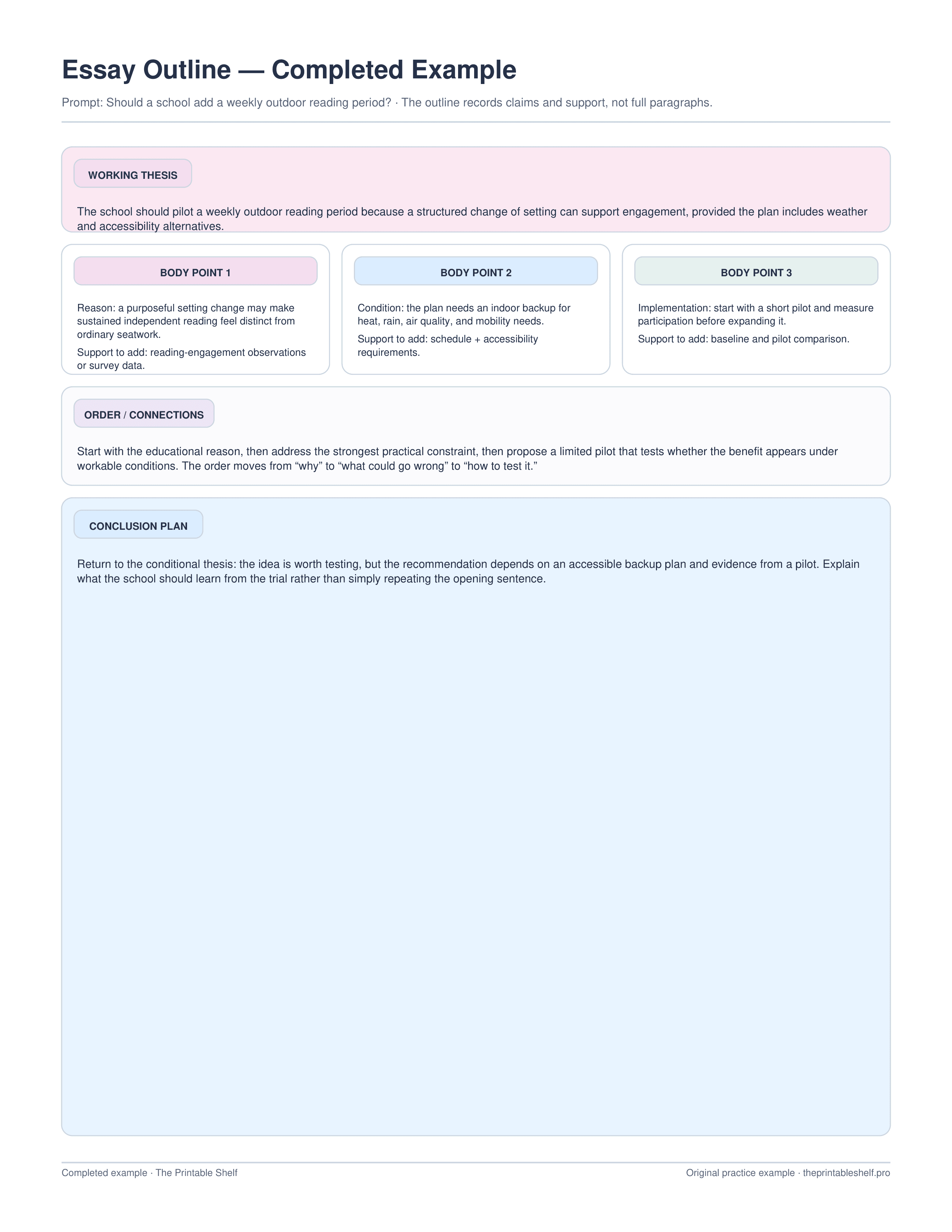
The sample outline turns a school-policy prompt into a conditional thesis, three distinct body points, support to collect, a logical order, and a conclusion job. It demonstrates planning decisions rather than writing miniature paragraphs in every box.
Best uses for this template
Ways to use it
Test thesis-to-body alignment
Put each body point under the working thesis and remove points that do not actually develop the central idea.
Plan evidence before drafting
Pair each point with the support or explanation it needs so the draft does not become a list of unsupported claims.
Reorder the essay logically
Move body points into an order that matches the reasoning of the assignment before writing transitions.
Common mistakes to avoid
Treating three body rows as a required essay length
Use the number of sections the argument needs; the worksheet is a planning scaffold, not a paragraph-count rule.
Listing topics instead of points
Write what each body section will claim, explain, or establish, not just the subject word.
Collecting evidence with no explanation plan
Note why the evidence matters so each paragraph has a reasoning job beyond inserting a quotation or fact.
Classroom fit
Suggested grades, use modes & standards
Suggested grade bands
These are practical use ranges, not hard limits. Text complexity and the amount of teacher modeling matter more than the worksheet alone.
Good fit for
Scaffold level: Advanced.
Common Core crosswalk
- W.6.4 · Produce clear writing appropriate to task, purpose, and audience
- W.6.5 · Plan, revise, edit, rewrite, or try a new approach
- W.7.4 / W.8.4 · Organize clear writing appropriate to task, purpose, and audience
These codes are a practical crosswalk for skills this organizer can support. They are not a claim that the worksheet alone fully teaches or assesses the standard.
Frequently asked questions
Is this only for five-paragraph essays?
No. The page offers three body-planning rows because that fits many assignments, but writers can use fewer or expand a row into several paragraphs when the content requires it.
What goes in the evidence side?
Use facts, examples, quotations, observations, reasoning notes, or other support allowed by the assignment, along with a reminder of how the support develops the point.
Should I write full sentences in the outline?
Use enough detail that the plan is clear. Short phrases are fine for many boxes, while the thesis usually benefits from being written as a complete working sentence.
Helpful guides
See where this organizer fits, when a different layout works better, and how to turn the completed page into a useful next step.
Keep organizing
You might also like
Free printable
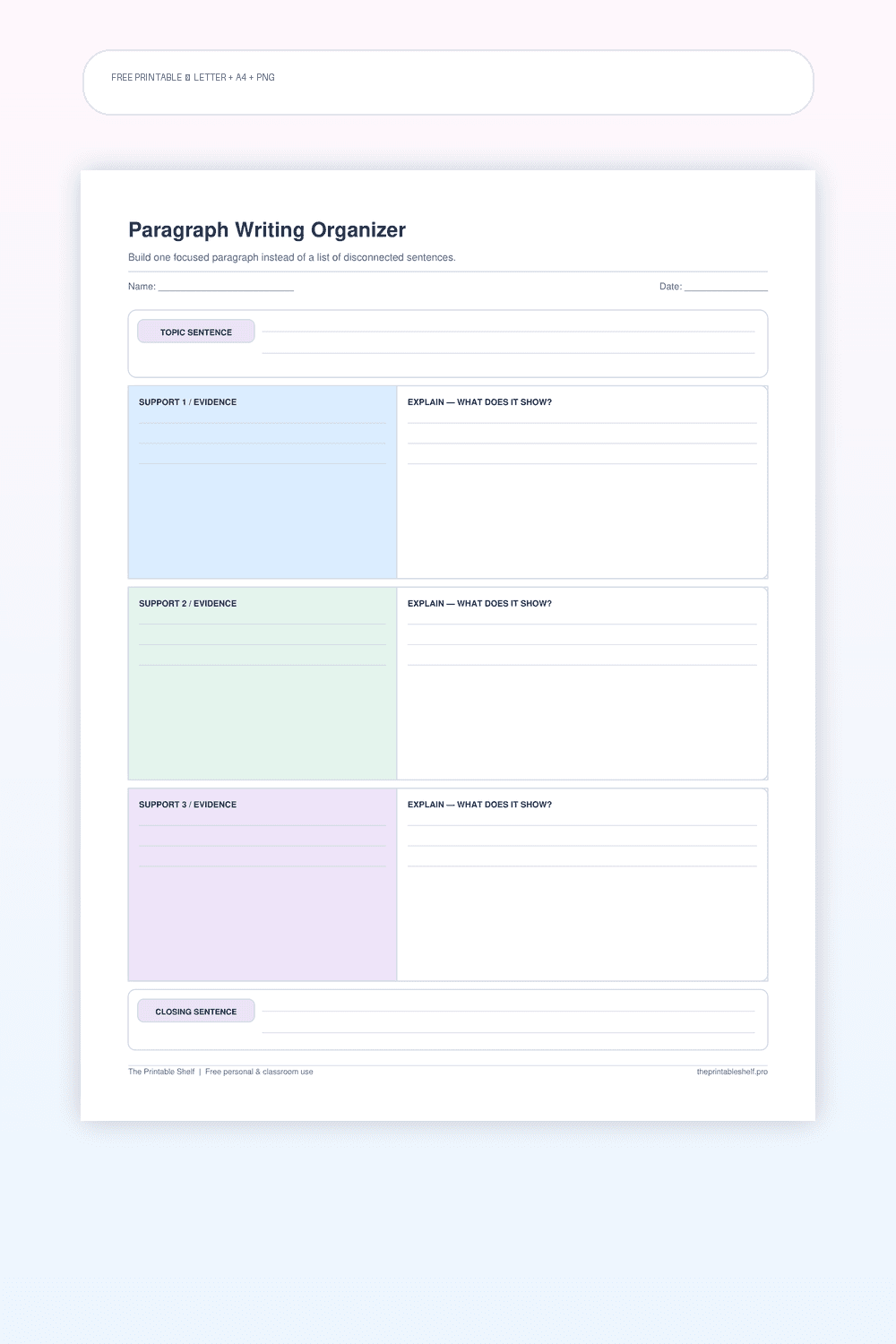
Paragraph Writing Graphic Organizer
A structured single-paragraph planner that separates the job of each sentence group: establish the controlling idea, support it with relevant points, explain those points, and close without introducing a new topic. The layout borrows the clarity of a hamburger-style organizer but avoids treating paragraph writing as a rigid five-sentence formula when a supporting idea needs more than one sentence.
Free printable
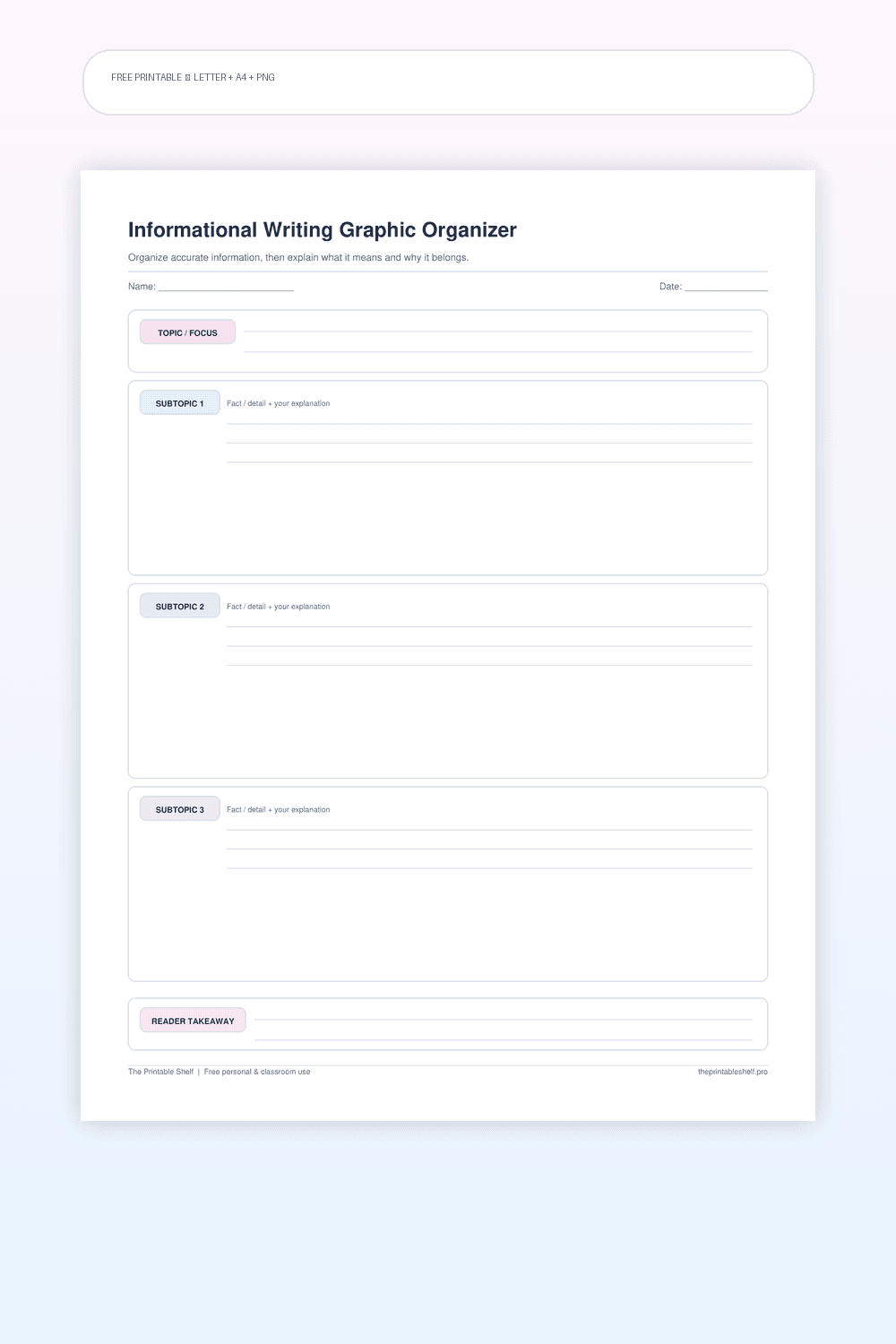
Informational Writing Graphic Organizer
A one-page planning sheet for explanatory and informational writing. It is designed to keep fact collection separate from explanation, because a strong informational paragraph does more than stack facts. The writer chooses a focused topic, groups the most useful information, and identifies the takeaway before drafting.
Free printable
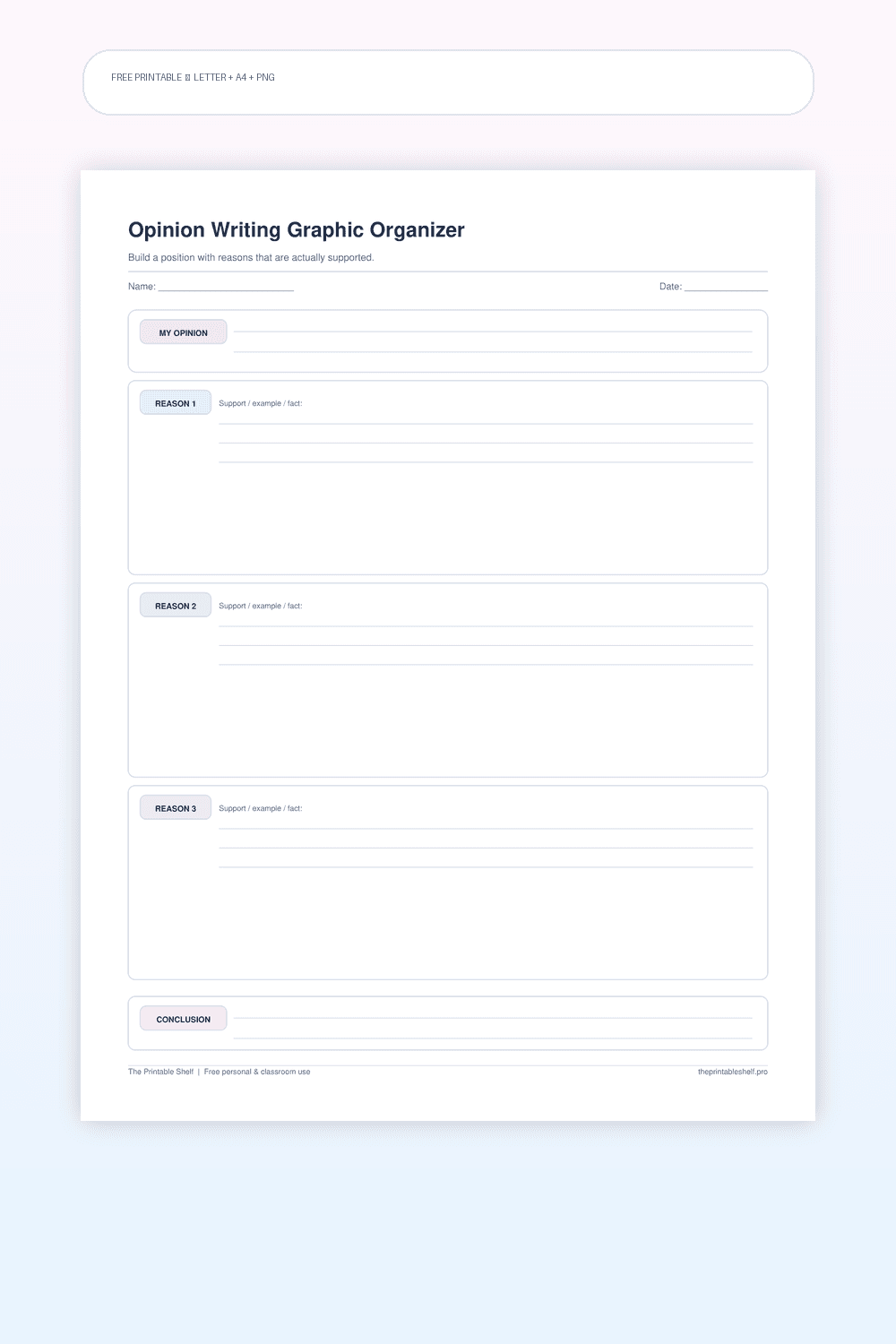
Opinion Writing Graphic Organizer
A structured prewriting page for opinion and early argument writing. It goes beyond the familiar opinion-plus-three-reasons worksheet by prompting the writer to support each reason and check whether every reason actually strengthens the same position. The result is a clearer bridge from brainstorming to a draft.