Work & Study · Free printable
Free Opinion Writing Graphic Organizer
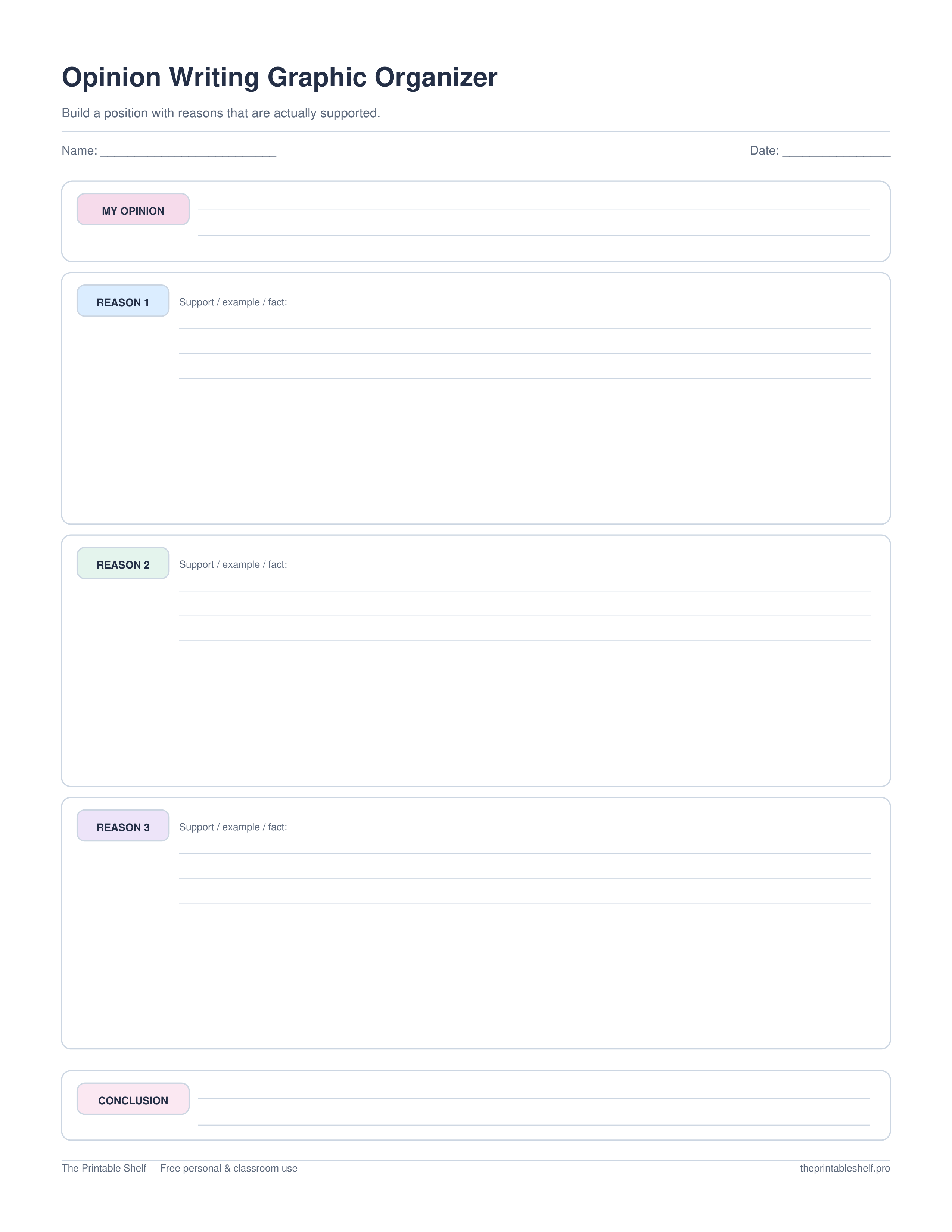
This opinion writing organizer helps students state a position, plan three reasons, attach an example or evidence to each reason, and finish with a conclusion that restates the position without copying it. Use it before drafting a paragraph, essay, response, or persuasive letter.
Edited by Tessa Vaughn · Planning & Organization Editor
Free download
Choose your file size
Print at 100% / Actual Size for the cleanest margins. Pick the paper size your printer normally uses.
No sign-up required · personal/classroom use
More useful layouts
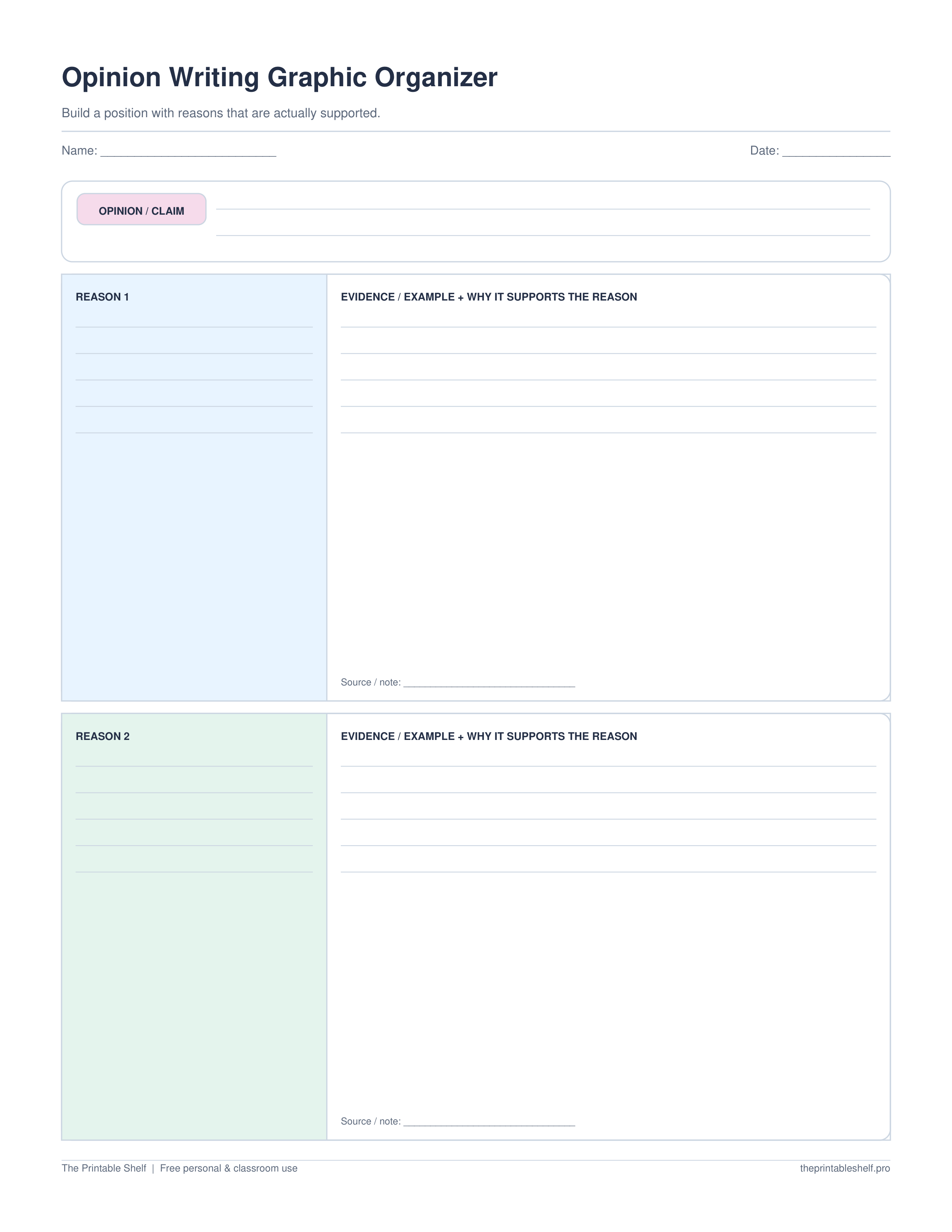
Evidence-focused
Uses two larger reason sections with evidence, explanation, and a compact source/note line.
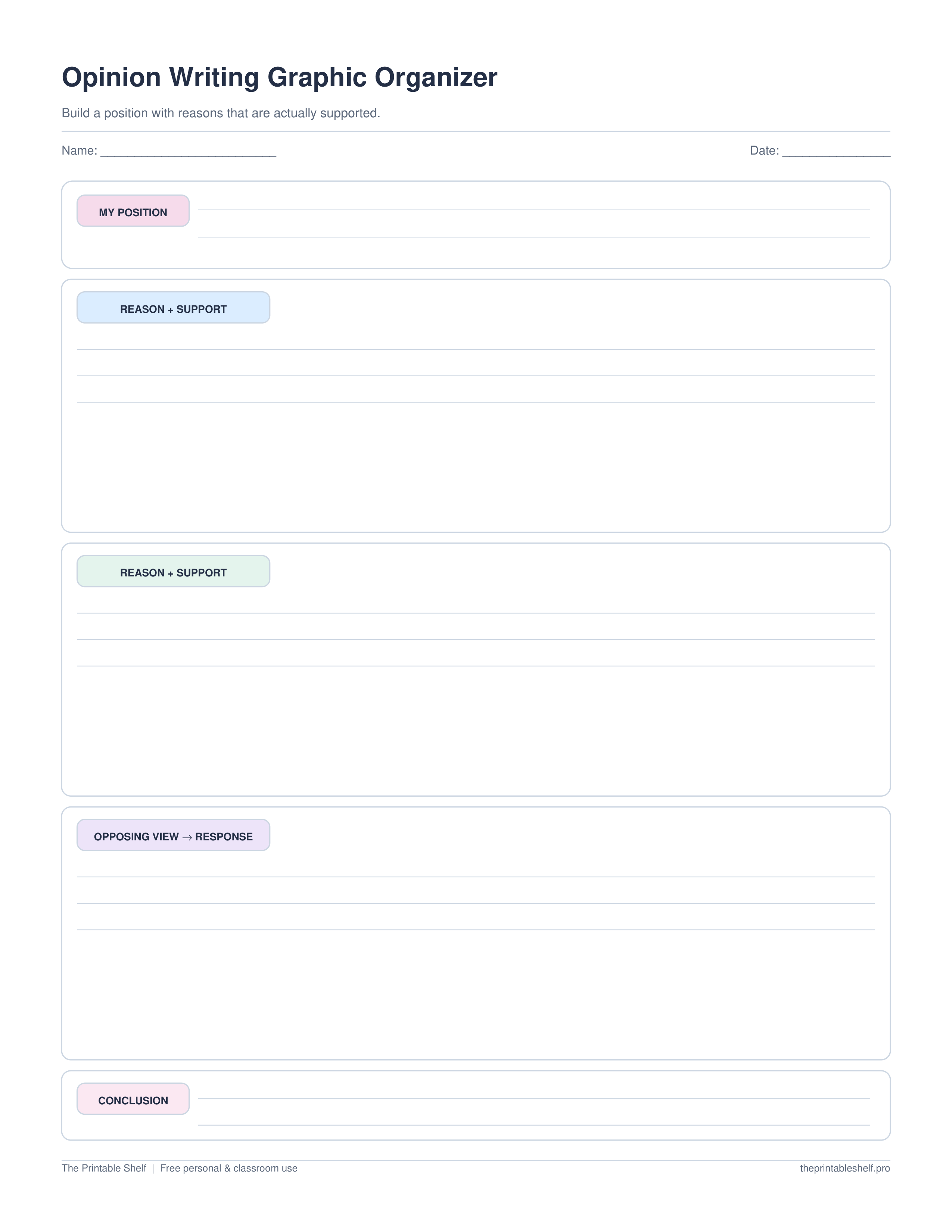
Counterpoint + response
Adds an opposing-view section and response so stronger writers can test their position before drafting.
What this printable is for
A structured prewriting page for opinion and early argument writing. It goes beyond the familiar opinion-plus-three-reasons worksheet by prompting the writer to support each reason and check whether every reason actually strengthens the same position. The result is a clearer bridge from brainstorming to a draft.
How to use it
Write the prompt at the top and turn it into a clear opinion statement. The statement should take a position someone could reasonably disagree with. ‘School lunches exist’ is a fact; ‘Students should have more fresh lunch choices’ is an opinion that can be supported with reasons. Keep the wording narrow enough that you can defend it in the space and length assigned.
Brainstorm more reasons than you expect to use, then choose the strongest distinct reasons the assignment needs and fit them into the available boxes. If two reasons are basically the same idea with different words, combine them rather than filling space with repetition. Leave an unused box blank when the argument is already adequately developed instead of inventing a weak point.
Under each reason, add an example, fact, experience, explanation, or text evidence. This support is what turns a list of opinions into persuasive writing. Ask, ‘What could I tell a reader that makes this reason believable?’ If the assignment requires research, note the source beside the evidence. If it is a personal-opinion assignment, a specific example is usually stronger than a vague statement such as ‘everyone knows.’
Put the reasons in an intentional order before drafting. You might lead with the easiest point to understand and finish with the strongest, or group similar ideas together so the paragraph flows naturally. Number the boxes after deciding the order. Then write a conclusion that returns to the opinion and shows why the reasons matter. Avoid copying the opening sentence word for word.
Use the organizer as a revision checklist after the draft is written. Highlight the sentence that states the opinion, underline each reason, and circle the evidence that supports it. If something on the planning page never appears in the draft, decide whether it should be added or removed from the plan. If a draft contains a new reason that was never planned, check whether it improves the argument or distracts from the original position.
Before calling the plan finished, read the opinion and each reason with the word ‘because’ between them. The connection should make sense every time. Then test the evidence by asking whether it genuinely supports that reason or merely relates to the topic. This quick check catches a common problem in early persuasive writing: a clear position followed by interesting details that do not actually help persuade the reader.
Customize instead
Need a different title, paper size, or orientation? →
Use the free Graphic Organizer Maker to build a custom Venn, KWL, Frayer, story map, T-chart, main-idea, sequence, or cause-and-effect page.
Also in a free pack
Download this organizer together with related pages when you want one reusable master PDF instead of separate files.
Best uses for this template
Ways to use it
Before a paragraph
Use one reason per box, attach a concrete support, then number the reasons in the order they should appear in the draft.
Before a persuasive letter
State what you want the reader to believe or do, then choose reasons that matter to that audience instead of repeating the same point.
During revision
Match each drafted reason to its support on the organizer. Unsupported reasons are easy to spot when the plan and draft are compared side by side.
Common mistakes to avoid
Using facts as the opinion statement
Write a position or recommendation that can be supported, not a statement that is simply true or false.
Repeating one reason three times
Combine overlapping ideas and choose reasons that support the opinion from genuinely different angles.
Giving reasons with no support
Add a fact, example, experience, explanation, or source-based detail beneath each reason.
Included layout options
Opinion + three reasons
Straightforward paragraph or persuasive-letter planning
Layout: Position, three reason/support sections, and conclusion
Evidence-focused
Develop fewer reasons more deeply instead of filling boxes
Layout: Two large reason sections paired with evidence, explanation, and source note
Counterpoint + response
Introduce basic argument awareness for stronger writers
Layout: Position, two supports, opposing view, response, and conclusion
Classroom fit
Suggested grades, use modes & standards
Suggested grade bands
These are practical use ranges, not hard limits. Text complexity and the amount of teacher modeling matter more than the worksheet alone.
Good fit for
Scaffold level: Standard.
Common Core crosswalk
- W.3.1 · Write opinion pieces supporting a point of view with reasons
- W.4.1 · Write opinion pieces supported by reasons and information
- W.5.1 · Write opinion pieces with logically ordered reasons and facts
These codes are a practical crosswalk for skills this organizer can support. They are not a claim that the worksheet alone fully teaches or assesses the standard.
Frequently asked questions
Is this the same as an OREO writing organizer?
It uses the same core logic—opinion, reasons, support, and a restated opinion—but the layout is not limited to a branded acronym and can be used with different opinion-writing structures.
Do students have to use three reasons?
No. The page provides room for three, but the assignment should determine how many strong reasons are needed. Two developed reasons are better than three repetitive ones.
Can this be used for argumentative writing?
It is best for opinion and introductory argument planning. More advanced argumentative writing may also need counterclaims, source evaluation, and more detailed evidence planning.
Helpful guides
See where this organizer fits, when a different layout works better, and how to turn the completed page into a useful next step.
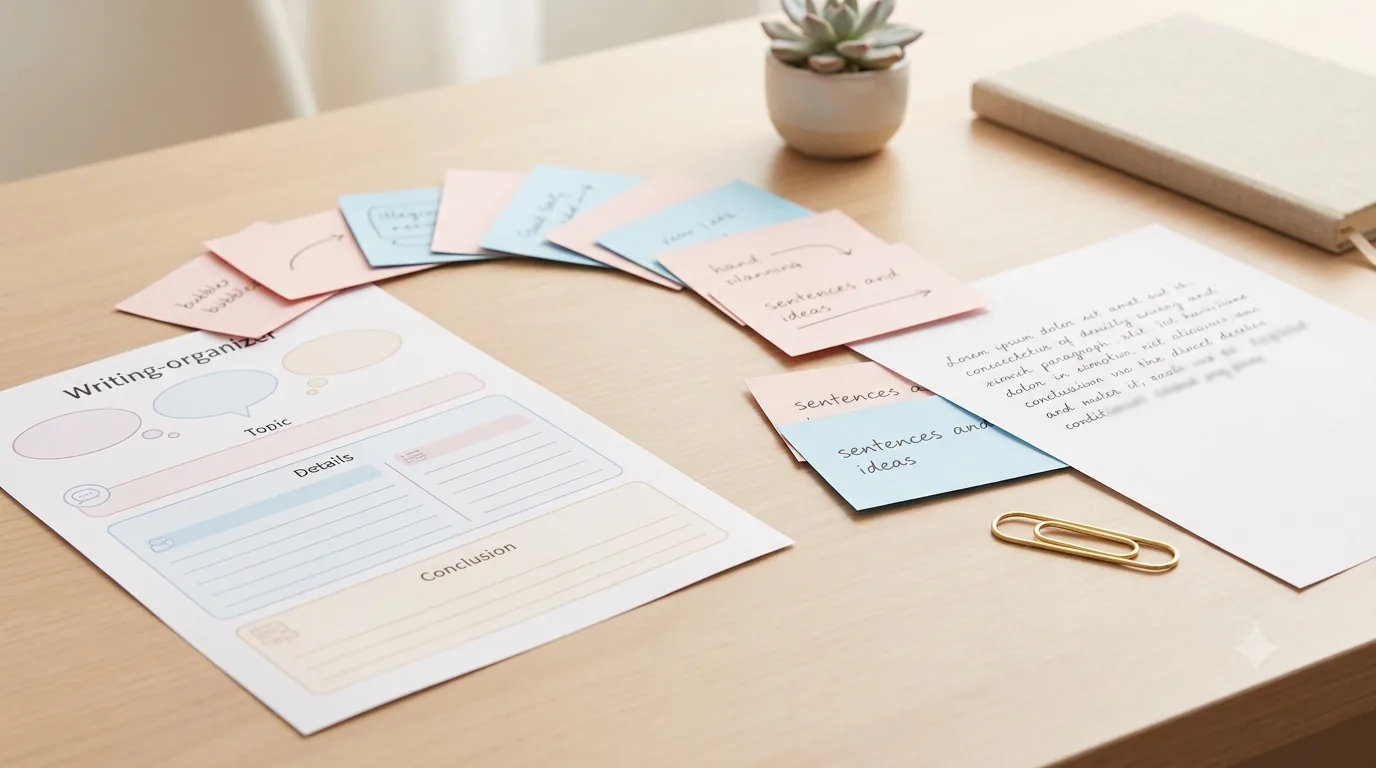
Free Writing Graphic Organizers: Which One to Use and When
Use free writing graphic organizers to plan ideas, structure paragraphs, compare evidence, sequence steps, and organize explanations before drafting.
Read guide →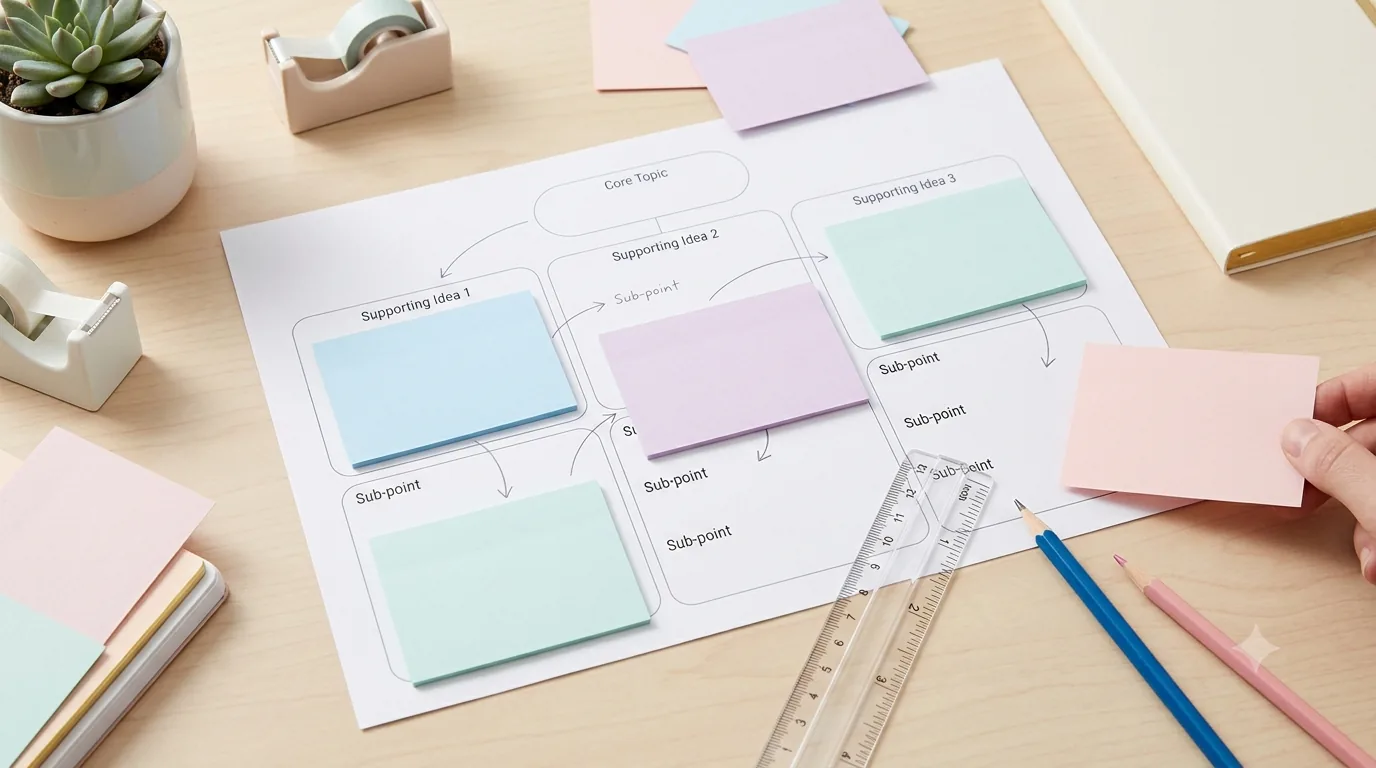
How to Use Graphic Organizers Effectively (Without Turning Them Into Busywork)
Learn how to choose, model, scaffold, and reuse graphic organizers so students think with them instead of simply filling in boxes.
Read guide →Keep organizing
You might also like
Free printable
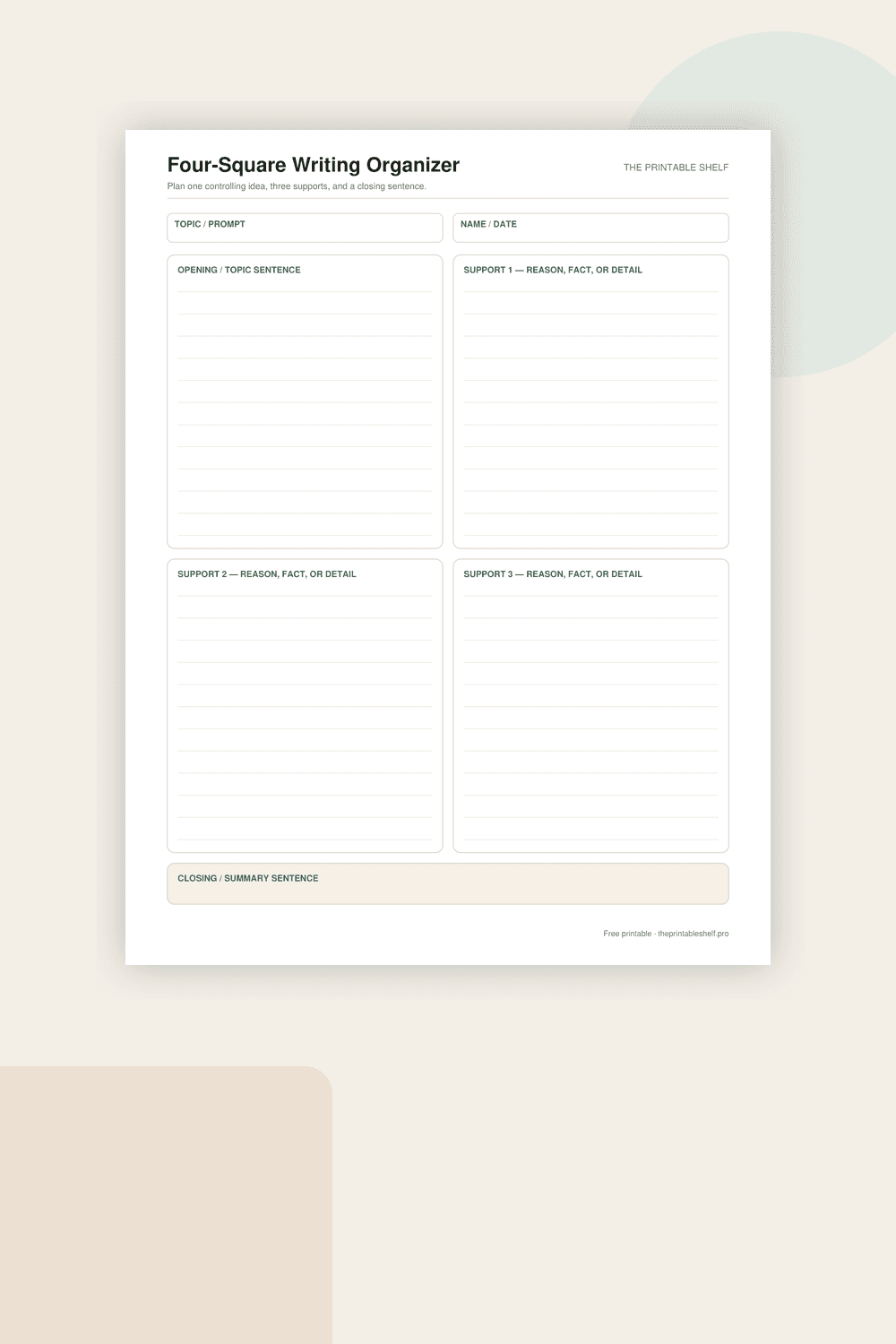
Four-Square Writing Organizer Printable
A practical four-box prewriting page based on the familiar four-square structure, simplified for clean one-page planning. The layout separates the controlling idea from three supporting points and adds a dedicated closing area so the writer can test whether the paragraph has a beginning, development, and purposeful ending before drafting.
Free printable
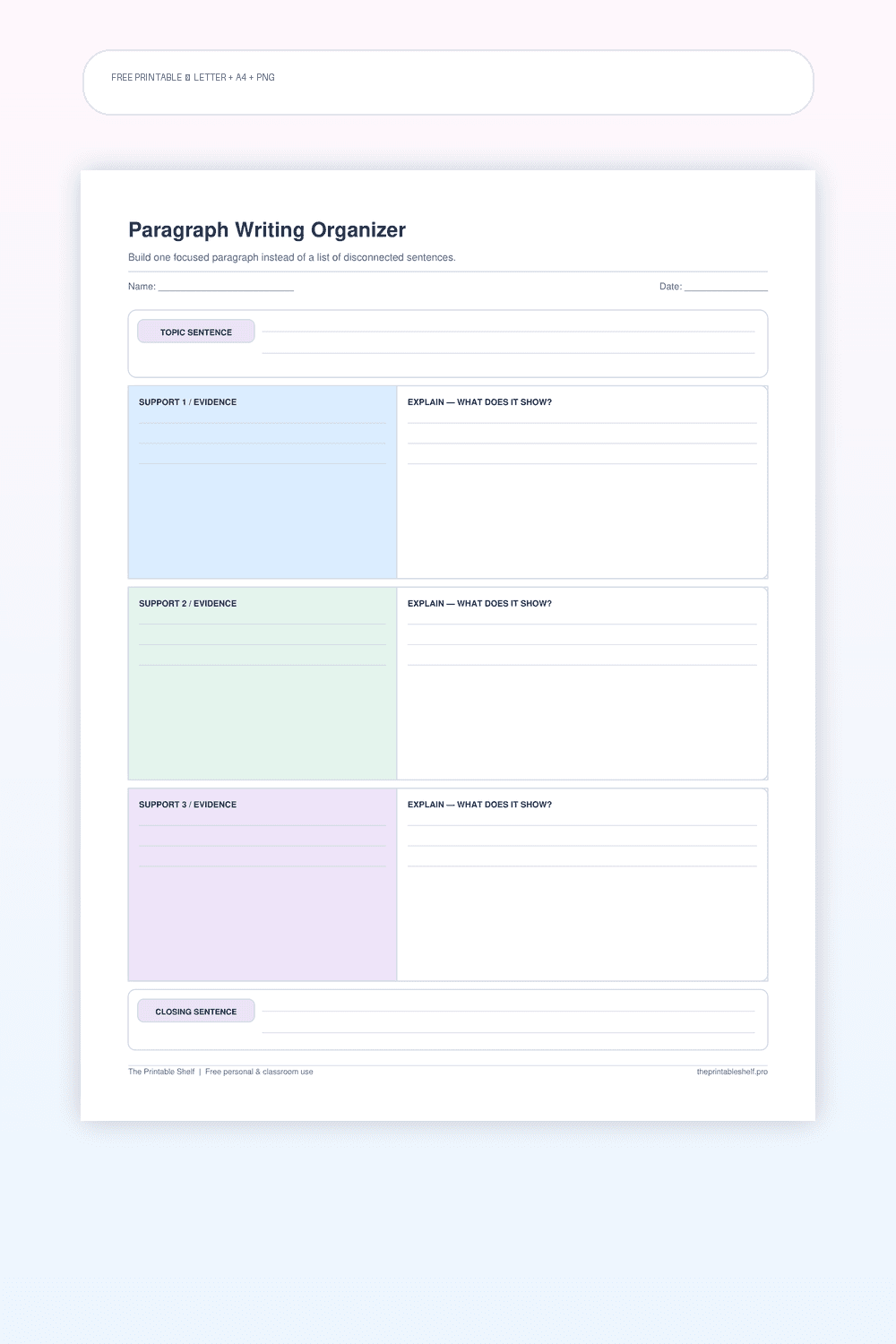
Paragraph Writing Graphic Organizer
A structured single-paragraph planner that separates the job of each sentence group: establish the controlling idea, support it with relevant points, explain those points, and close without introducing a new topic. The layout borrows the clarity of a hamburger-style organizer but avoids treating paragraph writing as a rigid five-sentence formula when a supporting idea needs more than one sentence.
Free printable
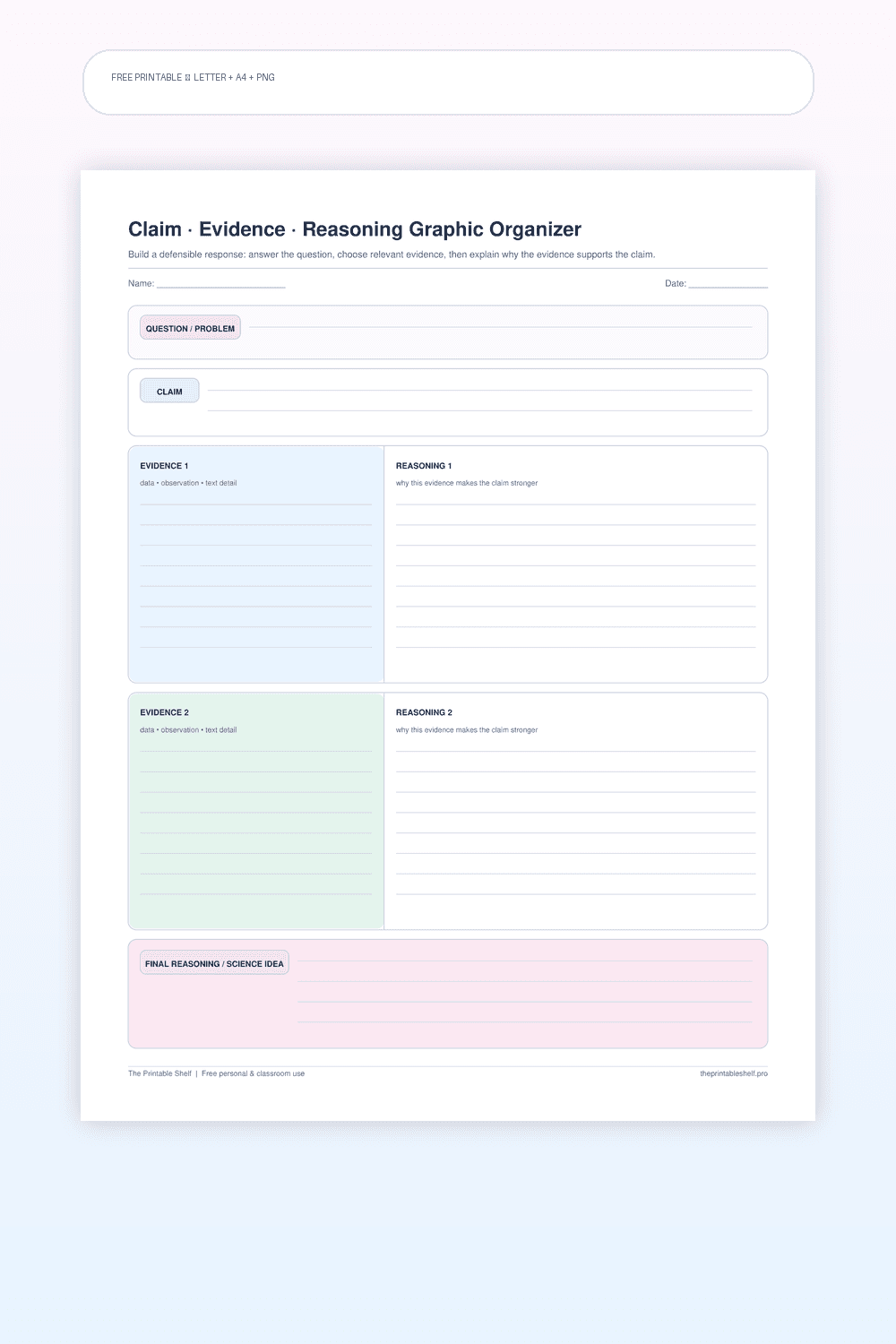
Claim Evidence Reasoning Graphic Organizer
A CER planning page for constructing evidence-based explanations, especially in science. The organizer keeps claim, evidence, and reasoning visually separate because they do different jobs: the claim answers the question, evidence provides appropriate observations or data, and reasoning links that evidence to the claim using relevant scientific ideas or principles. The layout can also support other evidence-based explanations when the teacher or assignment uses CER language.