How-to guide · Work & Study
How to Review Cornell Notes: Turn the Cue Column Into a Weekly Study System
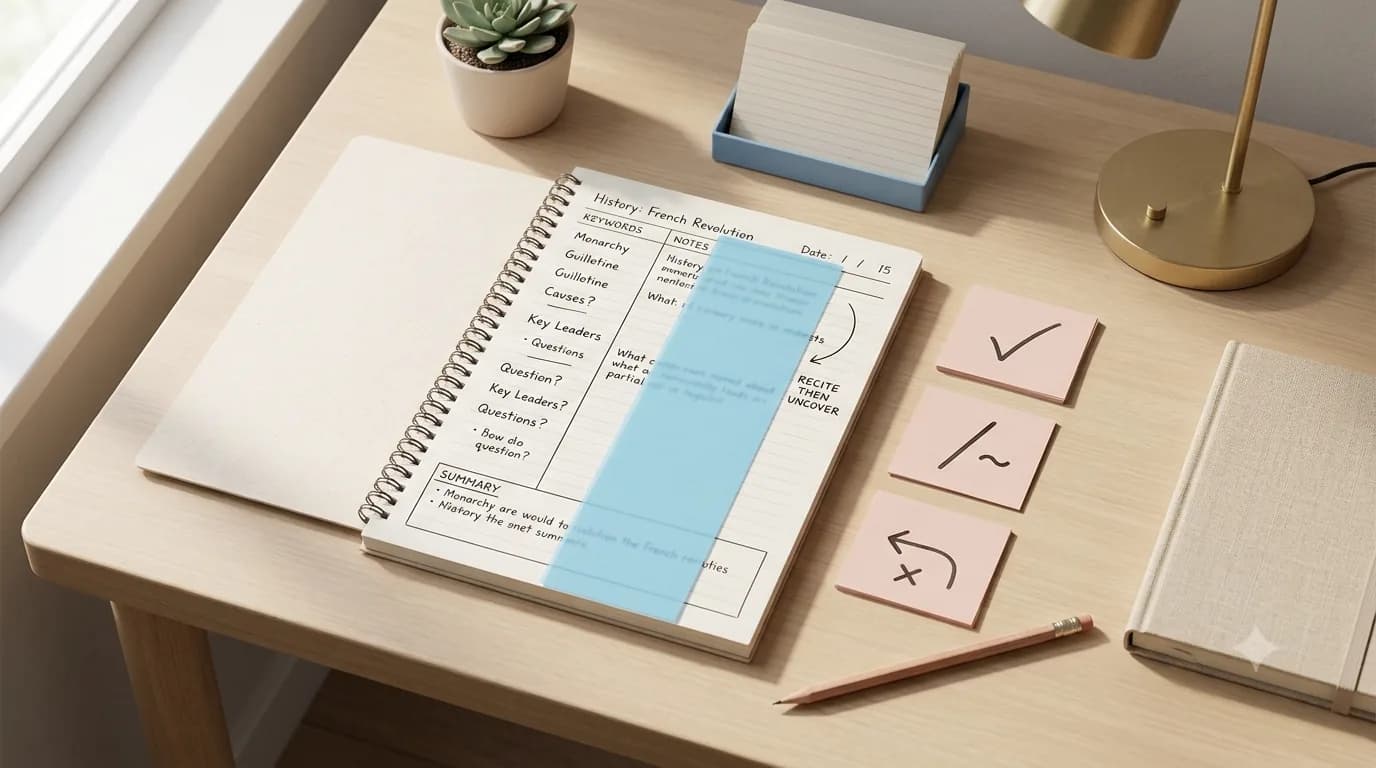
Cornell notes are easy to mistake for a page layout: narrow cue column, wide notes column, summary at the bottom. The actual study value appears after the notes are written. Cornell University's Learning Strategies Center places Questions, Recite, Reflect, and Review after Record for a reason. The page is supposed to become a self-testing system, not a cleaner transcript of class.
This guide starts at the moment class or reading ends. The goal is to convert a page you captured into prompts you can answer later, identify which ideas are weak, and create a review loop that takes minutes instead of rereading every line before an exam.
Step 1: do a short cleanup pass while the material is still fresh
Soon after class, scan the main notes for gaps, unclear abbreviations, missing labels, and diagrams that will make no sense next week. Do not rewrite the page for appearance. Clarify only what is necessary for future retrieval. Add the topic and date if they are missing, expand one cryptic abbreviation, and mark anything you need to verify from the text, slides, or instructor.
This is also the point to split a page that contains several unrelated topics. A cue question should point to a coherent block of notes. If one page mixes four lecture themes with no boundaries, draw horizontal separators or add subheadings before creating cues. Organization now makes self-testing later much faster.
Step 2: turn headings and facts into questions you can actually answer
Cornell University's guidance recommends formulating questions from the notes after class because doing so clarifies meaning and creates a setup for later exam study. A useful cue should demand an answer, not merely point at a word. Photosynthesis is a label. What inputs and outputs define photosynthesis? is a testable cue. Causes of the conflict is a label. What two conditions made the conflict escalate? asks for retrieval.
Mix question types. Use definition cues for core terms, why or how questions for relationships, compare questions for distinctions, and application prompts for material that will be used in problems or essays. If every cue begins What is, the review will favor recognition of definitions and may miss the reasoning the course expects.
Step 3: cover the notes and recite before you look
This is the part many students skip. Cornell's system specifically tells the learner to cover the note-taking column, look only at cues, and say the answers in their own words. That changes the task from recognition to retrieval. Barnard's learning guidance makes the same distinction: active recall asks you to retrieve from memory before consulting notes, whereas simply rereading the page is passive review.
Use a blank sheet, another notebook, or your hand to hide the main column. Answer aloud, on scratch paper, or in a short typed response. Only after making a real attempt should you uncover the notes. The attempt matters because it reveals whether the memory is available without the answer sitting in front of you.
Step 4: grade the answer, not the feeling of familiarity
After each cue, compare your response with the notes and mark the result. A simple three-level code works: check mark for complete, triangle for partly correct, and dot for missed or guessed. Avoid using "it felt familiar" as a category. Material often looks obvious when uncovered even when you could not produce it moments earlier.
For partial answers, identify exactly what was missing. If the cue asks for three causes and you recalled two, write the missing cause beside the cue or add a tiny reminder mark. If the explanation was vague, rewrite the cue to demand the missing relationship. The goal is to improve the next retrieval attempt, not punish the first one.
Step 5: use the summary as compression, not decoration
The summary box should answer what the page is mainly about in your own words. It is not the place to copy the first heading or squeeze every detail into four lines. A useful summary states the central idea and the relationship among the most important parts. If the page contains a process, summarize the process and why it matters. If it contains competing theories, name the distinction that organizes them.
Before an exam, summaries become a quick navigation layer. Scan the bottom of several pages to reconstruct the course story, then use cue questions to test details. If the summary cannot tell you why the page belongs in the unit, revise it after reviewing the cues.
Build a focused weekly review instead of one giant reread
Cornell's Learning Strategies Center recommends spending at least ten minutes each week reviewing previous notes. That does not mean rereading every page for ten minutes. Start with the cue columns from the week's material, test yourself, and spend most of the time on questions previously marked partial or missed.
A practical weekly pass is to scan page summaries briefly, spend most of the session covering and answering priority cues, and finish by updating marks or writing a new question that connects ideas across pages. Cornell’s ten-minute recommendation is a minimum review target, not a required minute-by-minute split. When a cue becomes consistently easy, stop giving it equal time. Review should become more selective as your knowledge improves.
Worked example: turn a biology page into a review session
Suppose the main notes cover cell membranes: phospholipid bilayer, selective permeability, diffusion, osmosis, and active transport. Weak cues would simply repeat those five terms. Stronger cues might ask: Why does the phospholipid bilayer block some substances more easily than others? How are diffusion and active transport different in both direction and energy use? What happens to water during osmosis when solute concentration differs across a membrane?
During review, cover the notes and answer each question. You explain diffusion correctly but cannot state why active transport requires energy, so mark that cue partial. You confuse which direction water moves in one osmosis example, so mark that cue missed. The next session begins with those two prompts, not with another full reread of phospholipid bilayer notes you already know.
For math and technical courses, make the cue column trigger a procedure
Cornell notes can work for technical material, but the cue needs to match the task. Instead of writing quadratic formula as the cue, try When should I use the quadratic formula instead of factoring? Beside a worked physics example, the cue can ask What information tells me which equation applies? For code, a cue can ask What bug does this pattern prevent? rather than naming the syntax alone.
Keep full worked problems or diagrams in the wide notes column. During review, cover the solution and use the cue to reconstruct the setup or next step. If the course is almost entirely visual, spatial, or problem-based, a different note format may fit better; Barnard's note-taking guide explicitly encourages choosing a style based on the class and the learner rather than treating one method as universal.
Before an exam, convert weak Cornell cues into a priority list
A few days before an exam, scan the marks from recent reviews. Collect only the missed and partial cues on a temporary study list. Group them by topic, then test again without notes. If several weak cues point to the same concept, stop drilling isolated questions and return to the underlying explanation, worked example, or reading section.
Barnard's active-recall guidance recommends practicing the kind of retrieval or application expected on the assessment. If the exam uses short responses, answer cues in complete explanations. If it uses problem solving, turn cues into problems. If it uses essays, combine several cue questions into a brief outline. The Cornell page supplies prompts; the review method should match the performance you will eventually need.
Three signs your cue column needs repair
First, every cue is a copied heading. Rewrite some as questions. Second, you can answer a cue with yes, no, or one vague word even though the notes contain a complex relationship. Raise the question level. Third, one cue points to half a page of unrelated notes. Split it into smaller prompts or add a subheading to the notes section.
Good cues get better over time. If a question repeatedly feels too easy, make it more integrative. If it remains impossible, check whether the notes actually contain enough information to answer it. A cue that demands knowledge never recorded on the page may be a useful study question, but it should be connected to a source where you can verify the answer.
A simple Cornell review routine to reuse every week
After each class, clarify the notes, write cue questions, and draft the summary. During the week, cover the notes and recite from the cue column. Mark complete, partial, or missed. At the weekly review, begin with partial and missed cues, then use the summaries to connect the week's pages. Before an exam, gather only persistent weak points and practice them in the format the assessment requires.
That routine is what separates Cornell notes from ordinary two-column notes. The printable gives the page structure, but the repeated cue-and-recall cycle creates the study system.
Frequently asked questions
How often should I review Cornell notes?
Review soon enough after class to clarify the page and write cue questions, then return regularly. Cornell's Learning Strategies Center recommends at least ten minutes each week reviewing previous notes; spend most of that time testing weak cues rather than rereading everything.
What should I write in the Cornell cue column?
Write keywords when they are useful, but favor questions that can test understanding: definitions, why/how relationships, comparisons, applications, formulas, or prompts that require you to reconstruct a process.
Should I reread Cornell notes before testing myself?
For active review, try the cue first with the main notes covered. Make a genuine retrieval attempt, then uncover the notes and check your answer. Rereading first can make material feel familiar without showing what you can recall independently.
Sources & further reading
These sources support the instructional background in this guide. The printable recommendations and usage notes above are The Printable Shelf's editorial guidance.
- Cornell Learning Strategies Center — The Cornell Note-taking System — Primary institutional guidance for the Record, Questions, Recite, Reflect, and Review workflow, including weekly review and covering notes during recitation.
- Barnard Center for Engaged Pedagogy — Studying for Memory & Comprehension — Current learning-support guidance distinguishing active retrieval from passive rereading and recommending self-testing that matches assessment demands.
- Barnard Center for Engaged Pedagogy — Note-Taking Guide — College note-taking guidance describing Cornell notes, the cue/notes/summary layout, and choosing note formats based on course needs.
- SAGE — An Introduction to the Cornell Note System — Published overview emphasizing the cue-column mini-quiz, recitation, reflection, and the summary's role in synthesizing a page of notes.
More guides
7 Cornell Notes Mistakes That Make the Method Less Useful
Fix seven common Cornell Notes mistakes, from empty cue columns to passive rereading, and turn each page into a practical study tool.
Read guide →
Cornell Notes vs. Outline Method: Which Is Better for Studying?
Compare Cornell notes with the outline method for lectures, textbooks, studying, review, and self-testing, then choose the format that fits the task.
Read guide →
How to Use Graphic Organizers Effectively (Without Turning Them Into Busywork)
Learn how to choose, model, scaffold, and reuse graphic organizers so students think with them instead of simply filling in boxes.
Read guide →