How-to guide · Work & Study
How to Use the Four-Square Writing Method to Plan a Paragraph
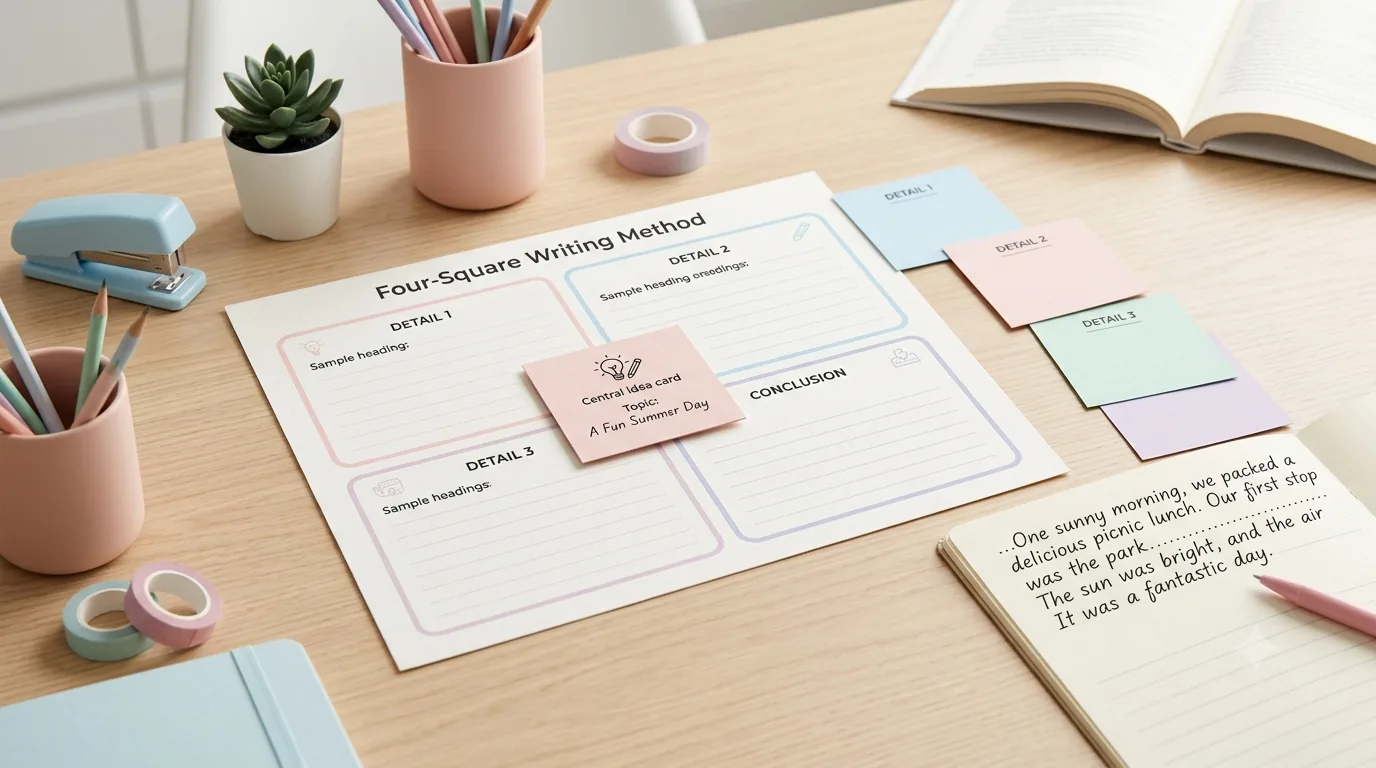
A four-square organizer looks simple enough to explain in a sentence: put the main idea in the center or opening area, add supporting ideas around it, and turn the notes into a paragraph. The hard part is not drawing the boxes. It is deciding what belongs in each one. When every square repeats the same reason, contains a vague word, or holds an unrelated fact, the page can look complete while the paragraph is still difficult to write.
The useful version of the method treats the organizer as a decision space. The writer decides on one focus, separates supporting points so they do not overlap, develops those points enough to be draftable, and tests whether the closing actually follows from the support. The IES writing practice guide supports explicit planning before drafting, and the Rowan University study in this article's sources examines Four Square specifically as a prewriting approach. The practical lesson is the same: the sheet works best as part of a writing process, not as an end product by itself.
What the four-square method is actually organizing
A four-square page is best for writing that has one manageable focus and a small set of supporting points. That may be a single paragraph, a short constructed response, or the planning stage for one body paragraph in a longer piece. The method is less useful when the assignment requires several claims, many sources, or a complex chronology; in those cases, a larger outline is usually easier to manage.
Our free Four-Square Writing Organizer uses an opening or topic-sentence area, three support sections, and a closing strip. That is intentionally more explicit than a completely blank four-quadrant sheet. The labels remind the writer that the support has to connect upward to the same focus and that the paragraph needs an ending that does more than repeat the first sentence.
Step 1: turn the prompt into one controlling idea
Before filling any support square, write what the paragraph is trying to explain, support, describe, or show. If the assignment asks, ‘Why are school gardens useful?’ a weak focus is ‘School gardens are good.’ A stronger controlling idea is ‘School gardens give students a practical way to learn science while contributing to the school community.’ The second sentence creates distinct support directions and tells the writer what kind of evidence would belong.
Test the focus with a boundary question: what would not belong in this paragraph? If almost any fact about gardens still seems acceptable, the focus is too broad. If the sentence is so narrow that only one example can support it, it may be too small for three support areas. Adjust the focus before the organizer fills with notes that later have to be deleted.
Step 2: give each support square a different job
The three support boxes are not three places to restate the same idea. Name the role of each box before adding details. For the school-garden example, Support 1 might be hands-on science, Support 2 responsibility and teamwork, and Support 3 food or habitat awareness. Those points all support the controlling idea, but each adds a different reason.
A quick overlap test helps. Cover two support headings and ask whether the remaining one still adds something the other boxes do not. If Support 1 says ‘students learn about plants’ and Support 2 says ‘students learn how plants grow,’ the two boxes probably need to merge. Replace one with a different angle rather than padding the planner to satisfy the printed layout.
Three boxes are a capacity, not a requirement. A paragraph with two well-developed supports can be stronger than one with a thin third point. The organizer should make reasoning clearer, not force a formula onto every assignment.
Step 3: expand notes until they are draftable
One-word entries such as teamwork, science, and food are labels, not paragraph material. Add enough information that each box can become one or more sentences. A practical support note has three parts: the point, a concrete example or fact, and why that detail matters to the focus. You do not need to write polished sentences yet, but you should be able to see the logic without inventing it during drafting.
For example, a developed support might read: ‘Science — measure plant growth each week; compare sunlight and water; makes abstract life-cycle lessons observable.’ That note contains a category, an example of what students do, and a connection back to learning. When every support square reaches that level, drafting becomes translation and refinement rather than a fresh brainstorming session.
Worked example: plan a paragraph before writing it
Suppose the prompt is: Explain one reason public libraries still matter when so much information is online. The controlling sentence could be: ‘Public libraries still matter because they give people reliable access to resources that may be expensive or unavailable at home.’ Support 1 could be internet and computer access, with a note about job applications or schoolwork. Support 2 could be books, databases, and research help that would otherwise cost money. Support 3 could be quiet study and meeting space, especially for people who do not have a suitable place to work at home.
Now test the boxes. The first support is about technology access; the second is about information access; the third is about physical space. They are related but not duplicates. A closing note might be: ‘By combining technology, information, and a place to work, libraries reduce barriers that an internet connection alone does not solve.’ The paragraph already has a logical spine before a full draft begins.
Notice what the organizer did not include: a history of libraries, every service a library offers, or a second claim about community events. Those ideas may be true, but they would make this particular paragraph less focused. Good planning includes deciding what to leave out.
Step 4: choose the order after the ideas are on the page
Do not assume the visual position of the squares is the required sentence order. Once the support is developed, number the boxes in the sequence that makes the paragraph easiest to follow. You might move from most familiar to most surprising, from general to specific, from cause to result, or from strongest evidence to a final point that sets up the conclusion.
Transitions should come after this decision. First, second, and finally are useful only when the order itself matters. For explanatory paragraphs, transitions such as another reason, for example, in addition, or as a result may show the relationship more accurately. A transition word cannot rescue support that was never logically connected.
Step 5: write the closing after the support is stable
Writers often fill the closing box immediately by rephrasing the opening. Wait until the supporting points are settled instead. Then ask: what do these details allow me to say now that I could not say at the start? A useful closing can show significance, reinforce a position, or state the result of the explanation without copying the topic sentence.
Read only the opening and closing aloud. They should sound like two ends of the same paragraph. Then read the support headings you actually plan to use between them. If one support feels disconnected, fix the support rather than stretching the closing to include it. This quick oral check is faster than drafting a whole paragraph and discovering afterward that the focus wandered.
How to adapt Four Square for different kinds of writing
For opinion writing, the focus states the position and each support square holds a different reason plus evidence or an example. For informational writing, the focus states what the paragraph will explain and the support boxes hold subtopics, facts, or examples. For a narrative paragraph, the boxes can hold three moments that develop one event, but a sequence organizer is usually better when chronology is the main challenge.
For students who need more support, prefill the focus or one support box and model how the detail connects. For students who need less support, remove prompts or ask them to decide how many support points are actually necessary. The goal is not permanent dependence on four boxes. It is learning to recognize focus, support, development, order, and closure even when no worksheet is present.
| Writing task | What goes in the focus area | What belongs in support boxes |
|---|---|---|
| Opinion | A clear position or claim | Different reasons with evidence or examples |
| Informational | The point the paragraph will explain | Distinct facts, subtopics, examples, or explanations |
| Constructed response | A direct answer to the question | Text evidence plus explanation of how it supports the answer |
| Narrative | The moment or purpose of the paragraph | Events or details that develop that same moment |
Common Four Square mistakes and how to fix them
Mistake one is writing a topic instead of a controlling idea. ‘Volcanoes’ gives the support boxes no direction; ‘Volcanoes reshape land through eruptions and the material they leave behind’ does. Mistake two is using synonyms as separate supports. Rename each square by its role to expose repetition. Mistake three is filling every square with single words. Add an example and a why-it-matters note before drafting.
Mistake four is treating the organizer like a sentence template. The boxes plan ideas; they do not dictate that every paragraph must have exactly five sentences. Mistake five is copying the squares into the draft in visual order without reconsidering sequence. Number the supports only after the content is developed. Mistake six is keeping the organizer beside the draft during revision and refusing to change anything. Once a complete paragraph exists, revise the paragraph as writing; the planner has already done its job.
Frequently asked questions
What is the Four Square writing method?
It is a visual prewriting method that separates a central focus from supporting ideas so a writer can organize a paragraph or longer response before drafting. Different versions arrange the boxes differently, but the central purpose is planning relationships between the main point and its support.
Does a Four Square paragraph have to have exactly three supporting details?
No. Three spaces are available for planning, but the writing task should determine how many supports are needed. A smaller set of developed points is better than adding a weak point only to fill a box.
Can the Four Square method be used for essays?
Yes, but use it at the right scale. One sheet can plan an overall short response or one body paragraph. For a longer essay with several claims and sources, use multiple sheets or move to a larger outline after the main ideas are established.
Sources & further reading
These sources support the instructional background in this guide. The printable recommendations and usage notes above are The Printable Shelf's editorial guidance.
- IES What Works Clearinghouse — Teaching Elementary School Students to Be Effective Writers — Evidence-based practice guide supporting explicit instruction in the writing process, including planning before drafting.
- Rowan University — Effects of Prewriting on Fifth-Grade Writing — University thesis examining Four Square as a prewriting approach and reporting improvement in participating students' narrative writing during the intervention.
- Reading Rockets — Prewriting — Instructional background on modeling prewriting strategies and transferring ideas from graphic organizers into a draft rather than treating the organizer as the final product.
More guides
Free Writing Graphic Organizers: Which One to Use and When
Use free writing graphic organizers to plan ideas, structure paragraphs, compare evidence, sequence steps, and organize explanations before drafting.
Read guide →
How to Use Graphic Organizers Effectively (Without Turning Them Into Busywork)
Learn how to choose, model, scaffold, and reuse graphic organizers so students think with them instead of simply filling in boxes.
Read guide →
How to Compare and Contrast Two Texts Without Just Making a List
Learn how to compare and contrast two texts by matching criteria, gathering evidence, using a Venn diagram, and turning notes into a clear response.
Read guide →