How-to guide · Work & Study
How to Use a Frayer Model for Vocabulary and Concepts

The Frayer Model looks simple: one term and four boxes. Its value comes from the decisions inside those boxes. A definition tells what a concept means, characteristics tell how to recognize it, examples test where the concept applies, and non-examples clarify where it does not. When those parts agree with one another, the learner is building a usable concept rather than memorizing a sentence for a quiz.
The IRIS Center at Vanderbilt describes the Frayer Model as a way to develop vocabulary and conceptual knowledge by combining definition, characteristics, examples, and non-examples. Its guidance also makes an important distinction: the organizer should not become a dictionary-look-up worksheet assigned before students have enough knowledge to reason about the concept. Teacher modeling, discussion, context, and repeated exposure are part of the strategy.
The four Frayer sections do different jobs
A strong Frayer Model is not four versions of the same definition. Each section tests meaning from a different angle. The definition states the concept in clear language. Characteristics identify features that help recognize or distinguish it. Examples show valid cases. Non-examples test the boundary by showing cases that may look related but do not meet the defining conditions.
That last box is often the most powerful. A learner who can explain why a square is an example of a quadrilateral and why a triangle is not is reasoning about attributes, not merely recalling a label. IRIS uses this same structure across mathematics, science, social studies, and English language arts, which is a clue that the model is best reserved for concepts with meaningful boundaries and relationships.
| Section | Best question | Weak entry to avoid |
|---|---|---|
| Definition | How would I explain this accurately in plain language? | A copied sentence containing unfamiliar words |
| Characteristics | What features help me recognize or distinguish it? | Random facts that are true but not defining |
| Examples | What clearly belongs in this category or concept? | One memorized example with no reason |
| Non-examples | What looks related but fails an important condition? | Anything completely unrelated to the topic |
Choose words that are worth Frayer-level attention
Do not use a Frayer Model for every vocabulary word in a chapter. IRIS recommends spending deeper instructional time on a smaller set of terms that are central to understanding the content. A word such as sedimentary rock, democracy, ecosystem, metaphor, or proportional relationship can support rich characteristics, examples, and contrasts. A simple label that needs only a quick definition may not justify a full page.
A useful selection test is: Will understanding this term help the learner understand several other ideas in the unit? Can the learner encounter good and bad examples? Are there attributes that distinguish it from nearby concepts? If yes, the Frayer Model can create connections. If no, a vocabulary list, quick sketch, or flashcard may be faster and more appropriate.
Step 1: build the definition from context, not from copying
If the concept is new, provide enough instruction before asking for an independent definition. IRIS explicitly warns against turning the Frayer Model into a homework worksheet that simply sends students to the dictionary. Read a short passage, examine a diagram, discuss an example, or supply a student-friendly starting definition. Then ask the learner to restate the meaning in language they can explain.
Check the definition against two tests. First, could it accidentally include a non-example? Second, does it depend on another undefined technical term? If a definition of erosion says weathering that moves things, the learner may still be unclear about both processes. A better definition names the central action and the material involved in direct language.
Step 2: write characteristics that actually identify the concept
Characteristics should help a learner decide whether an unfamiliar case fits the concept. For a triangle, three straight sides and a closed shape are useful characteristics. Can be red is not, even though some triangles are red. For historical fiction, a story set in a real past period and incorporating historically grounded context is more diagnostic than can be interesting.
Ask of each characteristic: If I remove this feature, could the thing still belong to the concept? If yes, the feature may be descriptive rather than defining. Descriptive facts can still be useful in some subjects, but the strongest Frayer pages prioritize features that help with recognition, classification, or explanation.
Step 3: choose examples that cover the concept's range
One obvious example can create a narrow mental picture. If the term is quadrilateral and the only example is square, a learner may incorrectly treat equal sides as part of the definition. Use examples that share the defining characteristics while varying surface features. A square, rectangle, trapezoid, and rhombus show that a four-sided polygon can take different forms.
In science or social studies, examples can come from different contexts for the same reason. For migration, examples might include movement caused by employment, conflict, climate, or family decisions. The goal is not to fill the box with a long list; it is to show enough variation that the learner can see what remains constant across valid cases.
Step 4: make non-examples close enough to teach something
A random non-example such as sandwich for the term quadrilateral reveals almost nothing about whether the learner understands the category boundary. Choose near misses that force attention to the defining boundary: triangle, open four-segment figure, or circle. Then explain the reason briefly. Triangle — closed polygon, but only three sides is much more useful than writing triangle alone.
The same principle works with abstract concepts. If the term is renewable resource, a non-example such as coal is useful because both belong to the broader topic of energy resources, but one fails the replenishment condition. Non-examples should create a meaningful contrast, not comic relief. AdLit likewise emphasizes examples and non-examples as part of applying and expanding word knowledge.
Worked example: Frayer Model for evaporation
Term: evaporation. Definition: the process in which liquid water changes into water vapor at the surface of the liquid. Characteristics: happens at the surface; involves a liquid changing to gas; can happen below the boiling point; the rate can increase with higher temperature, moving air, or greater exposed surface area. These notes are short enough for a printable but specific enough to distinguish the process.
Examples: a puddle becoming smaller on a warm day; wet clothes drying on a line; a shallow dish of water losing water over time. Non-examples: ice melting, because solid changes to liquid; water boiling throughout a pot, because boiling is a different vaporization process; condensation on a cold glass, because gas changes to liquid. The non-examples do real work because each is related to a state change but fails a defining condition.
A learner can now use the completed model as a test. If a new situation shows liquid slowly leaving the surface as vapor, it fits. If it describes droplets forming from water vapor, it belongs to condensation instead. The page has moved from definition storage to concept discrimination.
Do not complete every box at the same moment
IRIS notes that a Frayer Model does not have to be completed in one lesson. That is practical advice. Early in a unit, the teacher may provide a definition and one example. After reading or a demonstration, students can add characteristics. Later, after comparing related concepts, they can refine examples and non-examples. The page becomes a record of developing understanding rather than a one-time form.
This staged approach is especially useful when a concept is genuinely new. Asking students for sophisticated non-examples before they understand the defining features invites guessing. Guidance can decrease as knowledge increases: teacher-modeled first, guided completion next, then independent explanation once students have evidence and vocabulary to make defensible choices.
Use the Frayer Model for review without turning it into rereading
A completed Frayer Model can become a retrieval tool. Cover one quadrant and ask the learner to reconstruct it from the other three. Give a new example and ask which characteristic shows that it belongs. Present a near-miss and ask the learner to move it into examples or non-examples with a reason. These tasks force the student to use the concept instead of rereading the same filled page.
For test preparation, compare two Frayer Models for related concepts and identify the characteristic that separates them. Igneous versus sedimentary rock, simile versus metaphor, renewable versus nonrenewable resource, or mean versus median are more useful pairings than reviewing each word in isolation. The organizer can support comparison once each concept has been built clearly.
Frayer Model, concept web, or simple vocabulary card?
Choose a Frayer Model when the learner needs to define boundaries through characteristics, examples, and non-examples. Choose a concept web when the goal is to connect one idea to related categories, subtopics, features, or associations without requiring every branch to fit the same four-part structure. Choose a simple vocabulary card when a short meaning, example sentence, and quick visual are enough.
Using the most complex organizer is not automatically better instruction. A full Frayer page for a simple concrete word can create busywork. Reserve it for words or concepts where distinction matters and where examples and non-examples deepen understanding.
Common Frayer Model mistakes and quick fixes
Mistake one is assigning too many words. Select a few conceptually important terms instead. Mistake two is copying a dictionary definition that the learner cannot explain. Rephrase it after instruction or discussion. Mistake three is filling characteristics with trivia; keep features that help identify or distinguish the concept.
Mistake four is using unrelated non-examples. Choose near misses and state why they fail. Mistake five is grading the sheet mainly for fullness. A concise model with a few defensible characteristics and carefully contrasted non-examples can show more understanding than a page crowded with unexamined facts. Ask the learner to justify representative entries across the quadrants; the explanation reveals whether the model represents real concept knowledge.
Frequently asked questions
What are the four parts of a Frayer Model?
The common four sections are definition, characteristics, examples, and non-examples, with the target term or concept placed in the center.
What makes a good non-example in a Frayer Model?
A good non-example is related enough to be a plausible near miss but fails an important defining condition. Add a short reason so the contrast teaches the concept boundary.
Should students complete a Frayer Model before learning the word?
Usually not independently. For a new concept, model or provide enough context first, then build the organizer through guided discussion and repeated exposure before expecting independent completion.
Sources & further reading
These sources support the instructional background in this guide. The printable recommendations and usage notes above are The Printable Shelf's editorial guidance.
- IRIS Center — Building Vocabulary and Conceptual Knowledge Using the Frayer Model — Detailed instructional guidance on selecting key concepts, modeling the Frayer Model, guided practice, and using definitions, characteristics, examples, and non-examples.
- IRIS Center — Graphic Organizers — Defines the Frayer structure and distinguishes it from other vocabulary and concept organizers.
- AdLit — Frayer Model — Current classroom guidance for using the model across content areas and discussing completed models with peers.
More guides

How to Use Graphic Organizers Effectively (Without Turning Them Into Busywork)
Learn how to choose, model, scaffold, and reuse graphic organizers so students think with them instead of simply filling in boxes.
Read guide →
Free Reading Comprehension Graphic Organizers by Reading Skill
Free reading comprehension graphic organizers for story elements, main idea, sequence, cause and effect, comparison, vocabulary, and prior knowledge.
Read guide →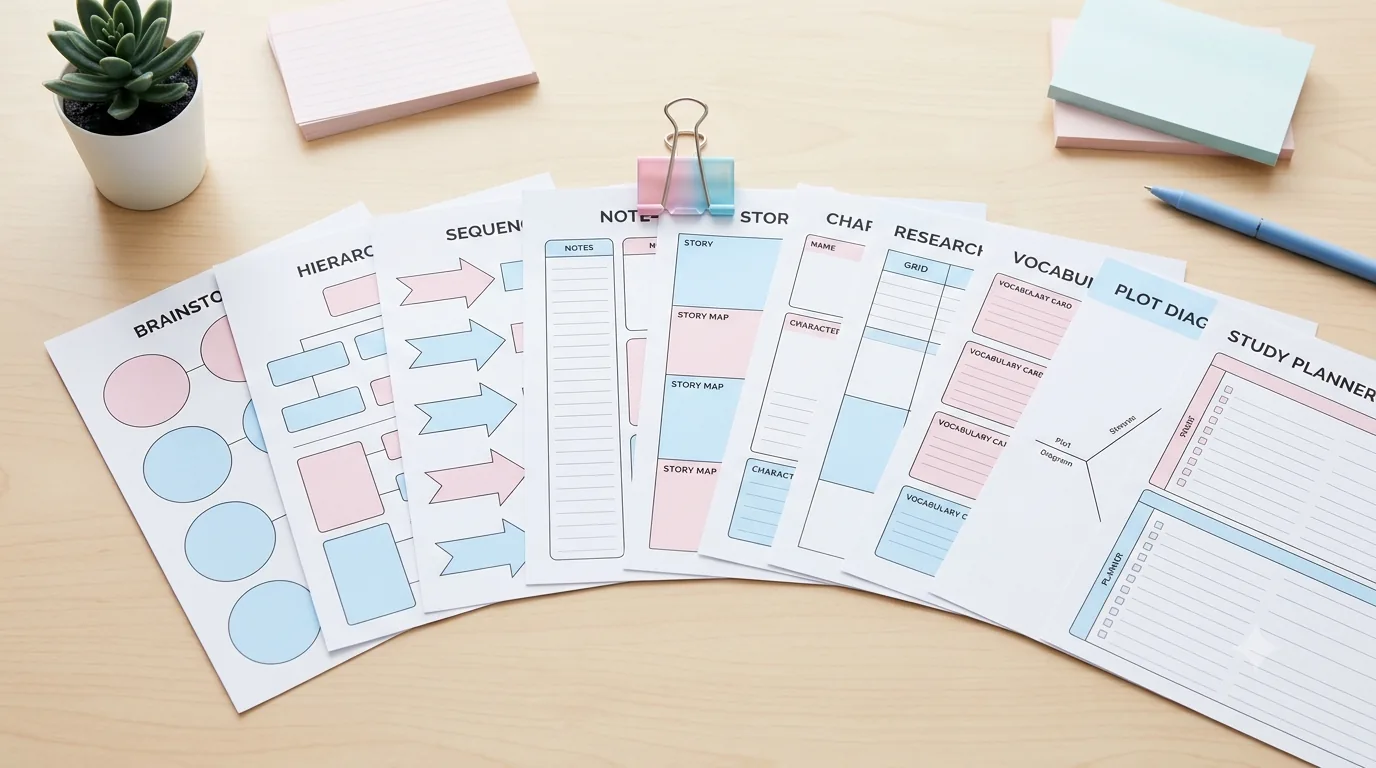
10 Free Graphic Organizers for Reading, Writing, and Studying
Download 10 free graphic organizers for reading, writing, comparison, vocabulary, sequencing, and study. Includes a guide to choosing the right one.
Read guide →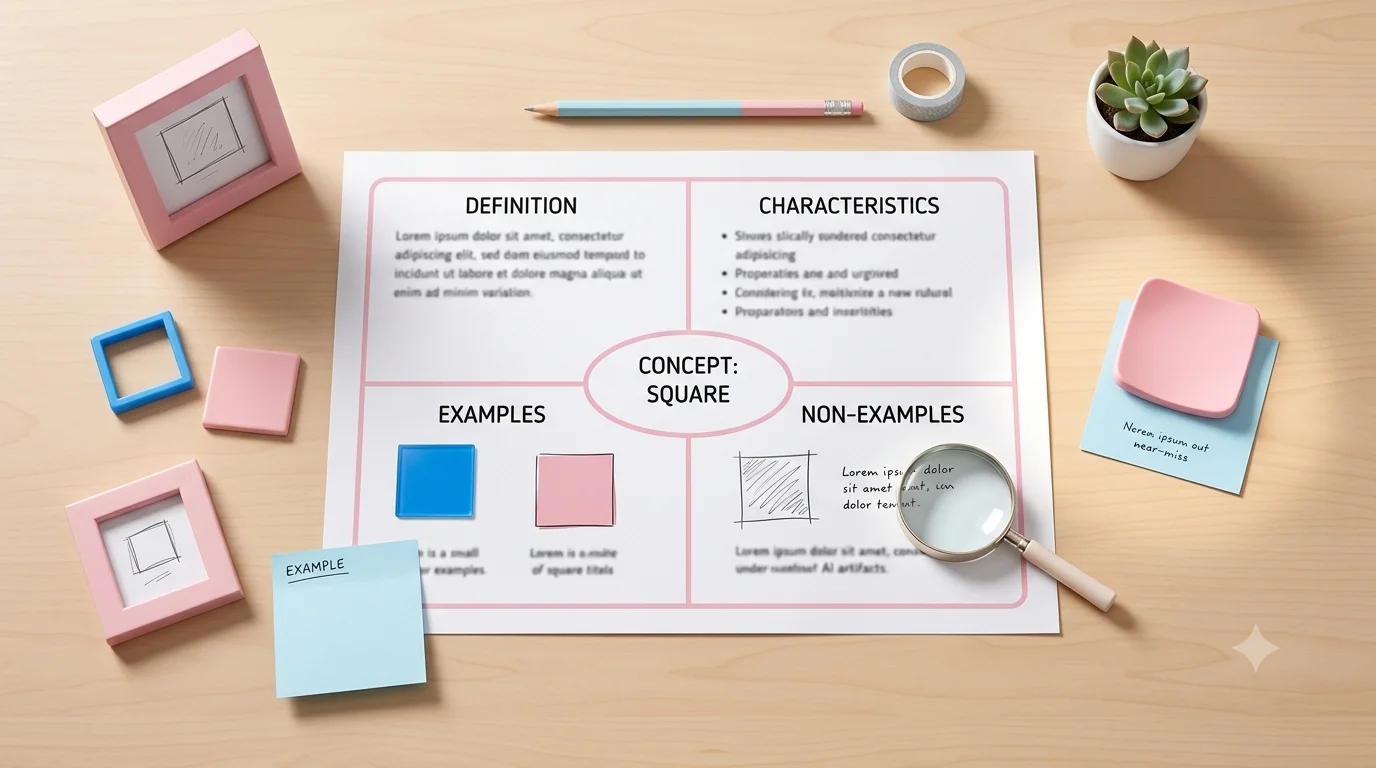
Frayer Model Examples and Non-Examples: How to Choose Ones That Actually Teach the Concept
Learn how to choose strong Frayer Model examples and non-examples, including near-misses, defining characteristics, and worked examples across subjects.
Read guide →