Work & Study · Free printable
Free Compare Two Texts Graphic Organizer
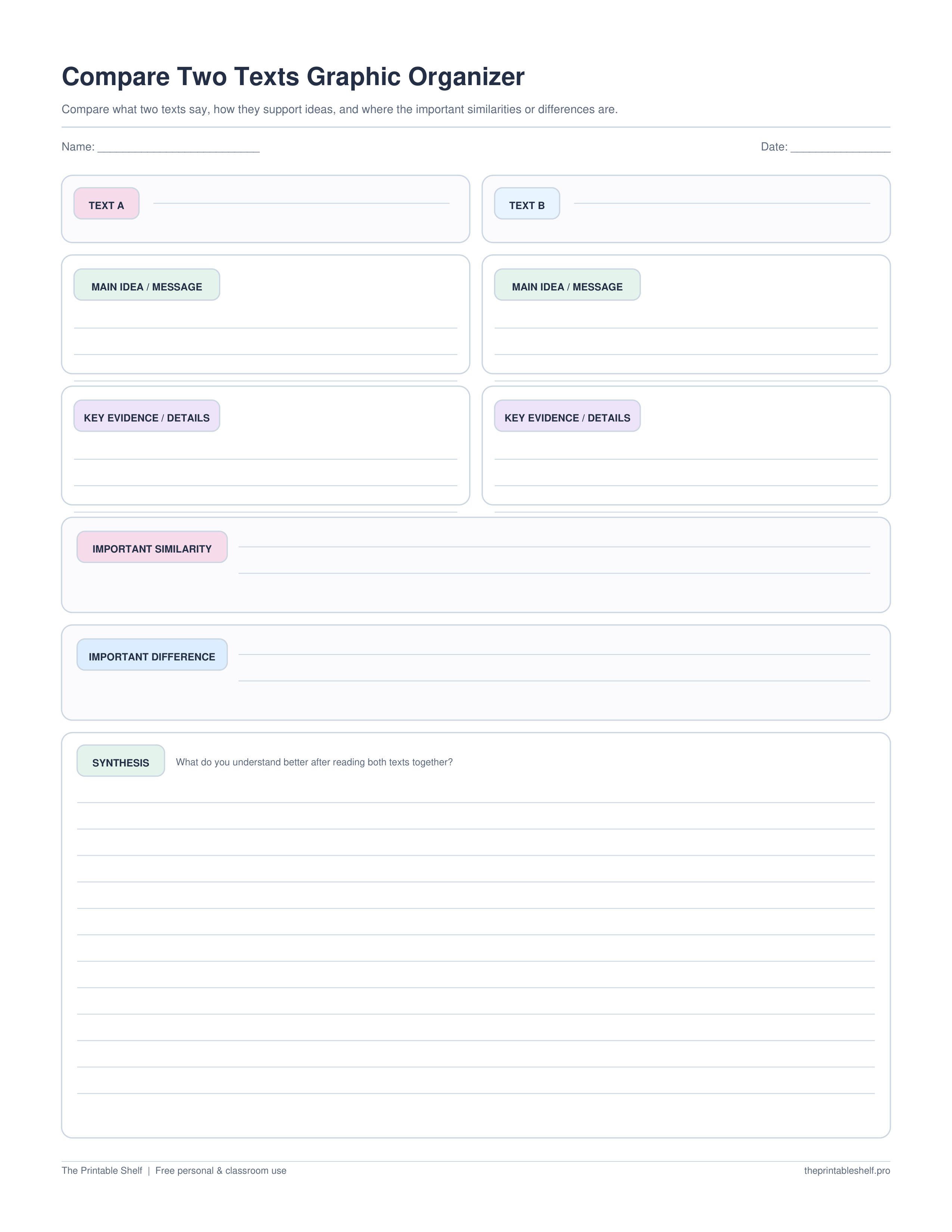
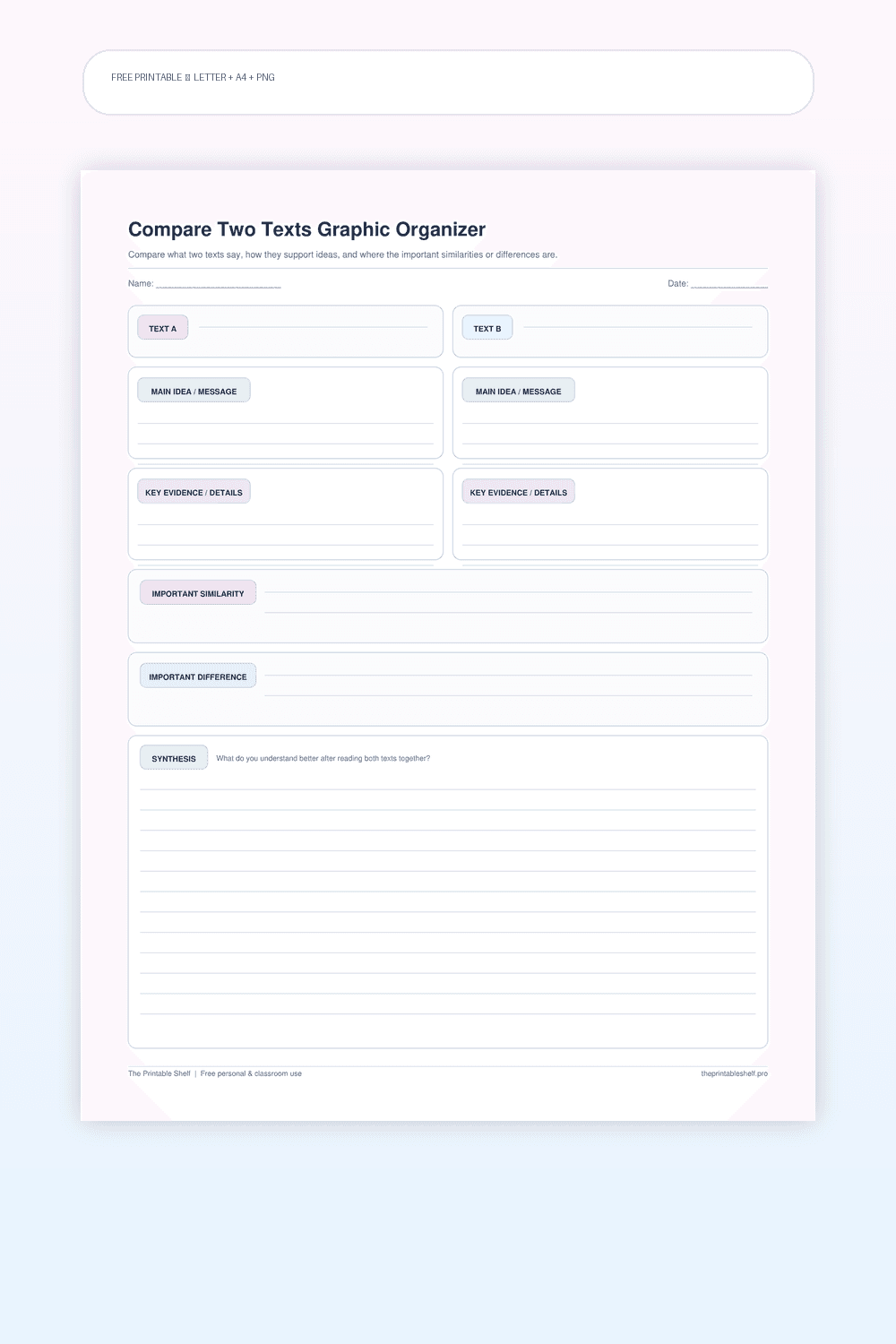
This free compare-two-texts organizer gives each source its own main-idea and evidence space, then asks for one important similarity, one important difference, and a synthesis statement about what becomes clearer after reading both texts. It works with paired articles, passages, accounts, or sources on a shared topic.
Edited by Tessa Vaughn · Planning & Organization Editor
Free download
Choose your file size
Print at 100% / Actual Size for the cleanest margins. Pick the paper size your printer normally uses.
No sign-up required · personal/classroom use
What this printable is for
A source-comparison organizer designed for two articles, passages, accounts, or other texts about a related topic. Unlike a simple Venn diagram, it provides enough room to preserve each text's main idea and evidence before asking the reader to synthesize across sources.
How to use it
Write the title or short label for Text A and Text B. Read each source for its own meaning before comparing. In the main-idea boxes, state the central point or message of each text in a complete sentence. Two texts can share a topic while making different claims, emphasizing different causes, or organizing information in different ways.
Record the strongest evidence or details under each text. Keep the evidence paired with its source so you do not accidentally blend information before you have compared it. If the sources disagree, preserve the difference accurately instead of rewriting both to sound the same. Page, paragraph, or section notes can be added beside the organizer when the assignment requires citation details.
Choose one important similarity. Focus on a similarity that helps answer the reading question, not a trivial shared feature such as both texts having a title. The similarity might involve a shared claim, overlapping evidence, a common explanation, a similar pattern, or agreement about an important event or outcome.
Choose one important difference and decide why it matters. A difference in examples may be minor; a difference in conclusion, evidence quality, perspective, scope, or explanation may change how the sources should be understood. Use the separate source notes to make sure the difference is grounded in what each text actually says.
Finish with the synthesis box. Explain what becomes clearer, more complex, or more questionable after considering both texts together. A synthesis is not a list of A plus B; it is a new statement built from the relationship between the sources. Use that statement to plan a comparison paragraph, discussion response, or evidence-based answer. If the sources disagree, name the disagreement precisely and check whether it comes from different evidence, scope, perspective, or purpose before deciding what the contrast means. Keep the comparison tied to the shared question or topic.
Fill it online
Type directly into this organizer →
Your answers autosave only in this browser. Print or save the filled page as PDF, download a high-resolution PNG, or clear it and start again—no account required.
Customize instead
Need a different title, paper size, or orientation? →
Use the free Graphic Organizer Maker to build a custom Venn, KWL, Frayer, story map, T-chart, main-idea, sequence, or cause-and-effect page.
Also in a free pack
Download this organizer together with related pages when you want one reusable master PDF instead of separate files.
Choose the support level
Blank, guided, example, or fill online
Use the blank page when students already know the routine. Choose the guided version when they need short prompts inside the sections. A completed example is available when this template benefits from modeling, and the online version lets students type before printing.
Blank
Independent use →
The standard printable with open writing space and no embedded hints. Download the Letter PDF.
Guided
Prompted scaffold
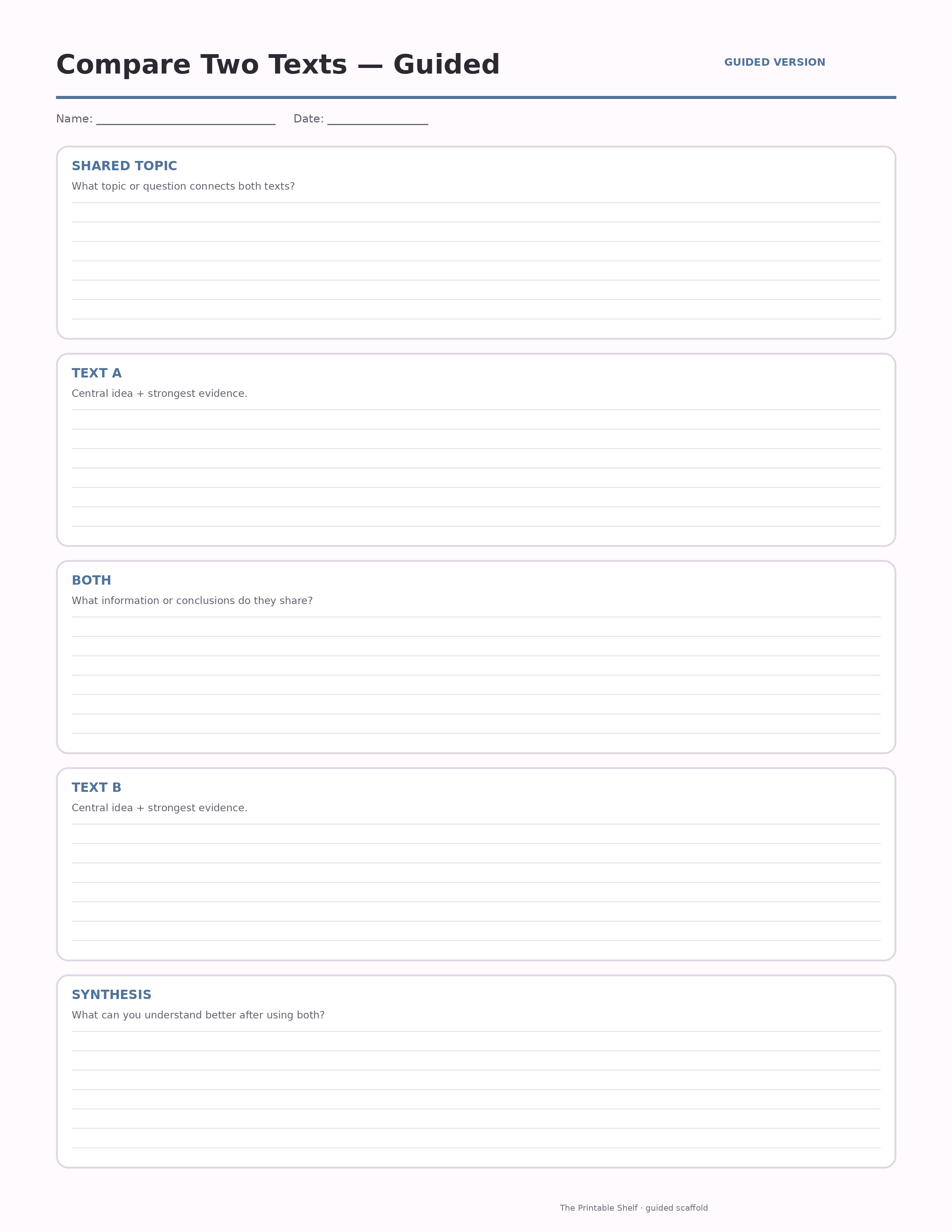
A scaffolded version with short prompts inside each section to help students know what kind of evidence or thinking belongs there.
Model
Completed example ↓
Use the finished sample to model the thinking before students work independently.
Online
Type before printing →
Autosave locally, print/save as PDF, or export the filled organizer as PNG.
Teaching set · 3 pages
Blank + guided + completed example in one PDF
Print the model first, practice with prompts, then move to the blank page without downloading three separate files.
Completed example
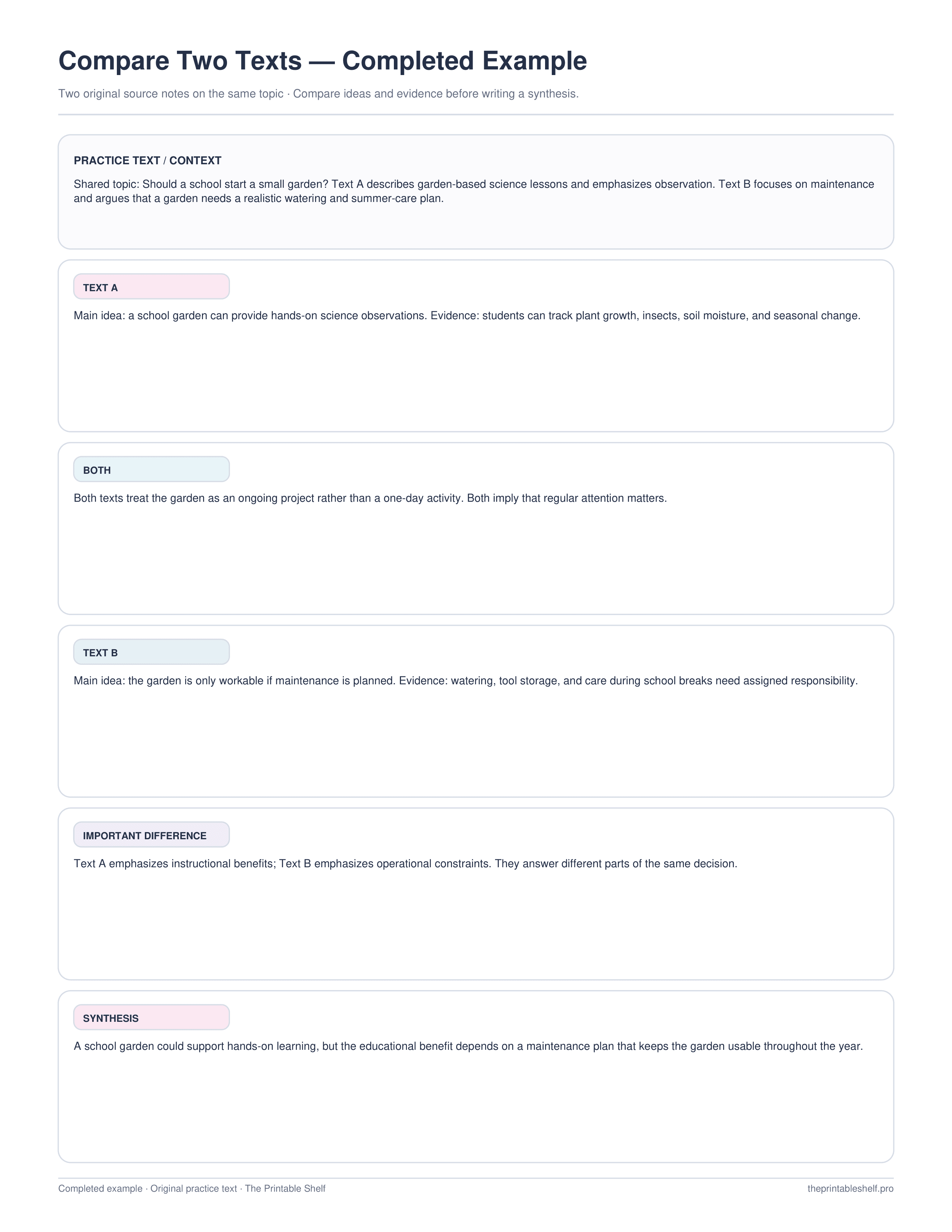
See how a finished page can look
See how to compare the main ideas and evidence in two short source notes, then write a synthesis that uses both.
Best uses for this template
Ways to use it
Compare paired nonfiction passages
Preserve each text's main idea and evidence before deciding where the sources agree or differ.
Prepare a synthesis paragraph
Use the similarity and difference boxes to build a final statement that explains what the two sources reveal together.
Notice source disagreement
Keep conflicting evidence or conclusions attached to the correct source so disagreement is analyzed rather than accidentally erased.
Common mistakes to avoid
Comparing before understanding each source
State the main idea and strongest evidence for each text first, then move to similarity and difference.
Listing trivial similarities
Choose comparisons that affect the answer, explanation, evidence, perspective, or conclusion.
Writing A plus B instead of a synthesis
Explain what becomes clearer or changes after the two sources are considered together.
Classroom fit
Suggested grades, use modes & standards
Suggested grade bands
These are practical use ranges, not hard limits. Text complexity and the amount of teacher modeling matter more than the worksheet alone.
Good fit for
Scaffold level: Advanced.
Common Core crosswalk
- RI.4.9 · Integrate information from two texts on the same topic
- RI.5.9 · Integrate information from several texts on the same topic
- RI.6.9 · Compare and contrast one author’s presentation with another’s
These codes are a practical crosswalk for skills this organizer can support. They are not a claim that the worksheet alone fully teaches or assesses the standard.
Frequently asked questions
How is this different from a Venn diagram?
A Venn diagram is excellent for quick overlap. This organizer gives each text more room for a main idea and evidence before asking for a synthesis across both sources.
Can I use it for fiction and nonfiction?
Yes, as long as the comparison question makes sense. The main-idea or message labels can be interpreted to fit the kind of text being compared.
What should go in the synthesis box?
Write what you understand after considering both sources together—such as a stronger conclusion, a qualification, or a relationship that neither source shows alone.
Helpful guides
See where this organizer fits, when a different layout works better, and how to turn the completed page into a useful next step.
Keep organizing
You might also like
Free printable
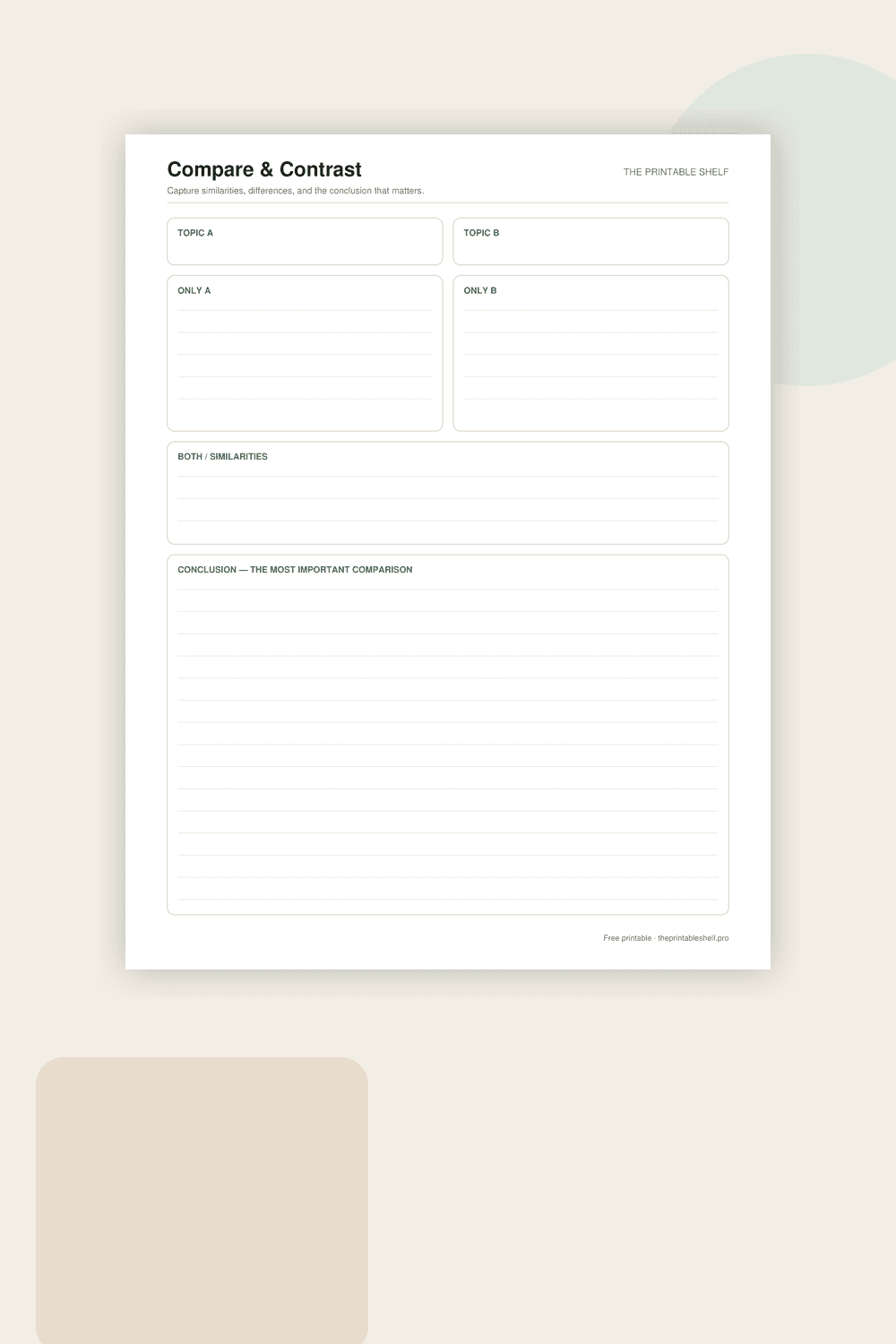
Compare and Contrast Graphic Organizer
A structured alternative to a Venn diagram for learners who need more writing space. Two difference boxes sit side by side, a full-width similarities area keeps shared traits together, and the final conclusion section turns the collected notes into an actual comparison rather than stopping at a list.
Free printable
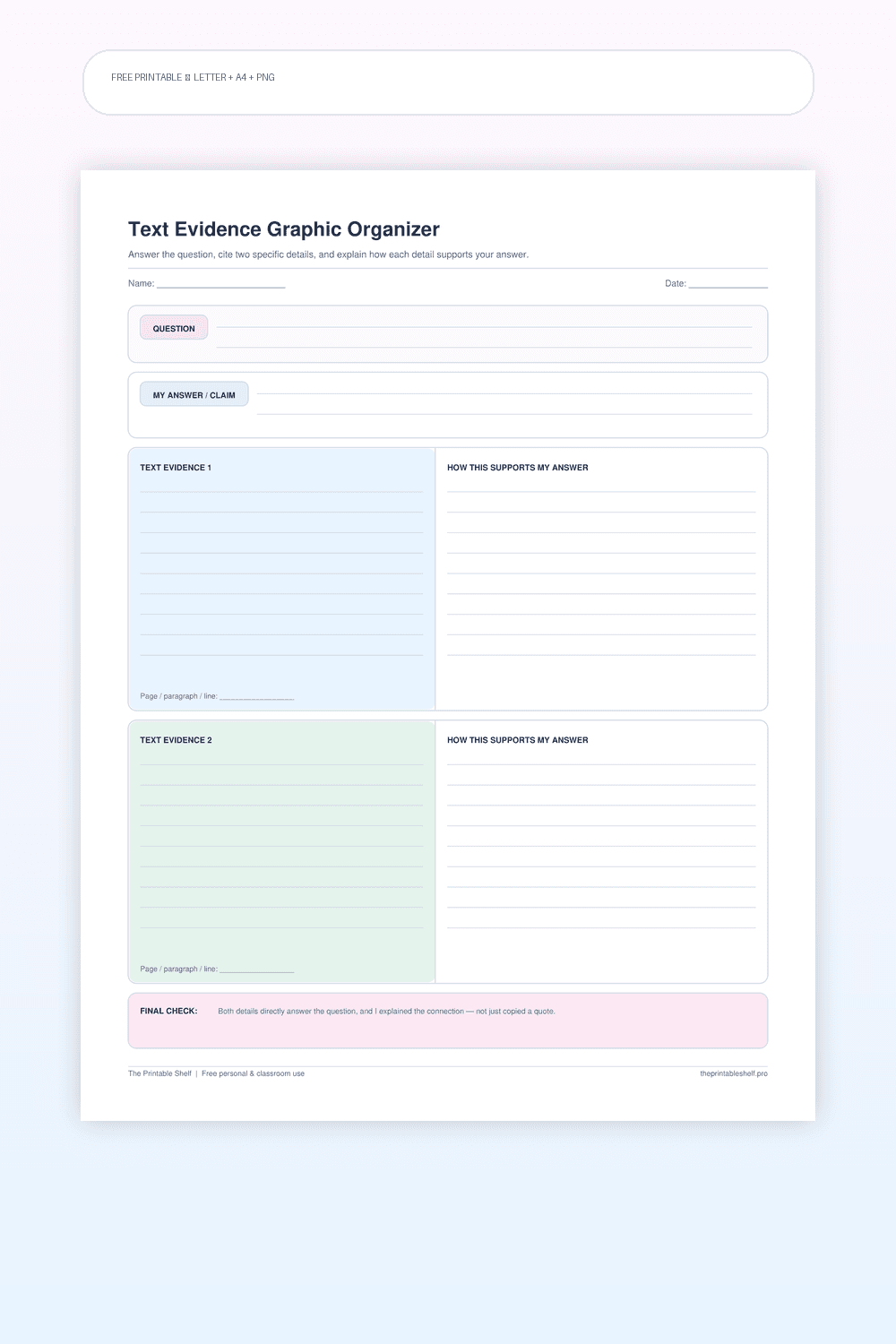
Text Evidence Graphic Organizer
A compact evidence-to-explanation organizer for reading responses and source-based writing. The page deliberately separates evidence from the explanation of evidence. That separation helps expose a common gap: a learner may copy a strong quotation or detail but never show why it supports the point being made. The organizer can be used with direct quotations, paraphrased details, page or paragraph references, and other text-specific evidence allowed by the assignment.
Free printable
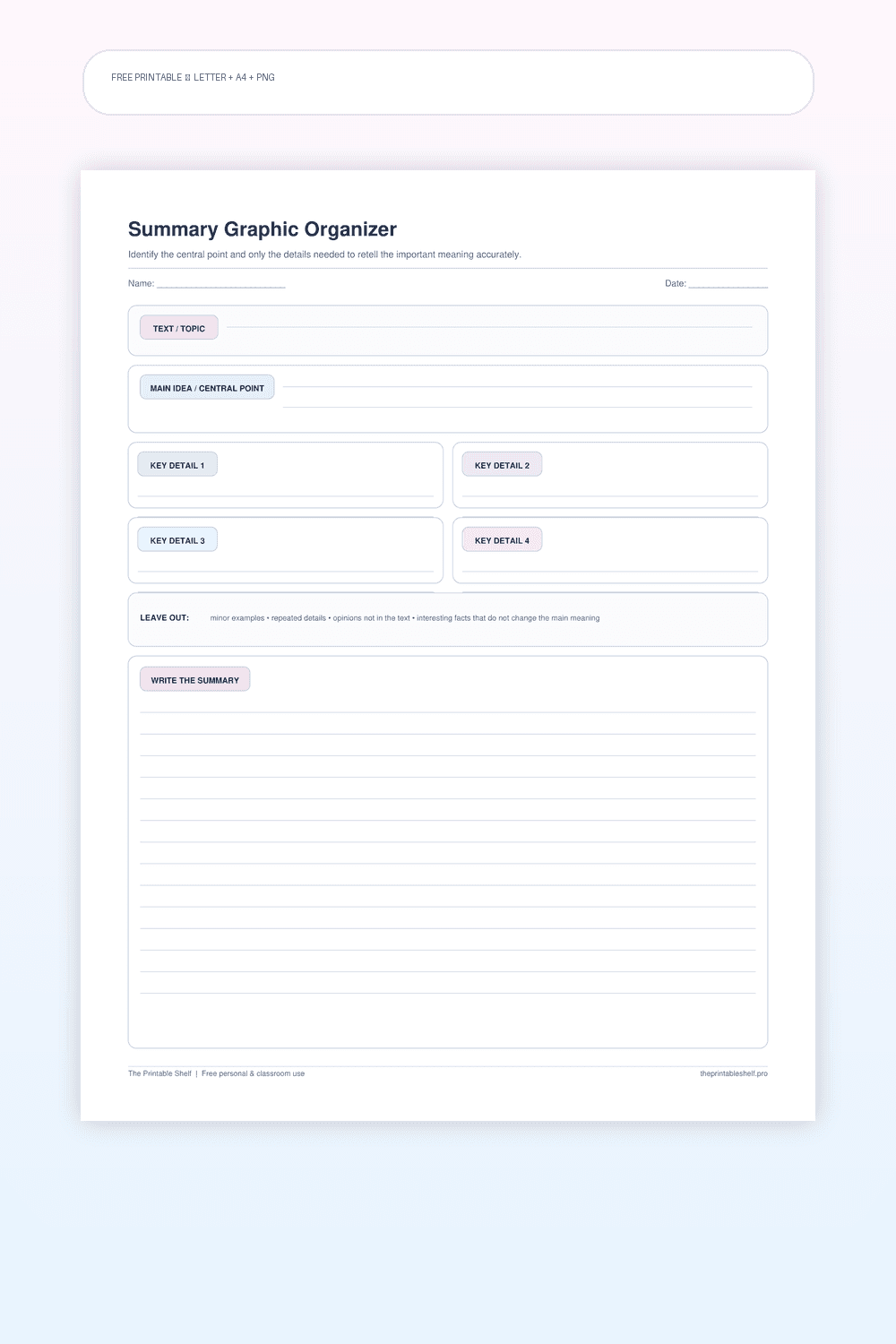
Summary Graphic Organizer
A reading-to-writing scaffold for compressing a text around its most important ideas. The page combines a main-idea box, a small set of key-detail slots, a deliberate 'leave out' check, and a final writing area. It is especially useful when learners can locate details but struggle to rank their importance. Unlike a beginning-middle-end retell, this organizer does not require every event to appear and can be used with nonfiction as well as narrative texts.