Work & Study · Free printable
Free Text Evidence Graphic Organizer
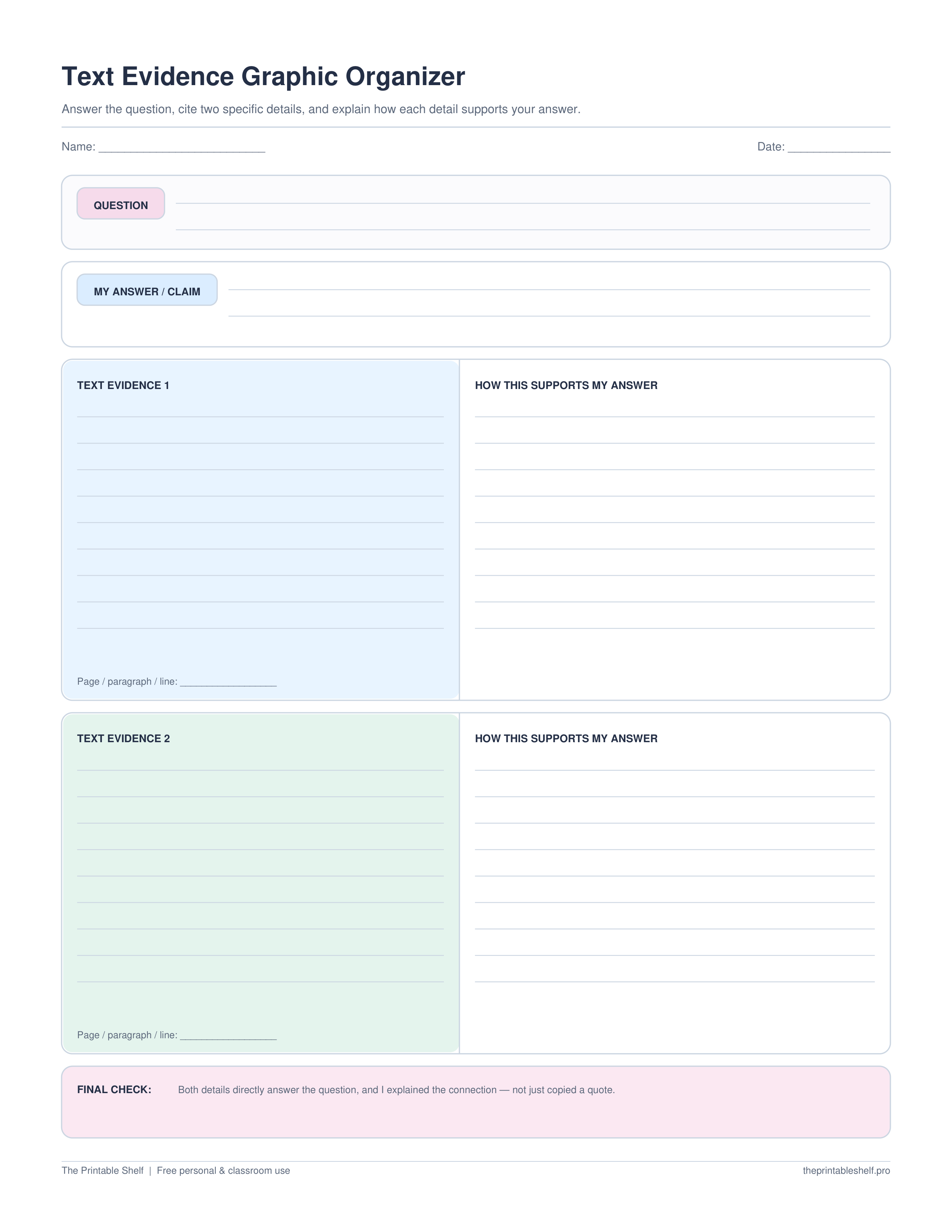
This free text evidence graphic organizer helps learners move beyond quote collecting. Start with the question and a focused claim, record two relevant pieces of textual evidence, then explain how each detail supports the claim. A final evidence check prompts the learner to judge relevance and sufficiency before drafting a response.
Edited by Tessa Vaughn · Planning & Organization Editor
Free download
Choose your file size
Print at 100% / Actual Size for the cleanest margins. Pick the paper size your printer normally uses.
No sign-up required · personal/classroom use
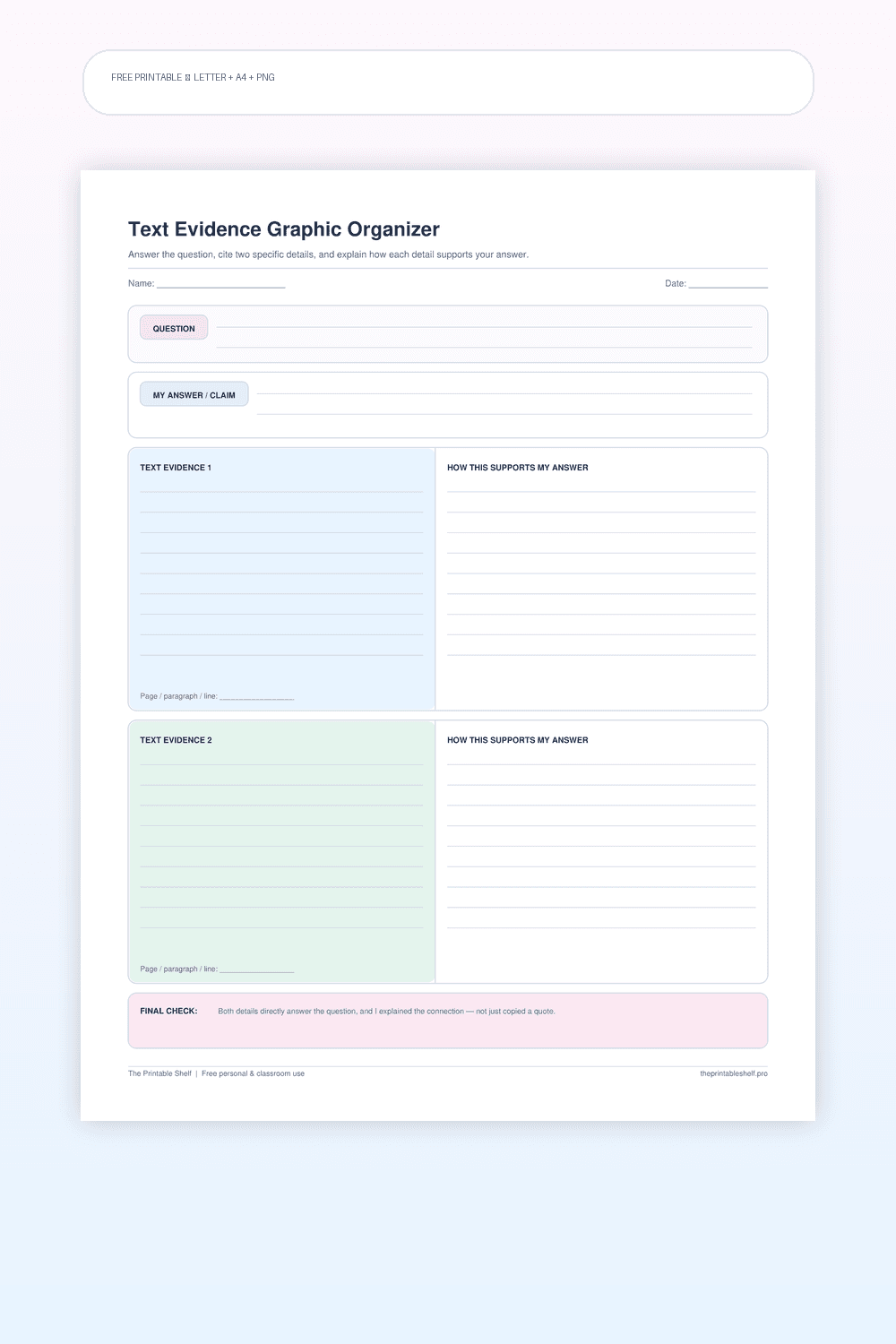
What this printable is for
A compact evidence-to-explanation organizer for reading responses and source-based writing. The page deliberately separates evidence from the explanation of evidence. That separation helps expose a common gap: a learner may copy a strong quotation or detail but never show why it supports the point being made. The organizer can be used with direct quotations, paraphrased details, page or paragraph references, and other text-specific evidence allowed by the assignment.
How to use it
Write the question first, then draft a focused tentative claim after understanding the relevant part of the text. Avoid a claim that merely repeats the prompt or tries to cover several unrelated ideas at once. Use the claim to test relevance, but keep it revisable: does this information support the point, challenge it, add necessary context, or suggest a more accurate answer?
Choose the strongest relevant evidence rather than the longest quotation. A short phrase, paraphrased action, statistic, example, or specific detail can be better than copying an entire paragraph. Record enough context that you can find the evidence again, especially when working from a long text. If the assignment requires citations, add the page, paragraph, line, or source information while the text is still open instead of reconstructing it later.
Use the explanation box to answer why this evidence supports the claim. Do not restate the quotation with a few synonyms. Name the relationship: what the detail reveals, shows, contrasts, demonstrates, or makes more likely. When a learner can explain that link clearly, the evidence is doing argumentative or analytical work instead of sitting beside the claim as an isolated quote.
If you use both evidence boxes, compare the details rather than filling the second box automatically. They should not simply duplicate the same point unless repetition itself matters. Look for evidence that adds distinct support, context, or qualification. If one detail is weak or only loosely related, replace it—or leave the extra box unused when one well-explained detail is sufficient for the task.
Use the completed organizer as a bridge to writing rather than as the final response. A simple paragraph can move from claim to evidence to explanation, then repeat that evidence-and-explanation pattern as needed. During revision, check that every quotation or detail has a clear job and that the reasoning remains visible even if the reader has not seen the organizer.
Fill it online
Type directly into this organizer →
Your answers autosave only in this browser. Print or save the filled page as PDF, download a high-resolution PNG, or clear it and start again—no account required.
Customize instead
Need a different title, paper size, or orientation? →
Use the free Graphic Organizer Maker to build a custom Venn, KWL, Frayer, story map, T-chart, main-idea, sequence, or cause-and-effect page.
Also in a free pack
Download this organizer together with related pages when you want one reusable master PDF instead of separate files.
Choose the support level
Blank, guided, example, or fill online
Use the blank page when students already know the routine. Choose the guided version when they need short prompts inside the sections. A completed example is available when this template benefits from modeling, and the online version lets students type before printing.
Blank
Independent use →
The standard printable with open writing space and no embedded hints. Download the Letter PDF.
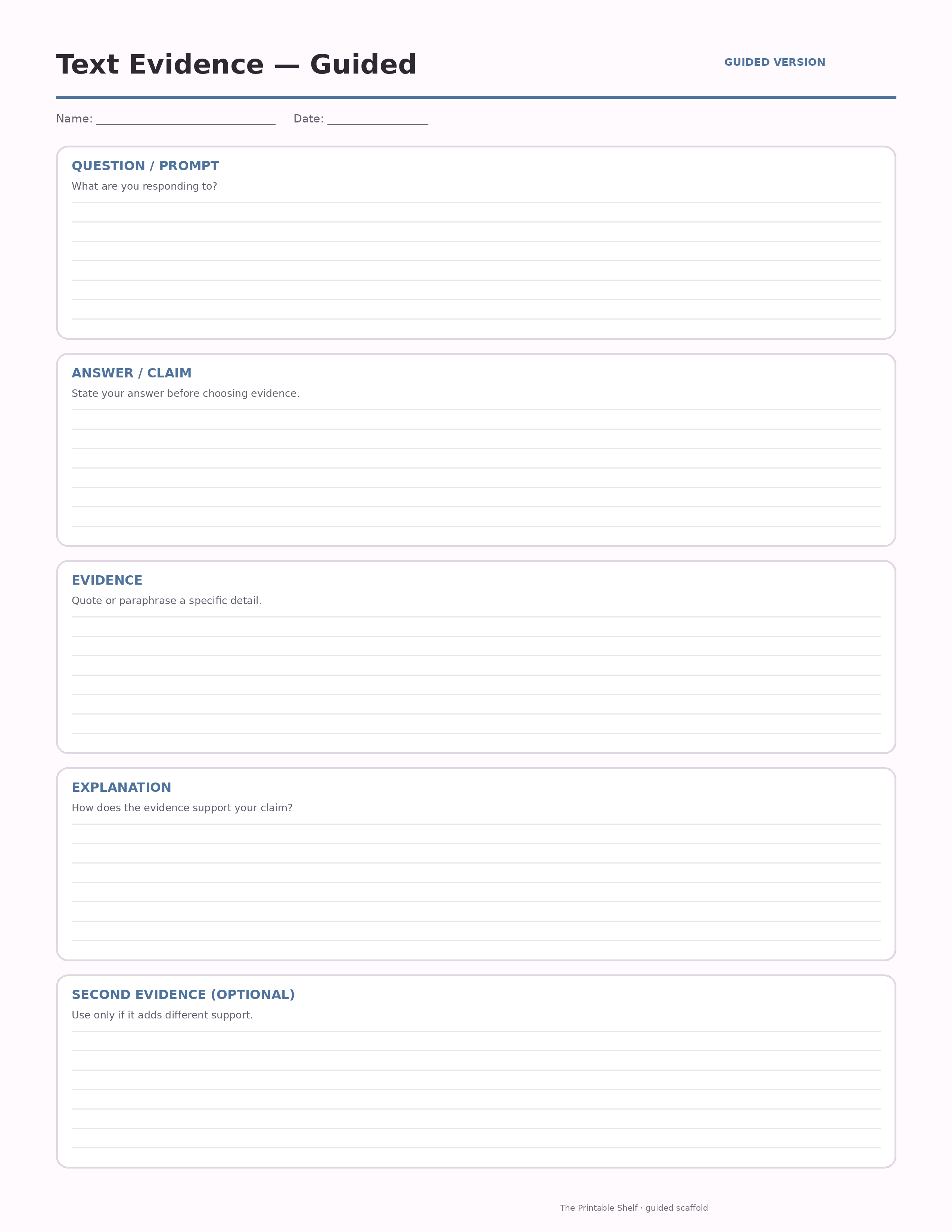
Guided
Prompted scaffold
A scaffolded version with short prompts inside each section to help students know what kind of evidence or thinking belongs there.
Model
Completed example ↓
Use the finished sample to model the thinking before students work independently.
Online
Type before printing →
Autosave locally, print/save as PDF, or export the filled organizer as PNG.
Teaching set · 3 pages
Blank + guided + completed example in one PDF
Print the model first, practice with prompts, then move to the blank page without downloading three separate files.
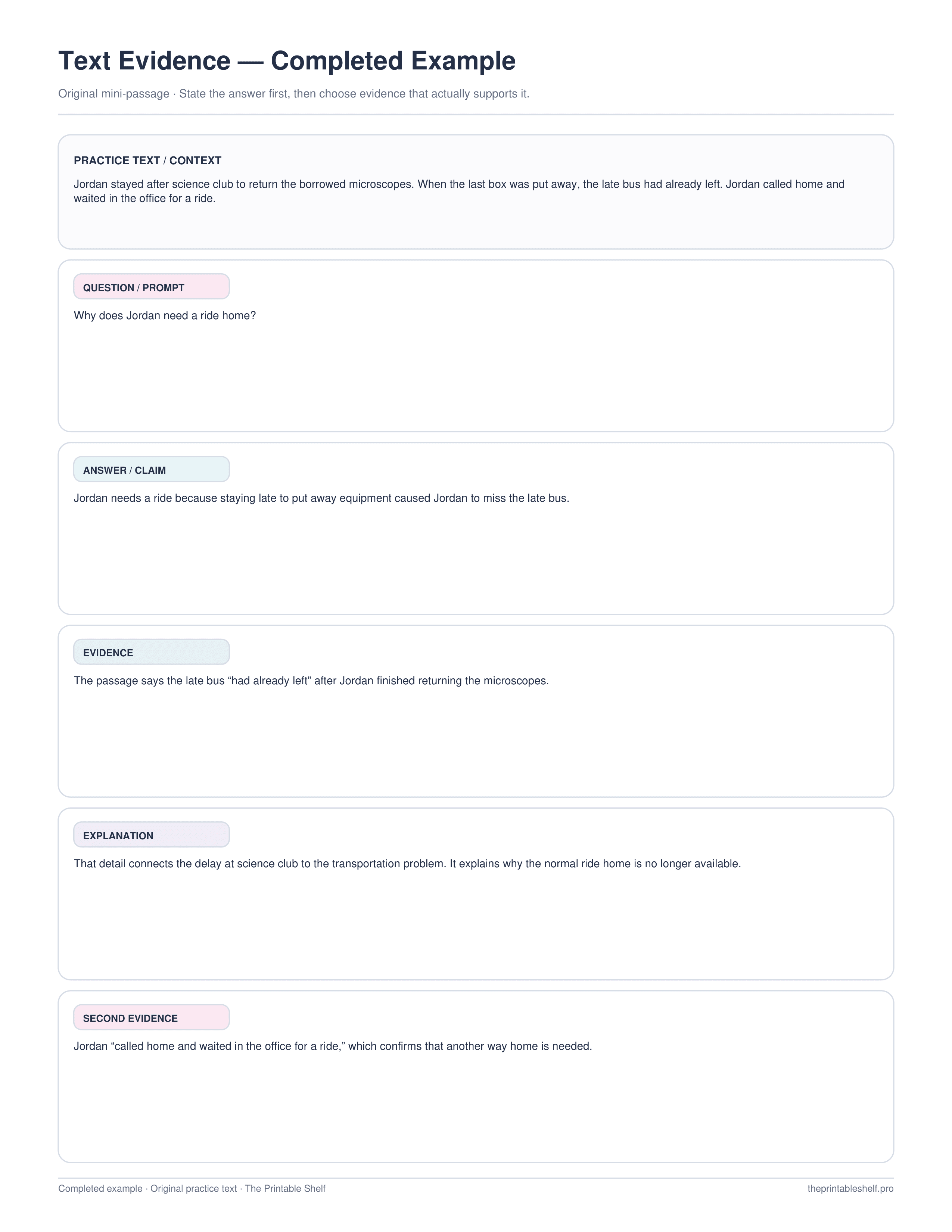
Completed example
See how a finished page can look
See how a claim, precise text evidence, and an explanation fit together using an original mini-passage.
Best uses for this template
Ways to use it
Build a short reading response
Move from a focused tentative answer to the relevant evidence the task needs, explain the connection, and revise the answer if the strongest text evidence points elsewhere.
Compare evidence quality
List two candidate details and decide which one is more relevant, specific, or sufficient for the claim.
Prevent quote dumping
Require an explanation beside each piece of evidence so copied text cannot substitute for analysis.
Common mistakes to avoid
Choosing the longest quotation
Choose the most focused specific detail that supports the claim while preserving enough context to interpret it accurately.
Repeating the evidence in the explanation
Explain the relationship between the evidence and claim: what does the detail demonstrate or make clear?
Selecting evidence with no question or working idea
Draft a tentative answer after understanding the relevant text, test it against supporting and challenging evidence, and revise the claim when needed.
Classroom fit
Suggested grades, use modes & standards
Suggested grade bands
These are practical use ranges, not hard limits. Text complexity and the amount of teacher modeling matter more than the worksheet alone.
Good fit for
Scaffold level: Standard.
Common Core crosswalk
- RL.4.1 / RI.4.1 · Refer to details and examples to support explanations and inferences
- RL.5.1 / RI.5.1 · Quote accurately from a text to support analysis
- W.5.9 · Draw evidence from literary or informational texts
These codes are a practical crosswalk for skills this organizer can support. They are not a claim that the worksheet alone fully teaches or assesses the standard.
Frequently asked questions
What counts as text evidence?
Depending on the task, text evidence may be a direct quotation, paraphrased detail, action, example, statistic, description, or other specific information from the source that supports the claim.
Do I have to use two pieces of evidence?
No. The printable provides room for two because many responses benefit from more than one support. The assignment and strength of the evidence should determine how much is actually needed.
What should go in the explanation box?
Explain how or why the selected evidence supports the claim. Avoid simply repeating the quotation or paraphrase; make the logical connection visible.
Helpful guides
See where this organizer fits, when a different layout works better, and how to turn the completed page into a useful next step.
Free Writing Graphic Organizers: Which One to Use and When
Use free writing graphic organizers to plan ideas, structure paragraphs, compare evidence, sequence steps, and organize explanations before drafting.
Read guide →
Free Reading Comprehension Graphic Organizers by Reading Skill
Free reading comprehension graphic organizers for story elements, main idea, sequence, cause and effect, comparison, vocabulary, and prior knowledge.
Read guide →
How to Use Graphic Organizers Effectively (Without Turning Them Into Busywork)
Learn how to choose, model, scaffold, and reuse graphic organizers so students think with them instead of simply filling in boxes.
Read guide →How to Make Inferences From Text Without Guessing
Learn how to make inferences from text using clues, relevant background knowledge, evidence checks, and a simple worked example for reading practice.
Read guide →How to Use Text Evidence in a Reading Response
Learn how to choose, cite, and explain text evidence in a reading response without quote dumping, with a worked example and free evidence organizer.
Read guide →How to Write Claim, Evidence, Reasoning (CER)
Learn how to write a claim-evidence-reasoning (CER) explanation, choose relevant data, connect evidence with science ideas, and revise a weak response.
Read guide →How to Identify Theme in a Story Without Guessing
Learn how to identify theme from repeated details, character choices, conflict, and evidence—not a one-word topic—with a worked example and free organizer.
Read guide →How to Determine Point of View in a Story
Learn how to identify first person, third-person limited, and third-person omniscient point of view using narrator clues, knowledge limits, and evidence.
Read guide →Keep organizing
You might also like
Free printable
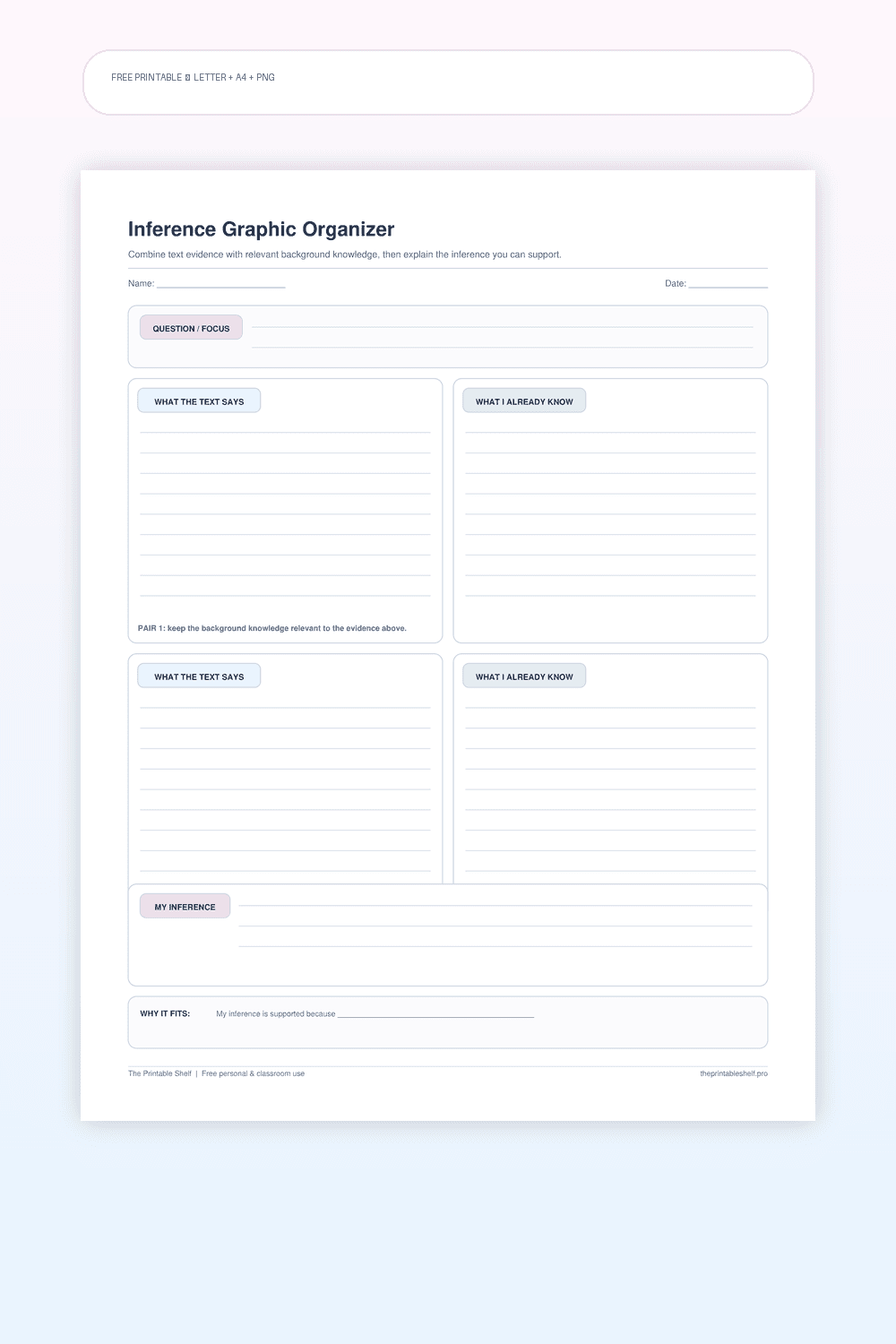
Inference Graphic Organizer
A reading-comprehension scaffold for conclusions that are implied rather than stated directly. The layout separates what the text actually provides from what the reader already knows, then asks for an inference supported by both. That distinction matters because an inference is not a guess or personal opinion; it should be a conclusion that remains accountable to textual clues and can be revised when new information changes the evidence.
Free printable
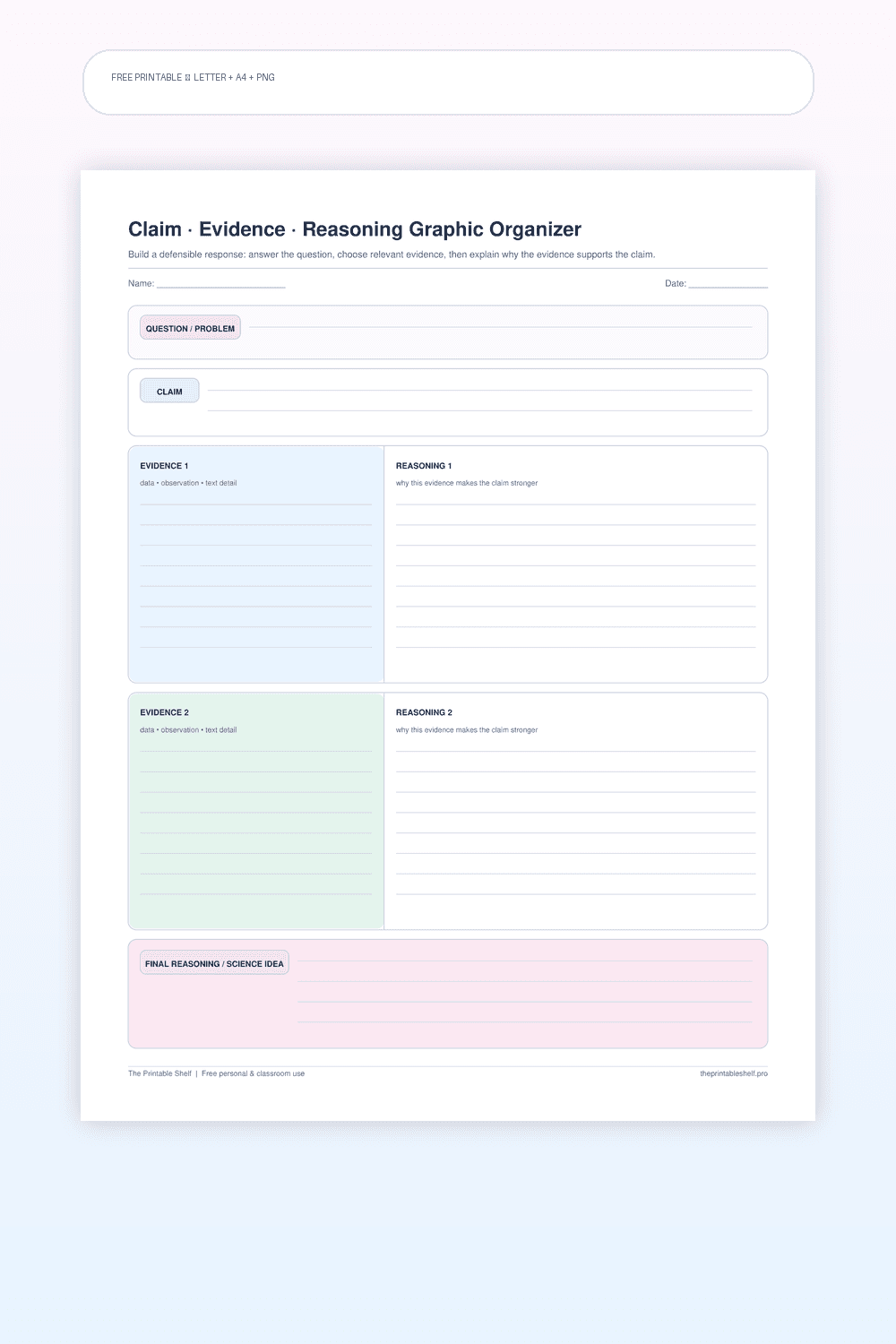
Claim Evidence Reasoning Graphic Organizer
A CER planning page for constructing evidence-based explanations, especially in science. The organizer keeps claim, evidence, and reasoning visually separate because they do different jobs: the claim answers the question, evidence provides appropriate observations or data, and reasoning links that evidence to the claim using relevant scientific ideas or principles. The layout can also support other evidence-based explanations when the teacher or assignment uses CER language.
Free printable
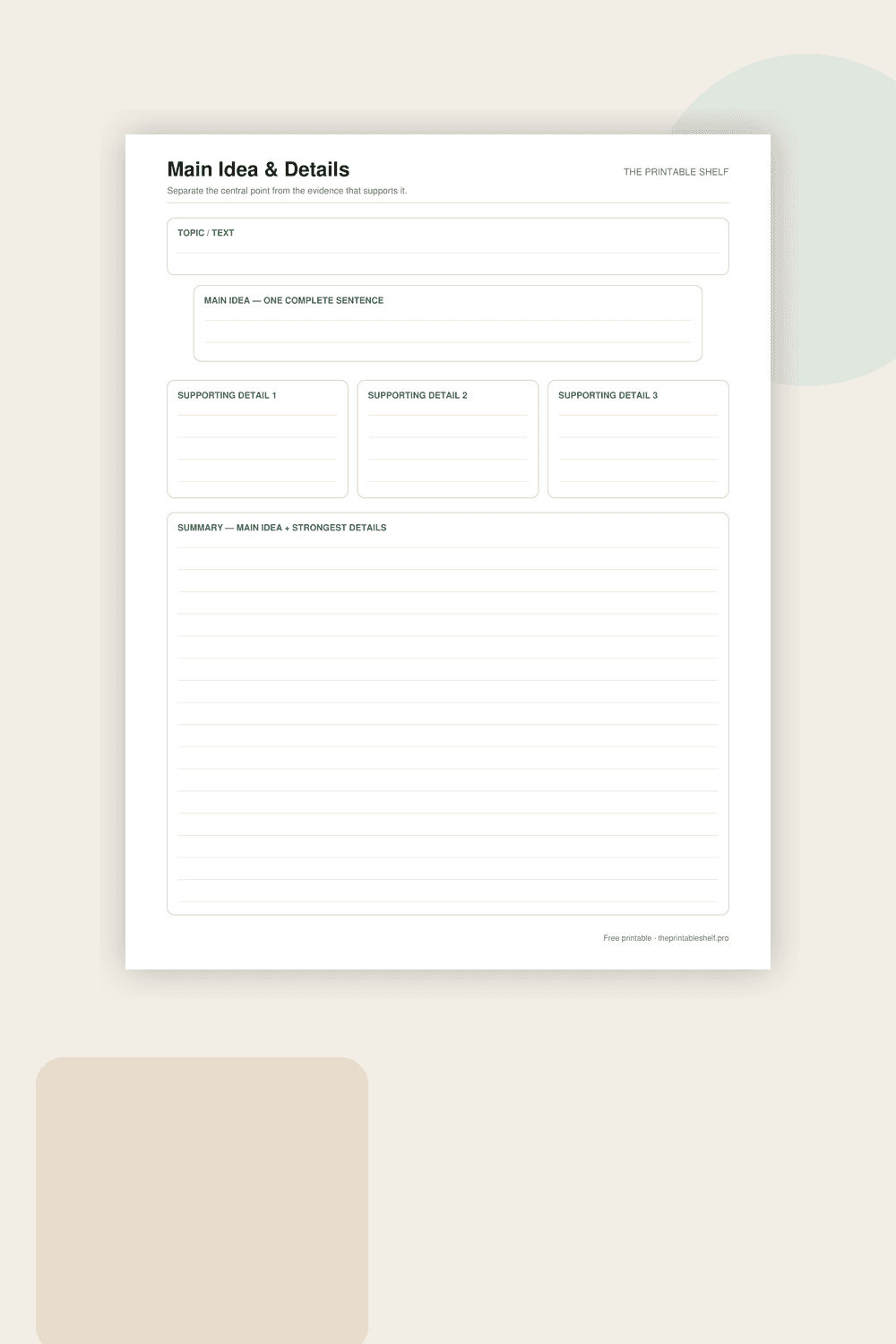
Main Idea and Details Graphic Organizer
A reading and note-taking organizer built around one central idea and three pieces of support. The extra topic box helps learners distinguish a broad subject from the author’s actual main point, while the final summary asks them to recombine the important information in their own words.