Work & Study · Free printable
Free Printable KWL Chart
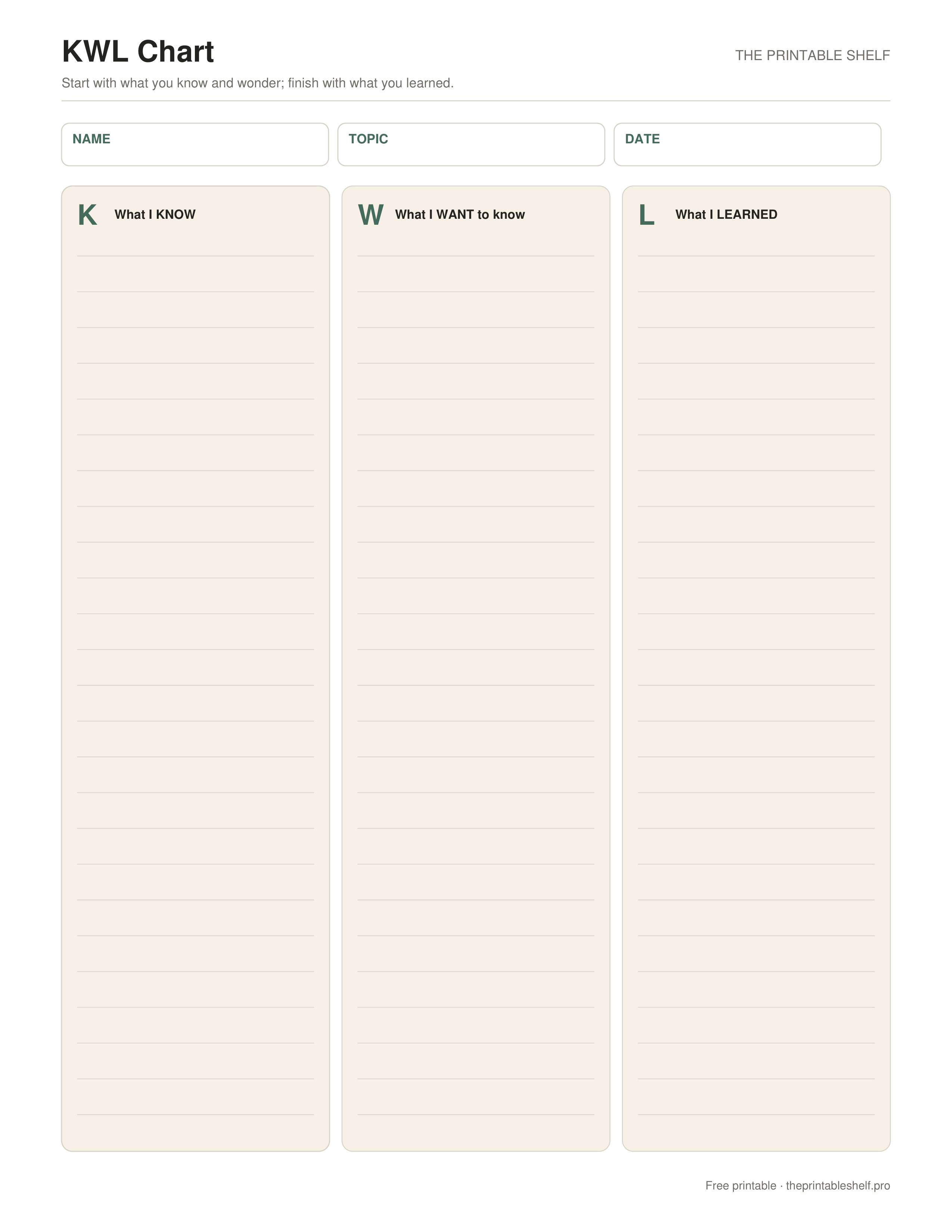
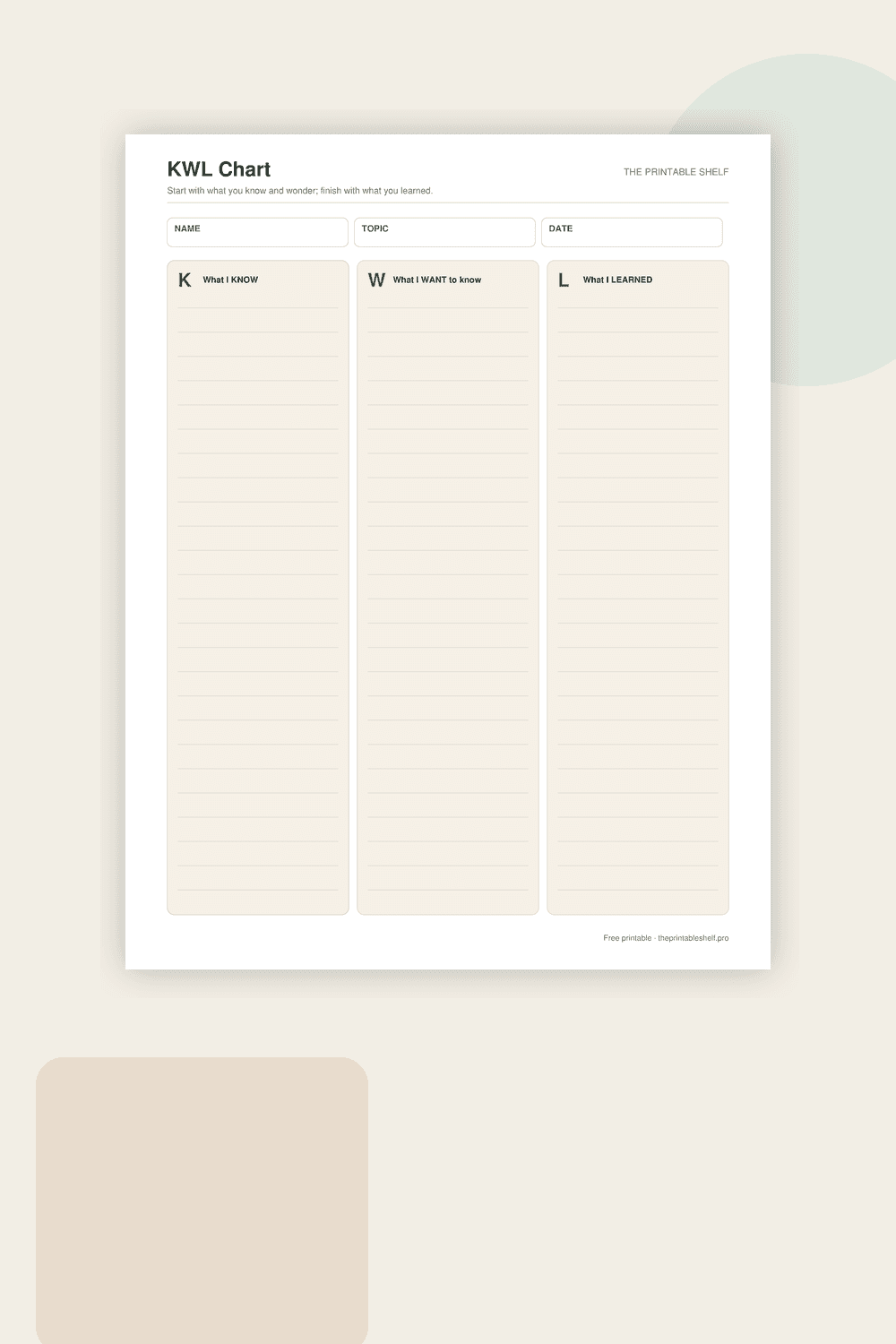
A KWL chart helps learners organize what they already know, what they want to find out, and what they learned. Fill in K and W before reading or instruction, then return to L afterward. This free version includes writing lines and comes in US Letter, A4, and PNG formats.
Edited by Tessa Vaughn · Planning & Organization Editor
Free download
Choose your file size
Print at 100% / Actual Size for the cleanest margins. Pick the paper size your printer normally uses.
No sign-up required · personal/classroom use
What this printable is for
A three-column learning organizer for activating prior knowledge and making questions visible before a lesson begins. The K column records what the learner thinks they know, W captures questions or wonderings, and L is completed afterward with new information, corrections, and answers discovered during learning.
How to use it
Write the topic at the top before opening the book, video, article, or lesson notes. In the K column, record what you already believe you know about the topic. Short phrases are enough. The goal is to surface prior knowledge, not to prove that every statement is correct. If you are using the sheet with a child or class, avoid correcting the K column immediately; uncertain ideas can become useful things to check.
Move to W and turn curiosity into specific questions. “Learn about sharks” is too broad to guide attention, while “How do sharks sense prey?” gives the learner something concrete to watch for. Write the questions that will genuinely guide attention before starting rather than filling the column to meet a quota. If a new question comes up halfway through the lesson, add it to W rather than squeezing it into the Learned column. That keeps questions and answers easy to match later.
Complete L after the learning activity, not while every answer is still being copied word for word. Write the important ideas in your own language, answer as many W questions as possible, and correct any K statements that turned out to be incomplete or inaccurate. If a W question is still unanswered, leave it visible. That gap can point to the next source, lesson, or research task instead of being treated as a failure.
For repeated topics, keep the sheet with the related notes rather than throwing it away after the lesson. A filled KWL chart is useful evidence of how understanding changed. Teachers can use it for a quick before-and-after check; independent learners can use it as a study map. For younger writers, accept keywords or small sketches first, then ask for one complete sentence in the L column at the end.
For group work, let each person complete K and W independently before comparing answers. That prevents the first confident speaker from supplying everyone else’s prior knowledge. Merge the best questions afterward, then use L as a shared check on which questions the lesson actually answered.
Customize instead
Need a different title, paper size, or orientation? →
Use the free Graphic Organizer Maker to build a custom Venn, KWL, Frayer, story map, T-chart, main-idea, sequence, or cause-and-effect page.
Also in a free pack
Download this organizer together with related pages when you want one reusable master PDF instead of separate files.
Completed example
See how a finished page can look
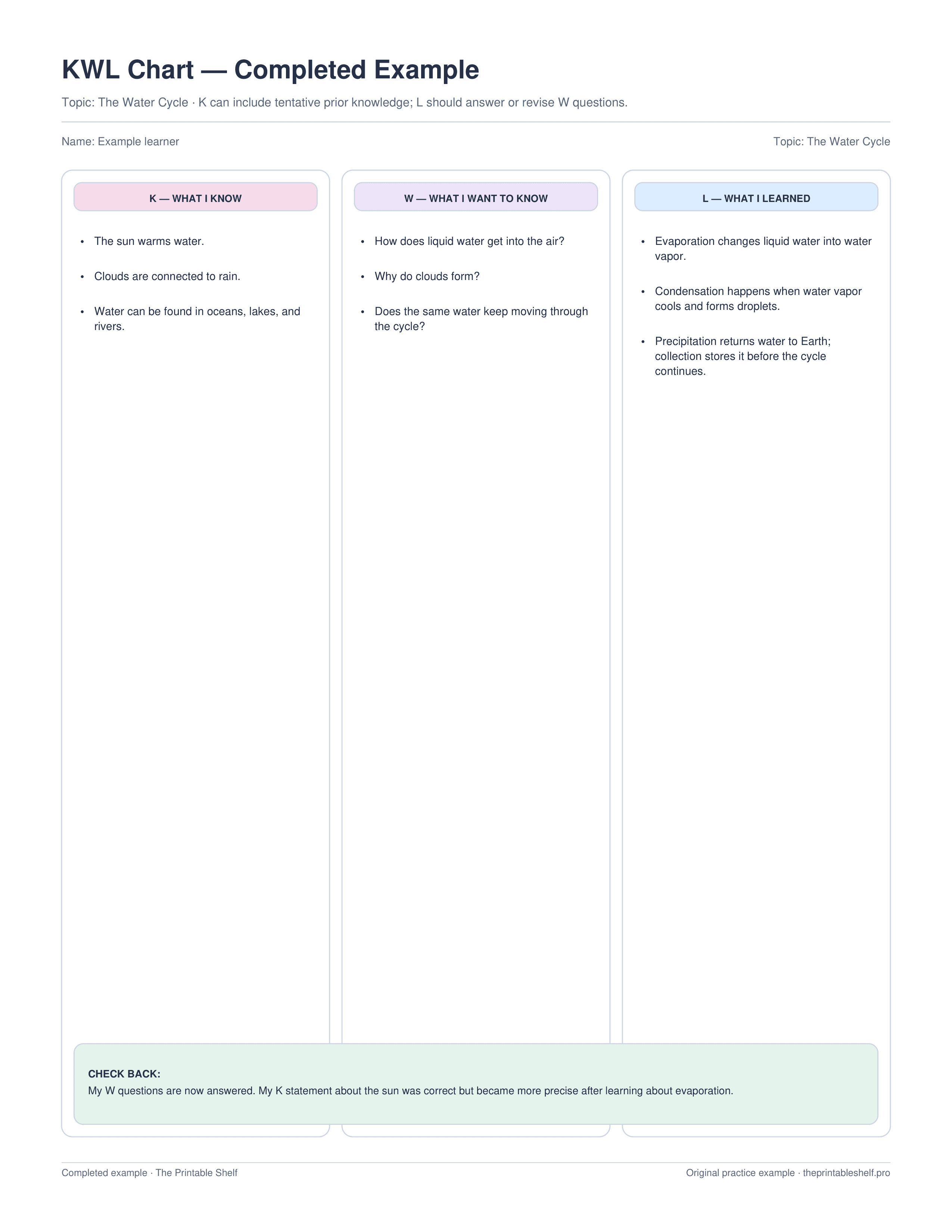
This example shows the timing of a KWL chart: tentative prior knowledge in K, answerable questions in W, then more precise learning in L after reading or instruction.
Best uses for this template
Ways to use it
Start a new topic
Use the K column to surface what learners think they know and the W column to turn curiosity or uncertainty into questions worth checking.
Track questions during reading
Keep useful W questions visible while reading or researching so new information has a purpose instead of becoming an unrelated fact list.
Close with evidence
Use the L column to record what can now be explained, corrected, or supported after the lesson rather than simply repeating the K column.
Common mistakes to avoid
Treating every K entry as a verified fact
Allow prior knowledge to include tentative ideas, then correct or refine them as evidence appears.
Filling the L column too early
Wait until the learner has actually read, observed, discussed, or researched enough to answer the questions.
Using W only for questions with one-word answers
Include questions that invite explanation, comparison, cause, evidence, or further inquiry.
Classroom fit
Suggested grades, use modes & standards
Suggested grade bands
These are practical use ranges, not hard limits. Text complexity and the amount of teacher modeling matter more than the worksheet alone.
Good fit for
Scaffold level: Beginner.
Common Core crosswalk
No narrow standards code is listed for this general-purpose template. Use it where the thinking task fits your local curriculum.
Frequently asked questions
What does KWL stand for?
K is what I Know, W is what I Want to know, and L is what I Learned.
Do I fill out the whole KWL chart at once?
Usually no. Complete K and W before the lesson or reading, then fill in L afterward.
Is this KWL chart lined?
Yes. Each column includes light writing lines, and the download is available in both Letter and A4 sizes.
Helpful guides
See where this organizer fits, when a different layout works better, and how to turn the completed page into a useful next step.
10 Free Graphic Organizers for Reading, Writing, and Studying
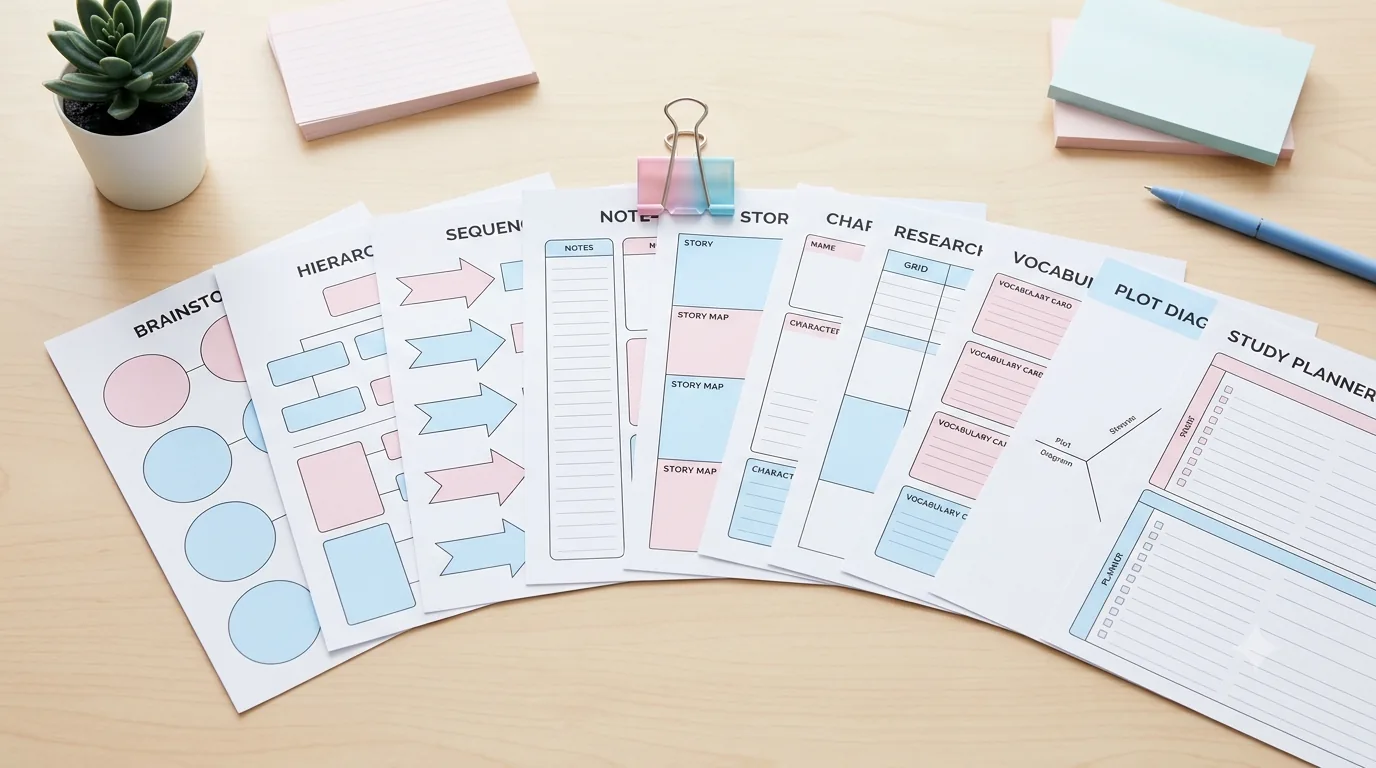
Download 10 free graphic organizers for reading, writing, comparison, vocabulary, sequencing, and study. Includes a guide to choosing the right one.
Read guide →
Free Writing Graphic Organizers: Which One to Use and When
Use free writing graphic organizers to plan ideas, structure paragraphs, compare evidence, sequence steps, and organize explanations before drafting.
Read guide →
Free Reading Comprehension Graphic Organizers by Reading Skill
Free reading comprehension graphic organizers for story elements, main idea, sequence, cause and effect, comparison, vocabulary, and prior knowledge.
Read guide →
How to Use a KWL Chart Before, During, and After Reading
Learn how to use a KWL chart before, during, and after reading, with practical prompts, a worked example, and fixes for common KWL mistakes.
Read guide →
7 Cornell Notes Mistakes That Make the Method Less Useful
Fix seven common Cornell Notes mistakes, from empty cue columns to passive rereading, and turn each page into a practical study tool.
Read guide →Keep organizing
You might also like
Free printable
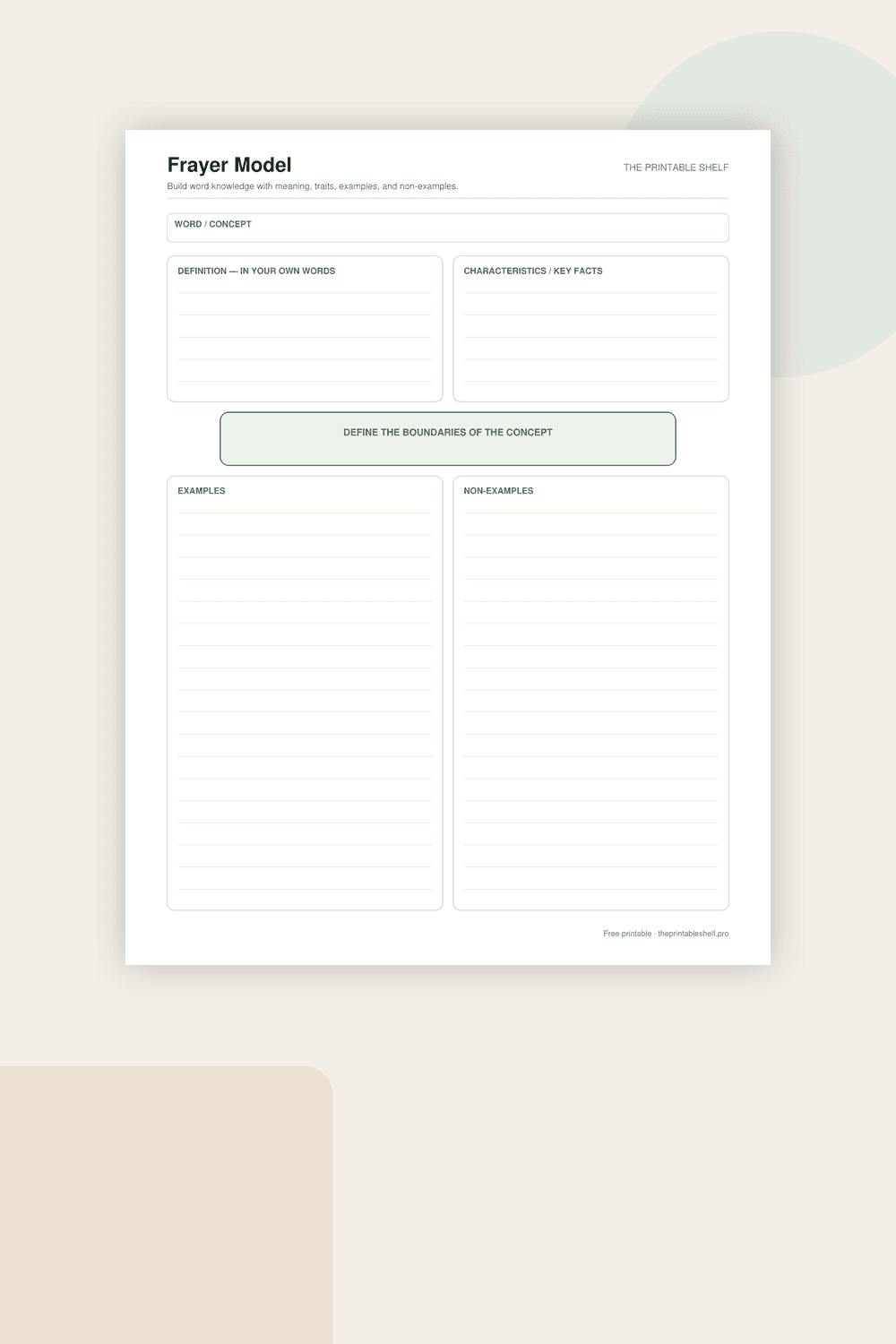
Printable Frayer Model Vocabulary Template
A classic four-part vocabulary and concept organizer upgraded from the site's older vocabulary map. Instead of stopping at a copied definition, the page asks for defining traits, clear examples, and deliberate non-examples, which helps learners distinguish what belongs to a concept from what only looks similar.
Free printable
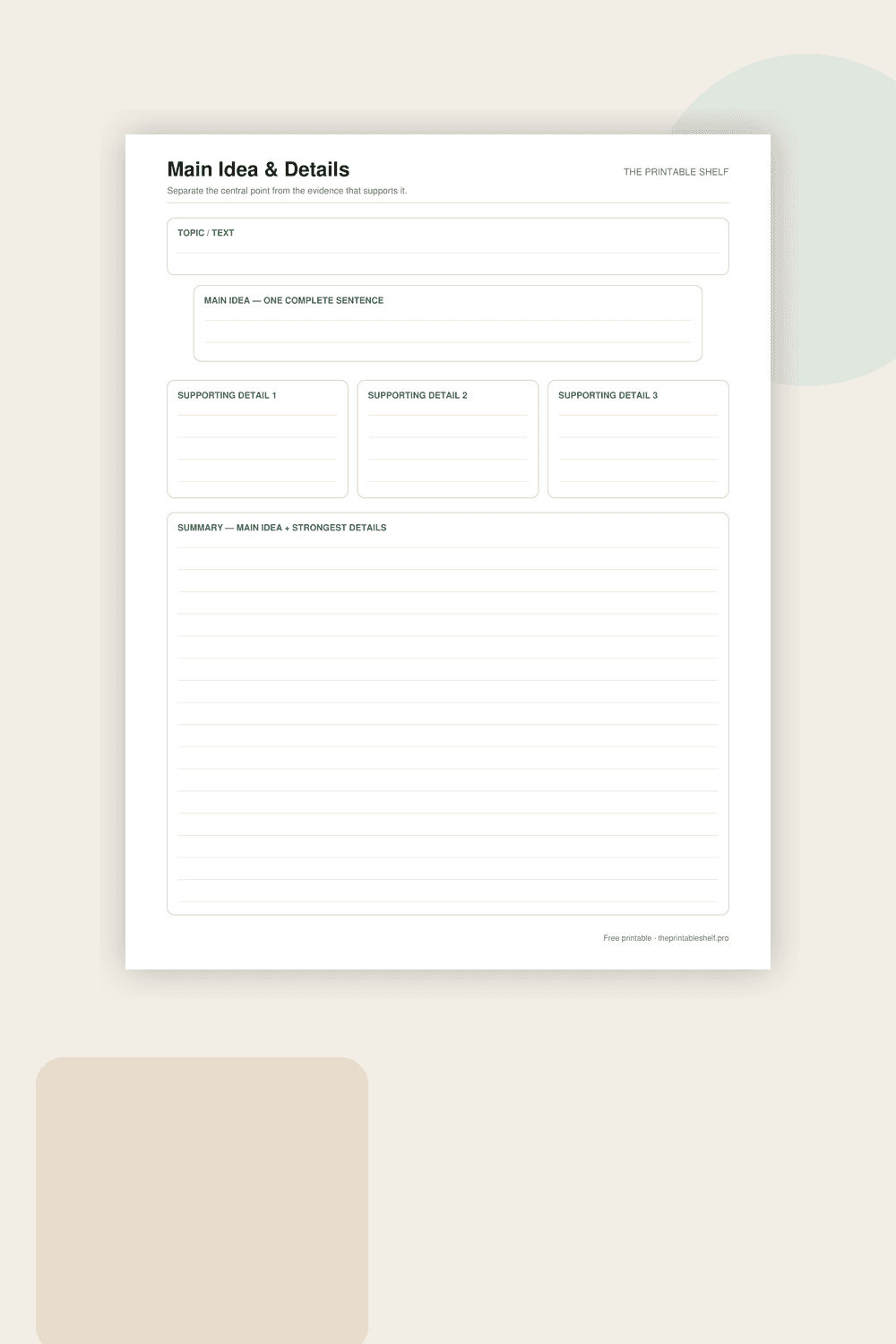
Main Idea and Details Graphic Organizer
A reading and note-taking organizer built around one central idea and three pieces of support. The extra topic box helps learners distinguish a broad subject from the author’s actual main point, while the final summary asks them to recombine the important information in their own words.
Free printable
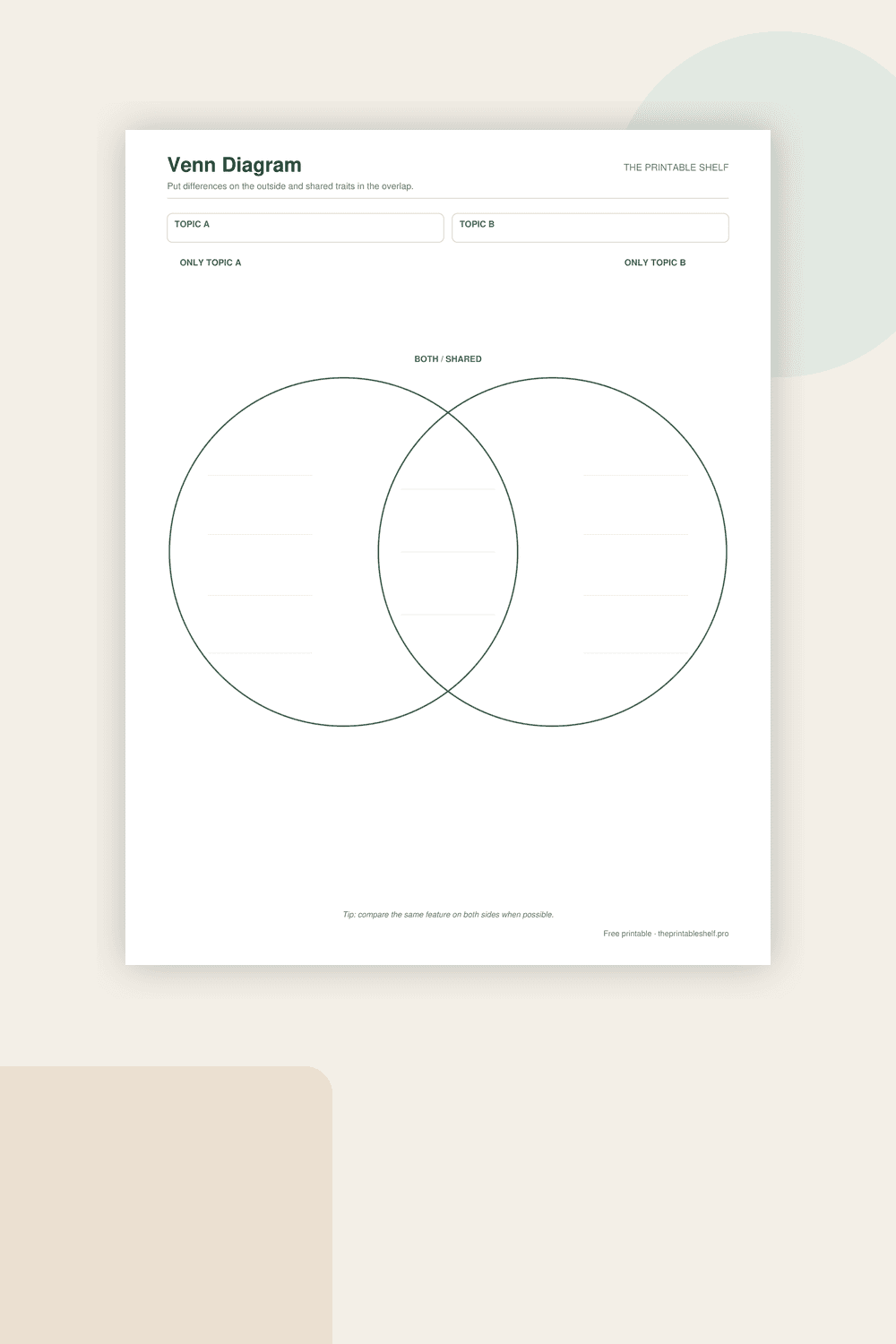
Printable Venn Diagram Template
A clean two-circle comparison organizer with dedicated topic fields, generous writing space, and light writing guides. The page is intentionally simple so the visual relationship does the teaching: differences stay on the outside, while anything true of both topics belongs in the middle overlap.