Work & Study · Free printable
Free Claim Evidence Reasoning Graphic Organizer
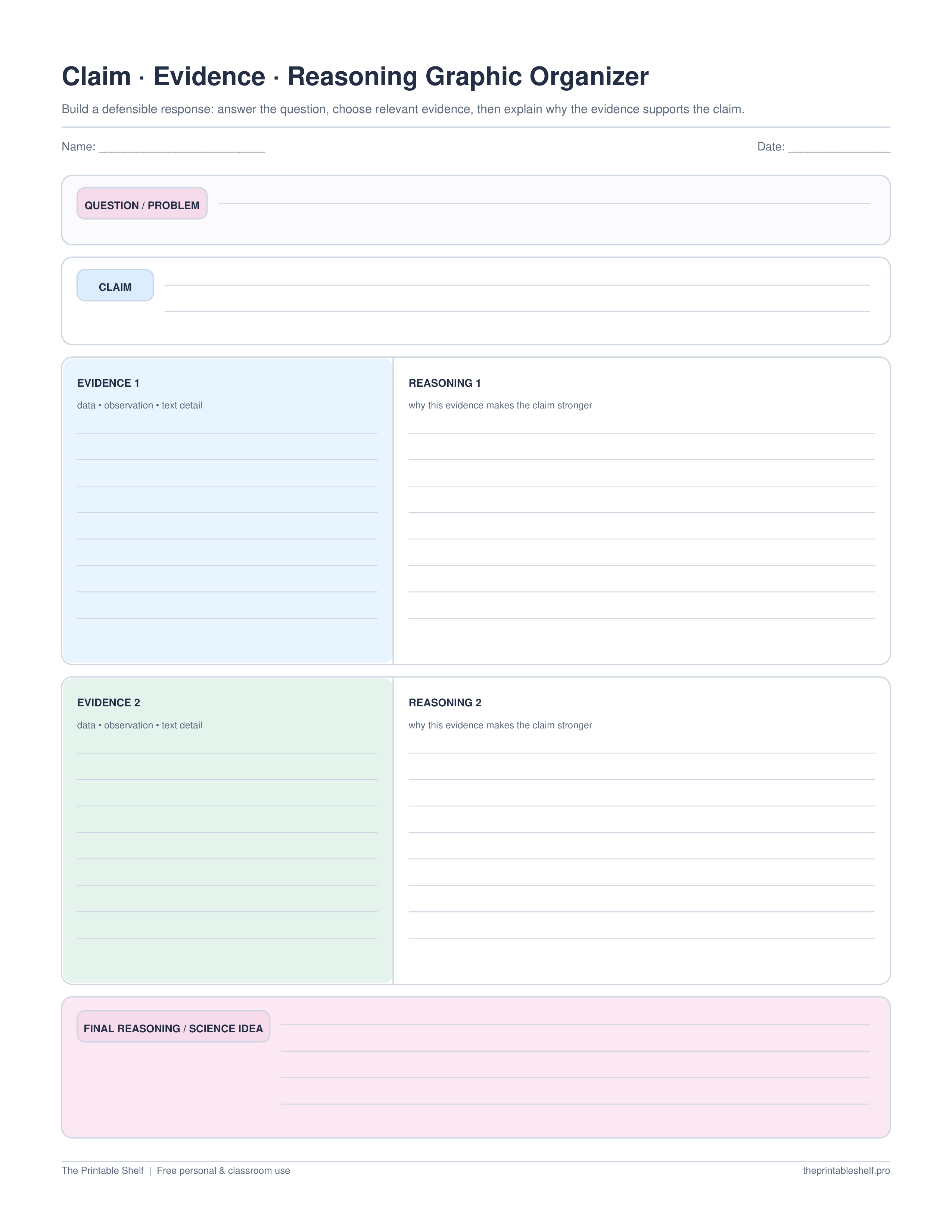
This free Claim-Evidence-Reasoning (CER) graphic organizer separates a scientific explanation into a claim that answers the question, evidence that supports the claim, and reasoning that explains why the evidence counts. Two evidence-reasoning pairs make the connection visible instead of letting evidence stand alone as a list of data.
Edited by Tessa Vaughn · Planning & Organization Editor
Free download
Choose your file size
Print at 100% / Actual Size for the cleanest margins. Pick the paper size your printer normally uses.
No sign-up required · personal/classroom use
What this printable is for
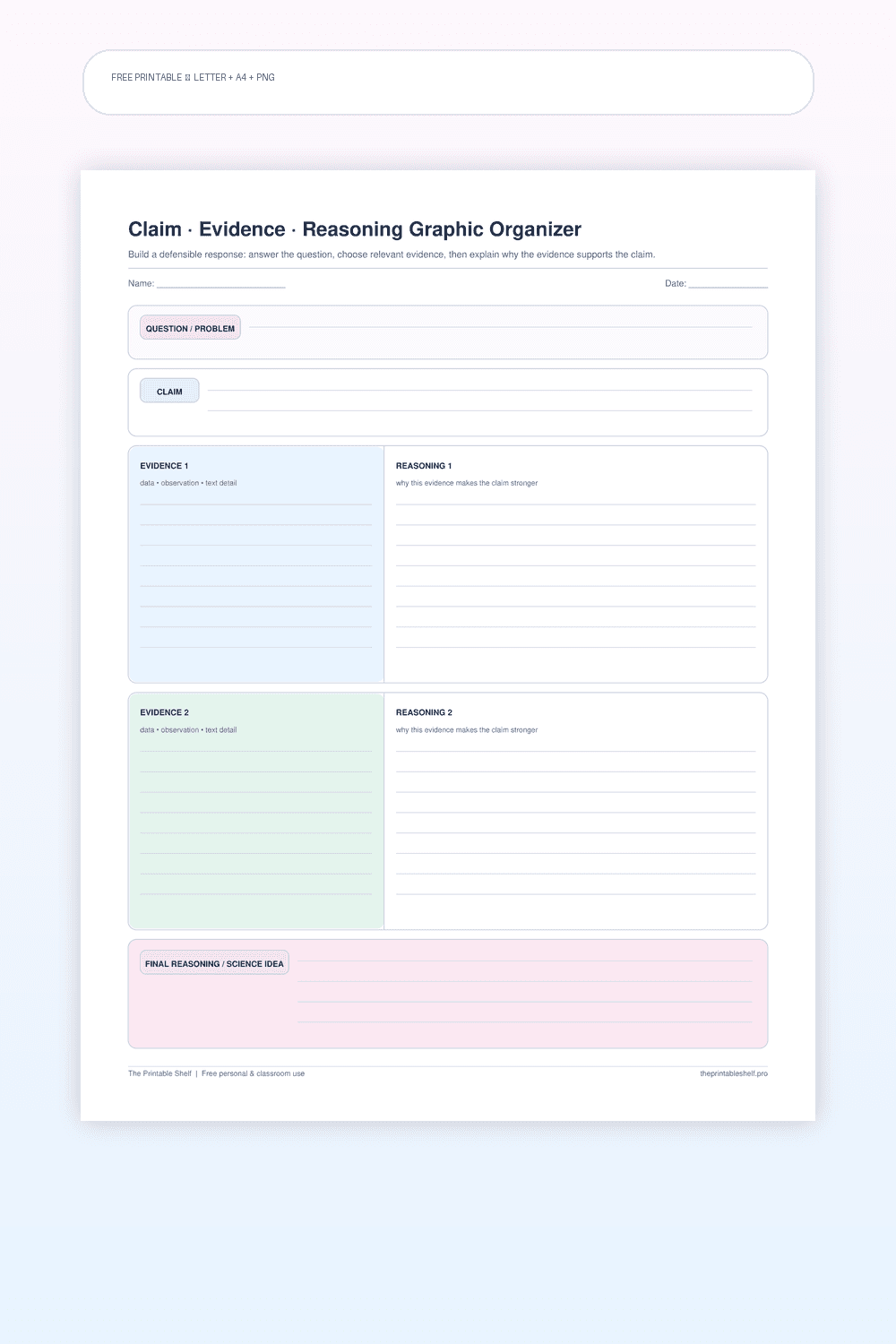
A CER planning page for constructing evidence-based explanations, especially in science. The organizer keeps claim, evidence, and reasoning visually separate because they do different jobs: the claim answers the question, evidence provides appropriate observations or data, and reasoning links that evidence to the claim using relevant scientific ideas or principles. The layout can also support other evidence-based explanations when the teacher or assignment uses CER language.
How to use it
Begin with the question or phenomenon and write one clear, provisional claim that answers it. The claim should be specific enough to evaluate but should not contain the entire explanation. When a task asks students to choose between possible explanations, predictions, or outcomes, the claim is the conclusion they will test against the available evidence. If the question has multiple parts, decide whether one claim can answer them coherently or whether the work needs to be separated.
Record evidence that is relevant to the claim and appropriate for the investigation or source. Evidence may include observations, measurements, patterns in data, results, or other information the task allows. More evidence is not automatically stronger evidence: a small set of precise observations or measurements that directly bear on the claim can be more useful than a long list of loosely related facts. Preserve units, conditions, or comparison information when those details affect what the data mean.
Use the reasoning space to explain why each piece of evidence supports the claim. This is the step most likely to disappear if evidence and reasoning share one box. Name the scientific idea, relationship, mechanism, or principle that makes the data relevant. Do not simply repeat the evidence or say 'this proves my claim.' The reader should be able to see the bridge from what was observed to why the conclusion follows.
Compare the two evidence-reasoning pairs before writing the final explanation. They may show the same pattern from different observations, or each may support a different part of the claim. Remove evidence that is irrelevant, contradictory without explanation, or too weak to support the conclusion. If the evidence points away from the original claim, revise the claim rather than forcing the data to fit it.
After planning, combine the parts into complete prose. A CER response does not have to look like three worksheet boxes in the final version; the structure should remain visible through the logic of the explanation. During revision, check that the claim answers the original question, the evidence is appropriate and sufficient for the task, and the reasoning actually connects the evidence to the claim with the relevant science.
Fill it online
Type directly into this organizer →
Your answers autosave only in this browser. Print or save the filled page as PDF, download a high-resolution PNG, or clear it and start again—no account required.
Customize instead
Need a different title, paper size, or orientation? →
Use the free Graphic Organizer Maker to build a custom Venn, KWL, Frayer, story map, T-chart, main-idea, sequence, or cause-and-effect page.
Also in a free pack
Download this organizer together with related pages when you want one reusable master PDF instead of separate files.
Choose the support level
Blank, guided, example, or fill online
Use the blank page when students already know the routine. Choose the guided version when they need short prompts inside the sections. A completed example is available when this template benefits from modeling, and the online version lets students type before printing.
Blank
Independent use →
The standard printable with open writing space and no embedded hints. Download the Letter PDF.
Guided
Prompted scaffold
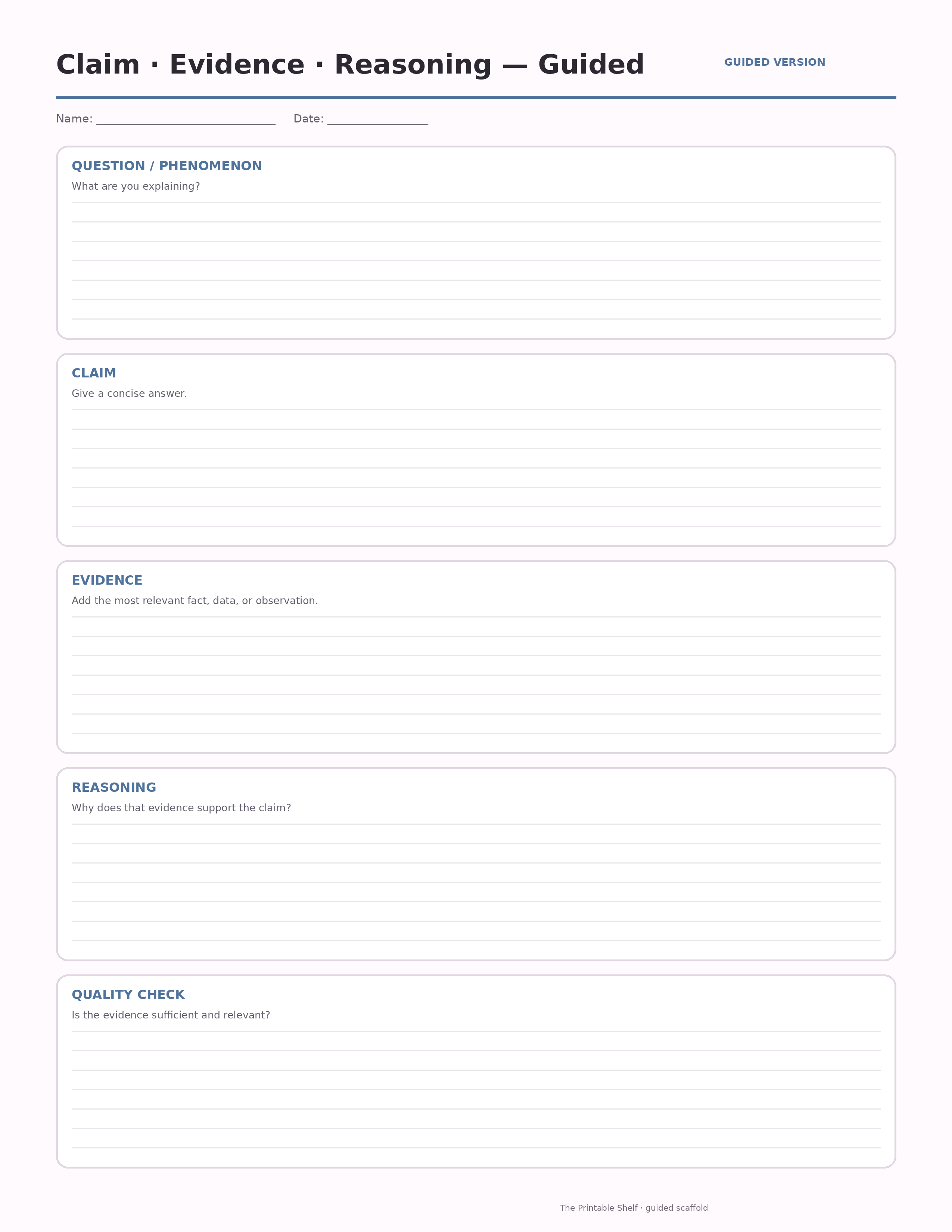
A scaffolded version with short prompts inside each section to help students know what kind of evidence or thinking belongs there.
Model
Completed example ↓
Use the finished sample to model the thinking before students work independently.
Online
Type before printing →
Autosave locally, print/save as PDF, or export the filled organizer as PNG.
Teaching set · 3 pages
Blank + guided + completed example in one PDF
Print the model first, practice with prompts, then move to the blank page without downloading three separate files.
Completed example
See how a finished page can look
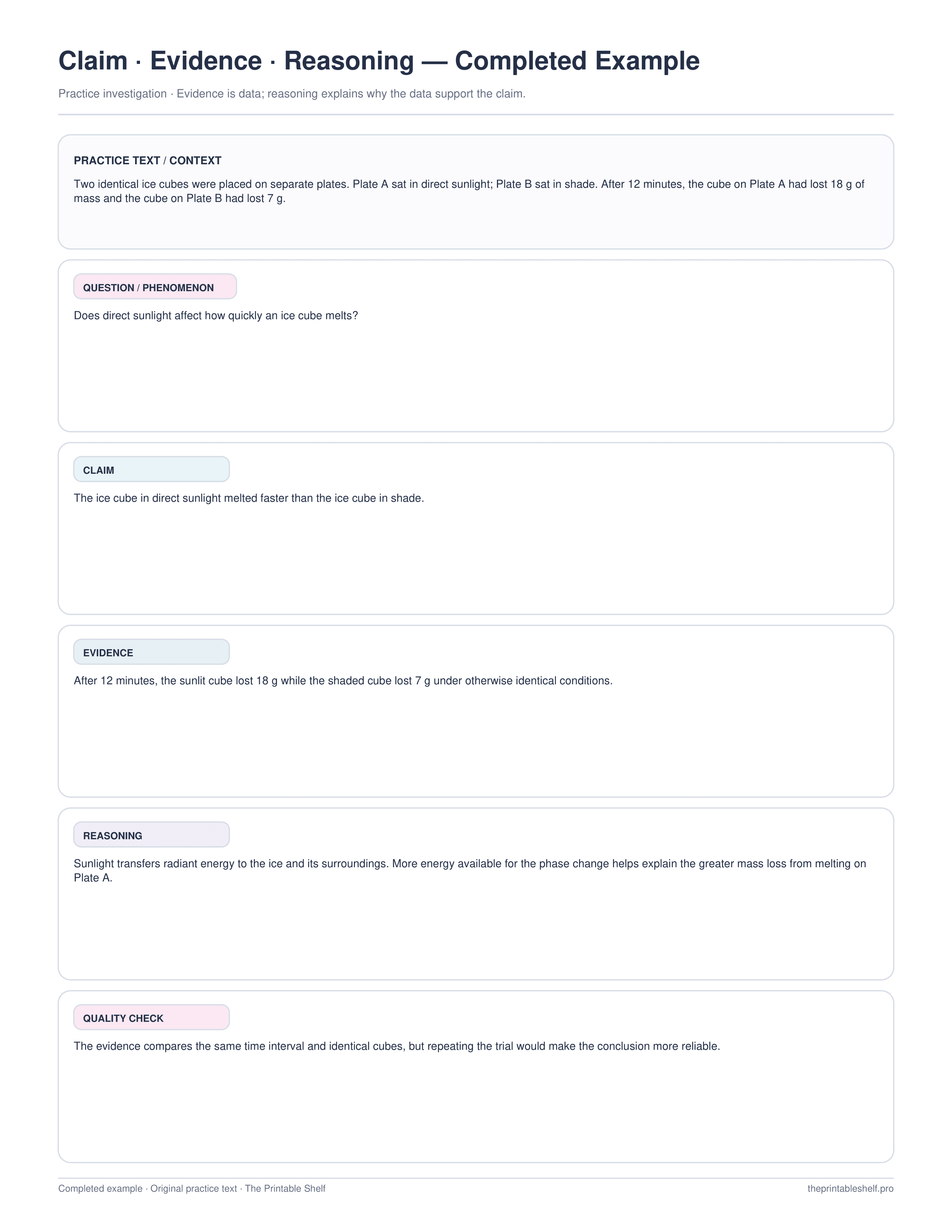
See a complete claim-evidence-reasoning response built from a simple original ice-melting investigation.
Best uses for this template
Ways to use it
Explain investigation results
State the conclusion, select the most relevant observations or data, and connect them with the science concept that makes the evidence meaningful.
Separate data from reasoning
Use paired boxes so learners can see that recording a result is not the same as explaining why that result supports a conclusion.
Revise a claim when evidence changes
Compare the original conclusion with the available evidence and update the claim instead of forcing contradictory data into the explanation.
Common mistakes to avoid
Repeating evidence as the reasoning
Add the scientific principle, mechanism, or relationship that explains why the evidence supports the claim.
Listing every observation
Choose evidence that is relevant and sufficient for the specific claim rather than treating quantity as quality.
Keeping a claim that conflicts with the data
Treat the claim as revisable. Update it when the best available evidence supports a different conclusion.
Classroom fit
Suggested grades, use modes & standards
Suggested grade bands
These are practical use ranges, not hard limits. Text complexity and the amount of teacher modeling matter more than the worksheet alone.
Good fit for
Scaffold level: Advanced.
Common Core crosswalk
- W.5.1 · Write opinion pieces supported by reasons and information
- W.6.1 · Write arguments supported by clear reasons and relevant evidence
- WHST.6-8.1 · Write discipline-specific arguments focused on evidence
These codes are a practical crosswalk for skills this organizer can support. They are not a claim that the worksheet alone fully teaches or assesses the standard.
Frequently asked questions
What does CER stand for?
CER stands for Claim, Evidence, and Reasoning. The claim answers the question, evidence supports the claim, and reasoning explains why the evidence supports that conclusion.
What is the difference between evidence and reasoning?
Evidence is the relevant observation, data, or information. Reasoning is the justification that connects that evidence to the claim using an appropriate scientific idea or relationship.
Do I always need two pieces of evidence?
No. The organizer provides room for two evidence-reasoning pairs, but the amount needed depends on the question, quality of the evidence, and assignment expectations.
Helpful guides
See where this organizer fits, when a different layout works better, and how to turn the completed page into a useful next step.
Free Writing Graphic Organizers: Which One to Use and When
Use free writing graphic organizers to plan ideas, structure paragraphs, compare evidence, sequence steps, and organize explanations before drafting.
Read guide →
Free Reading Comprehension Graphic Organizers by Reading Skill
Free reading comprehension graphic organizers for story elements, main idea, sequence, cause and effect, comparison, vocabulary, and prior knowledge.
Read guide →
How to Use Graphic Organizers Effectively (Without Turning Them Into Busywork)
Learn how to choose, model, scaffold, and reuse graphic organizers so students think with them instead of simply filling in boxes.
Read guide →How to Use Text Evidence in a Reading Response
Learn how to choose, cite, and explain text evidence in a reading response without quote dumping, with a worked example and free evidence organizer.
Read guide →How to Write Claim, Evidence, Reasoning (CER)
Learn how to write a claim-evidence-reasoning (CER) explanation, choose relevant data, connect evidence with science ideas, and revise a weak response.
Read guide →Keep organizing
You might also like
Free printable
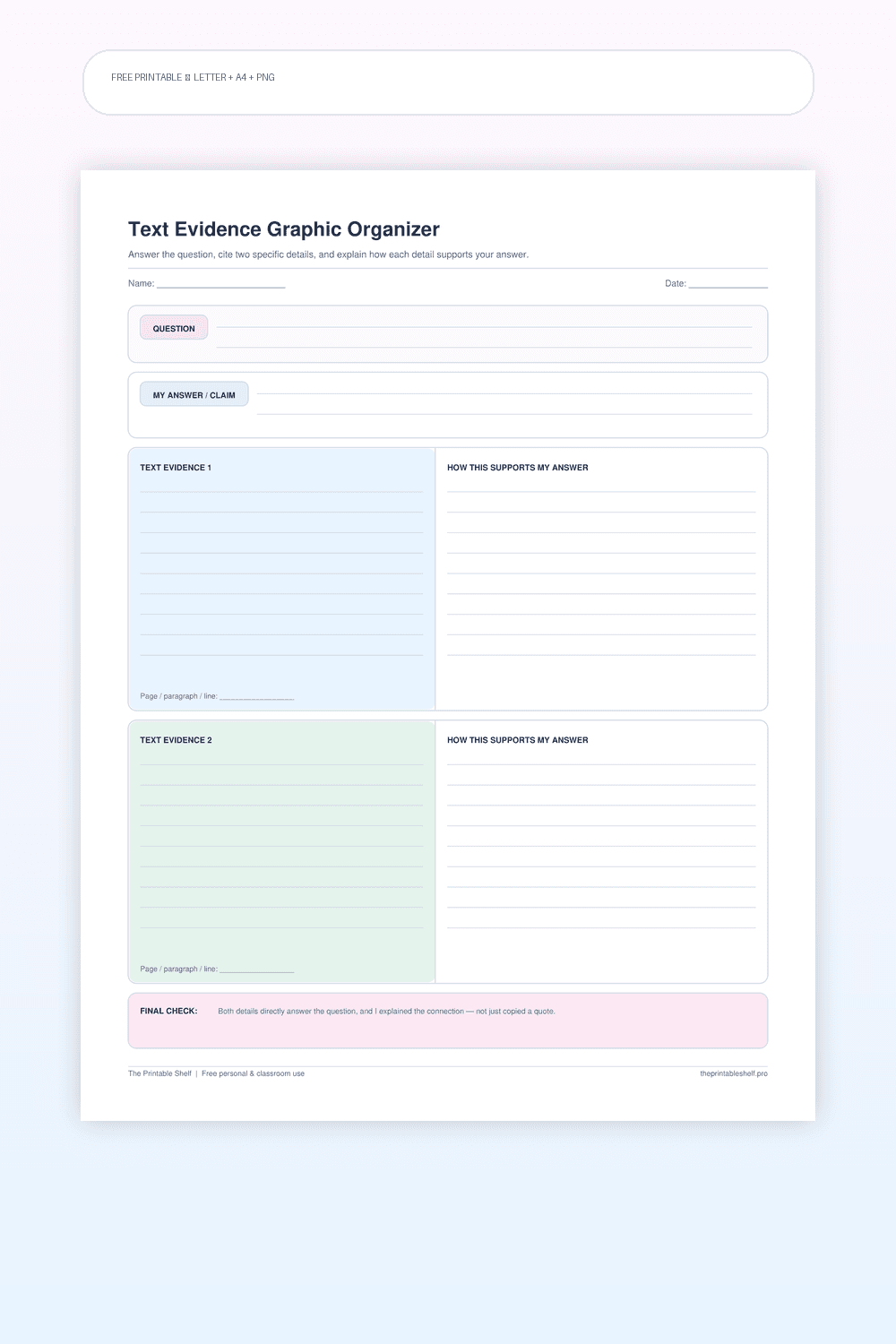
Text Evidence Graphic Organizer
A compact evidence-to-explanation organizer for reading responses and source-based writing. The page deliberately separates evidence from the explanation of evidence. That separation helps expose a common gap: a learner may copy a strong quotation or detail but never show why it supports the point being made. The organizer can be used with direct quotations, paraphrased details, page or paragraph references, and other text-specific evidence allowed by the assignment.
Free printable
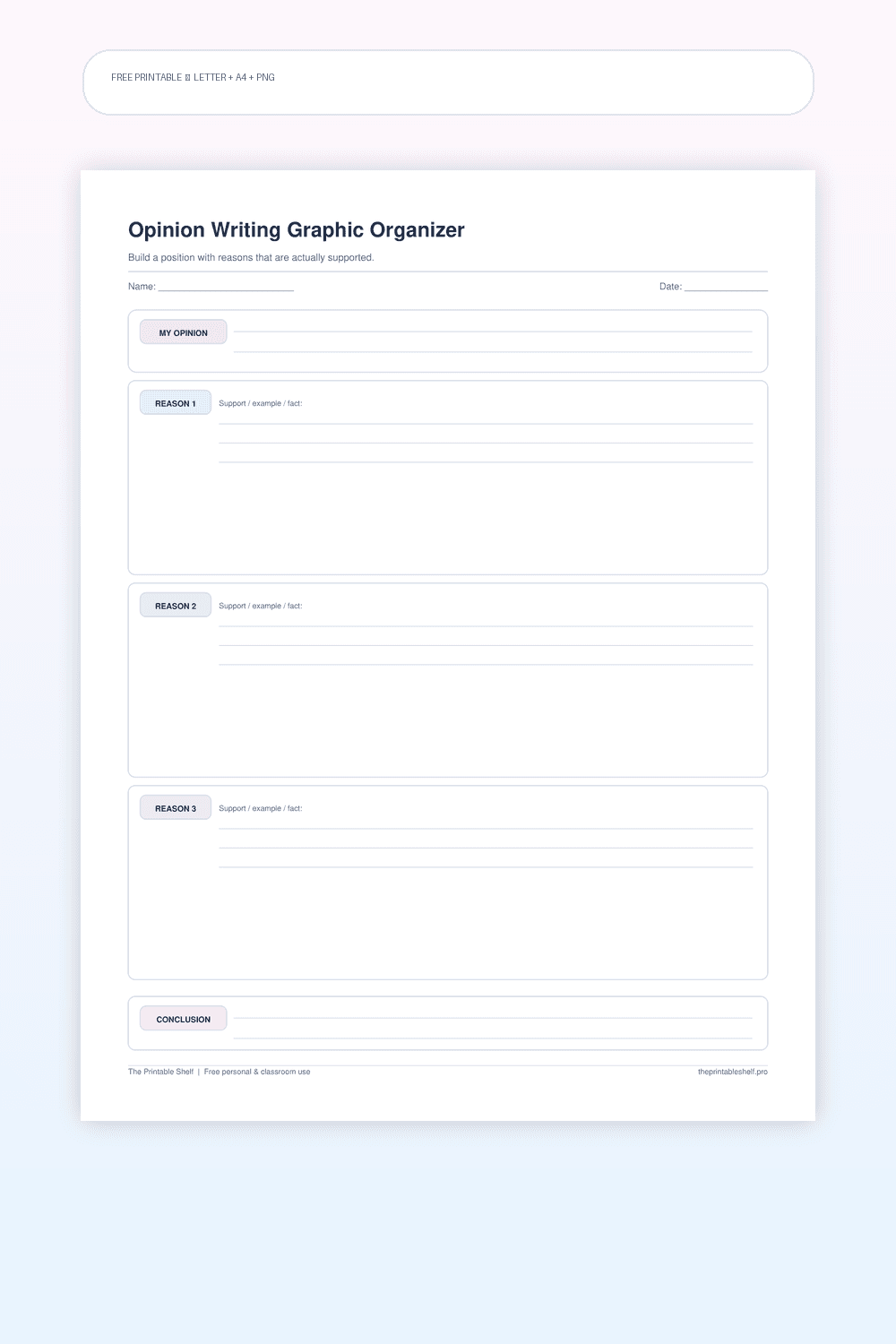
Opinion Writing Graphic Organizer
A structured prewriting page for opinion and early argument writing. It goes beyond the familiar opinion-plus-three-reasons worksheet by prompting the writer to support each reason and check whether every reason actually strengthens the same position. The result is a clearer bridge from brainstorming to a draft.
Free printable
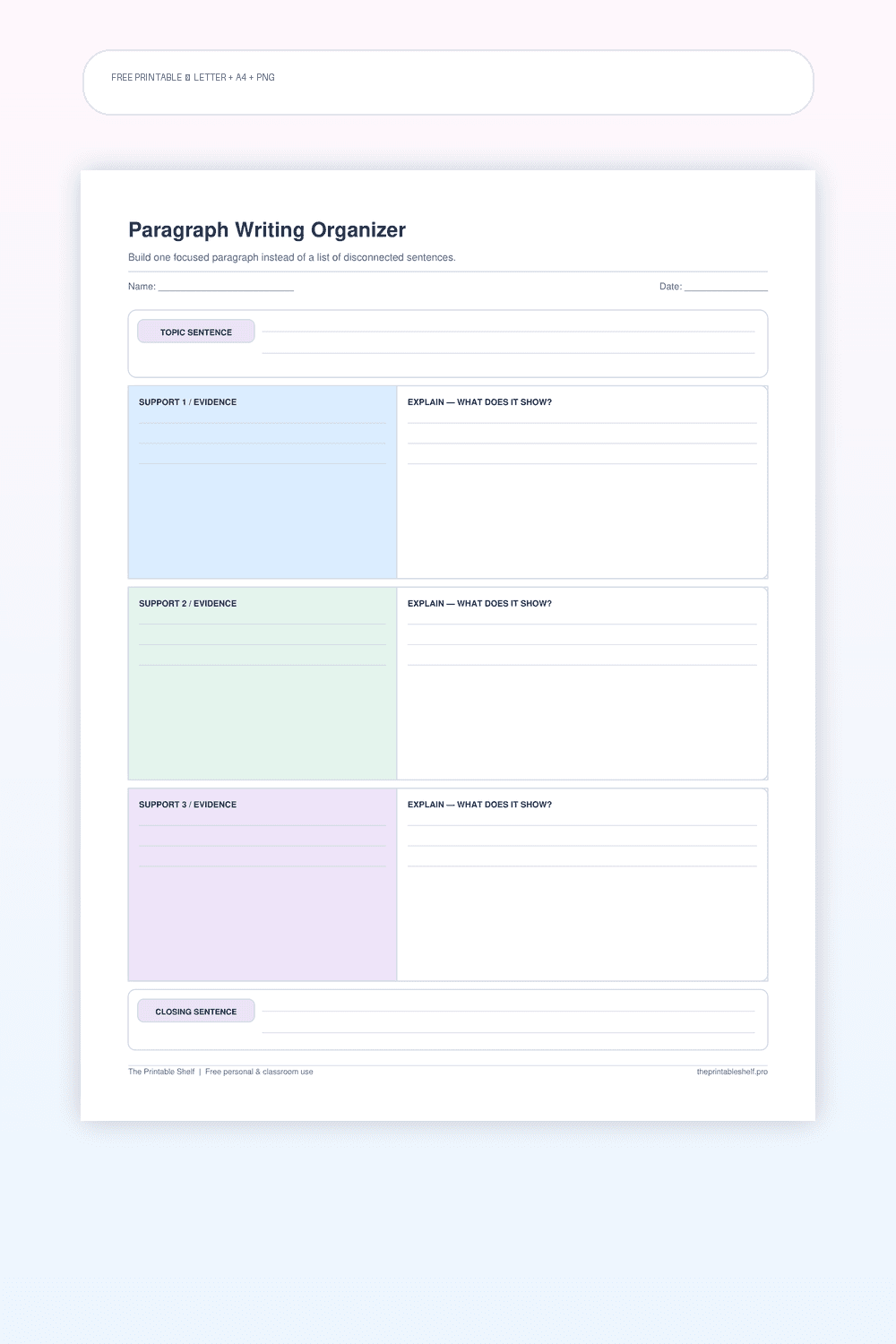
Paragraph Writing Graphic Organizer
A structured single-paragraph planner that separates the job of each sentence group: establish the controlling idea, support it with relevant points, explain those points, and close without introducing a new topic. The layout borrows the clarity of a hamburger-style organizer but avoids treating paragraph writing as a rigid five-sentence formula when a supporting idea needs more than one sentence.