Work & Study · Free printable
Free Research Notes and Source Organizer Printable
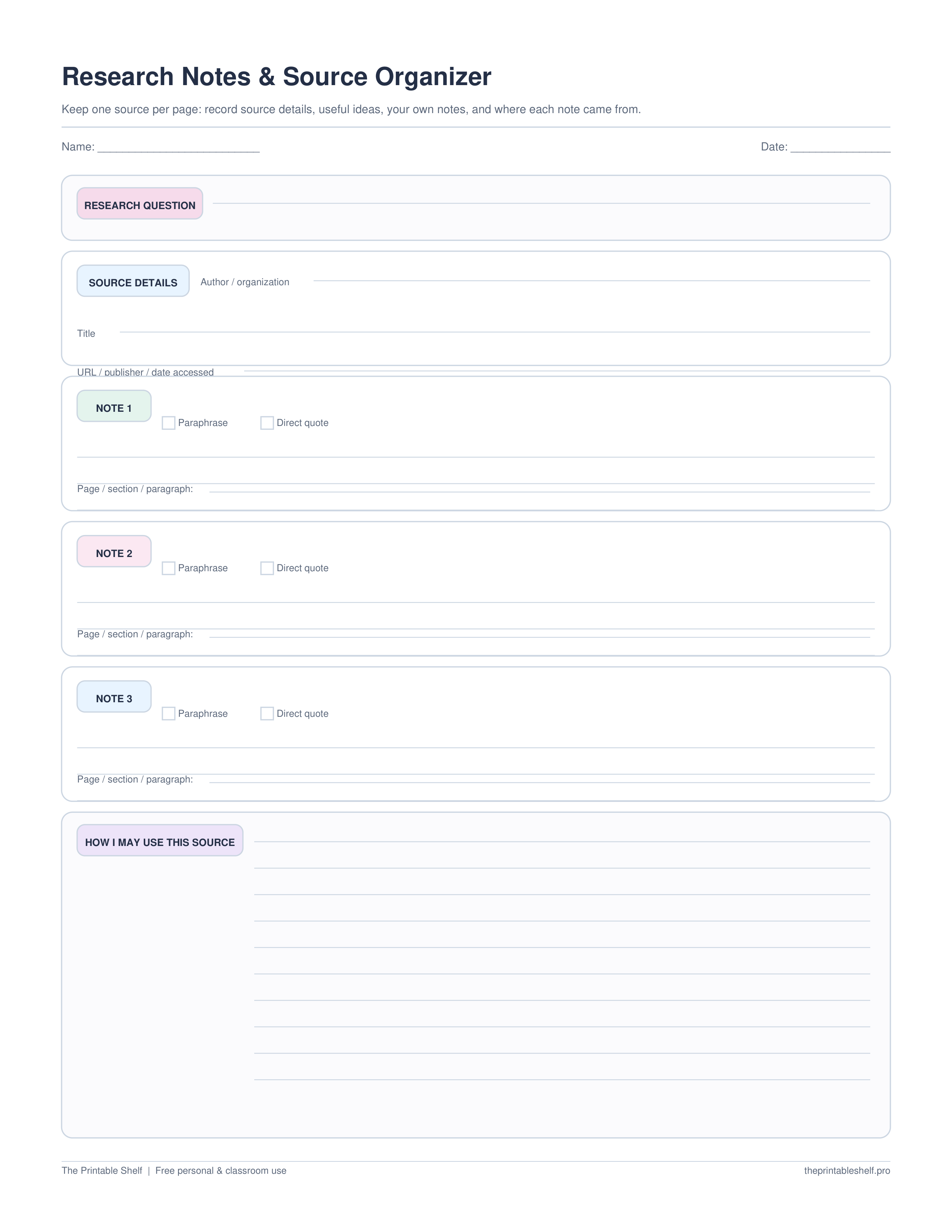
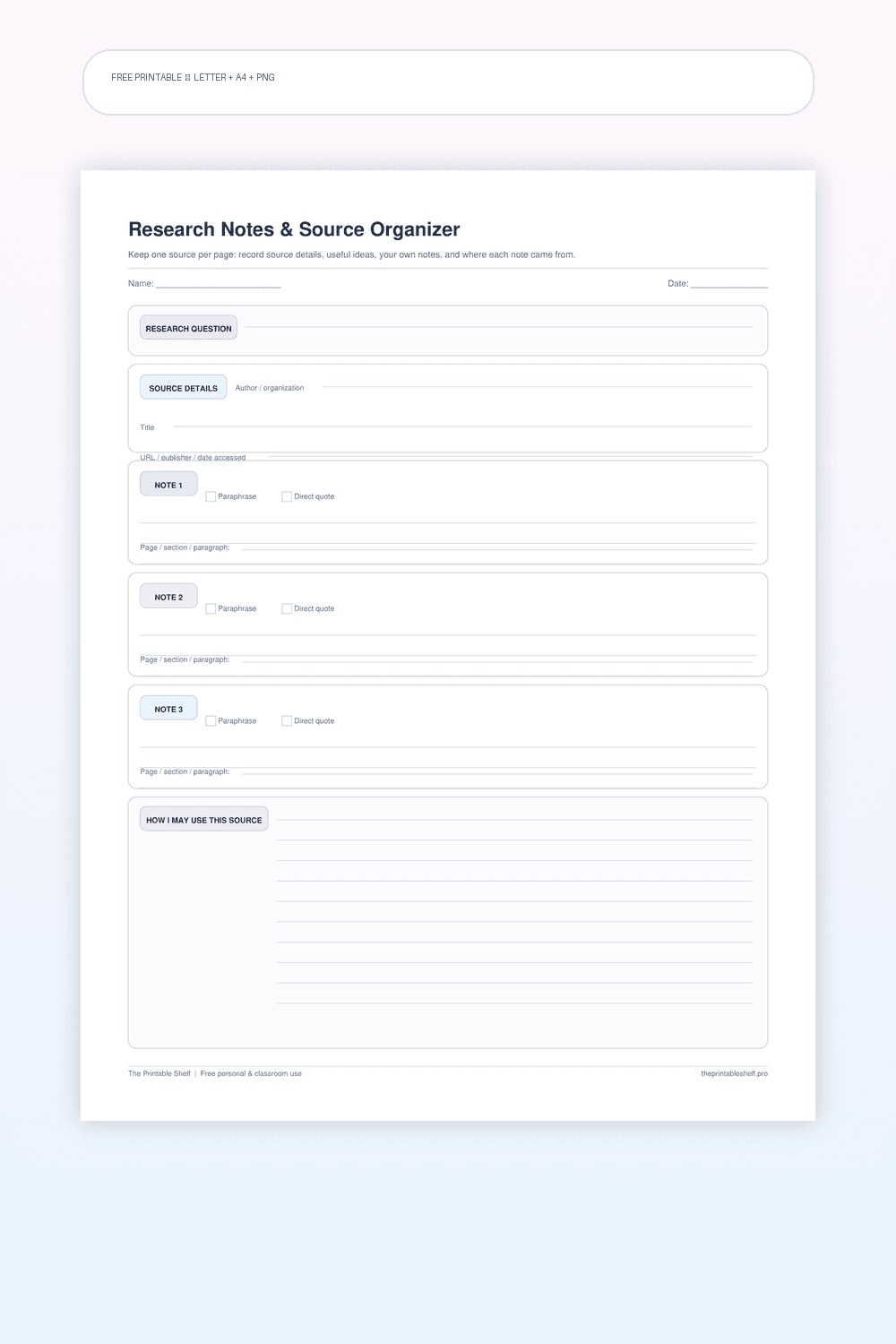
This free research notes and source organizer keeps one source per page, records source details, separates paraphrases from direct quotations, preserves page or section locators, and asks how each note may contribute to the research question. It helps writers keep attribution attached to ideas before drafting begins.
Edited by Tessa Vaughn · Planning & Organization Editor
Free download
Choose your file size
Print at 100% / Actual Size for the cleanest margins. Pick the paper size your printer normally uses.
No sign-up required · personal/classroom use
What this printable is for
A source-based note-taking sheet for research projects. The layout is intentionally organized around one source at a time so writers can preserve where information came from while deciding which notes are useful. It is a planning aid, not an automatic citation generator or substitute for the citation style required by an assignment.
How to use it
Write the research question at the top and record enough source details to identify the source again: author or organization, title, publisher or website, URL when relevant, and access or publication information your assignment may require. Citation formats differ, so use the exact style guide or teacher instructions for the final bibliography.
Keep one source on each sheet. In each note section, mark whether the note is a paraphrase or a direct quotation. A paraphrase should be written in your own wording and sentence structure while preserving the source meaning. A direct quotation should preserve the source wording accurately and be clearly marked so it is never mistaken for your own prose later.
Record a page, section, paragraph, timestamp, or other locator when the source provides one. Even when the final citation style does not require every locator, keeping it in the research notes makes fact checking and quotation verification much easier. For web pages without stable page numbers, use a descriptive section heading or another locator that helps you find the passage again.
Use the 'how I may use this source' section to connect the notes to the research question. Decide whether the source may provide background, evidence, a definition, a contrasting view, data, an example, or a lead to another source. This step discourages collecting facts that never contribute to the project.
Before drafting, compare source sheets and group notes by the claim or section they support. Do not copy the source sheet into the paper in the order notes were collected. Research writing usually becomes stronger when the writer reorganizes information around the paper's questions and claims while preserving source attribution. When two sources support the same point, keep both origins visible and decide whether they corroborate, qualify, or contradict one another before combining them in the draft.
Customize instead
Need a different title, paper size, or orientation? →
Use the free Graphic Organizer Maker to build a custom Venn, KWL, Frayer, story map, T-chart, main-idea, sequence, or cause-and-effect page.
Also in a free pack
Download this organizer together with related pages when you want one reusable master PDF instead of separate files.
Completed example
See how a finished page can look
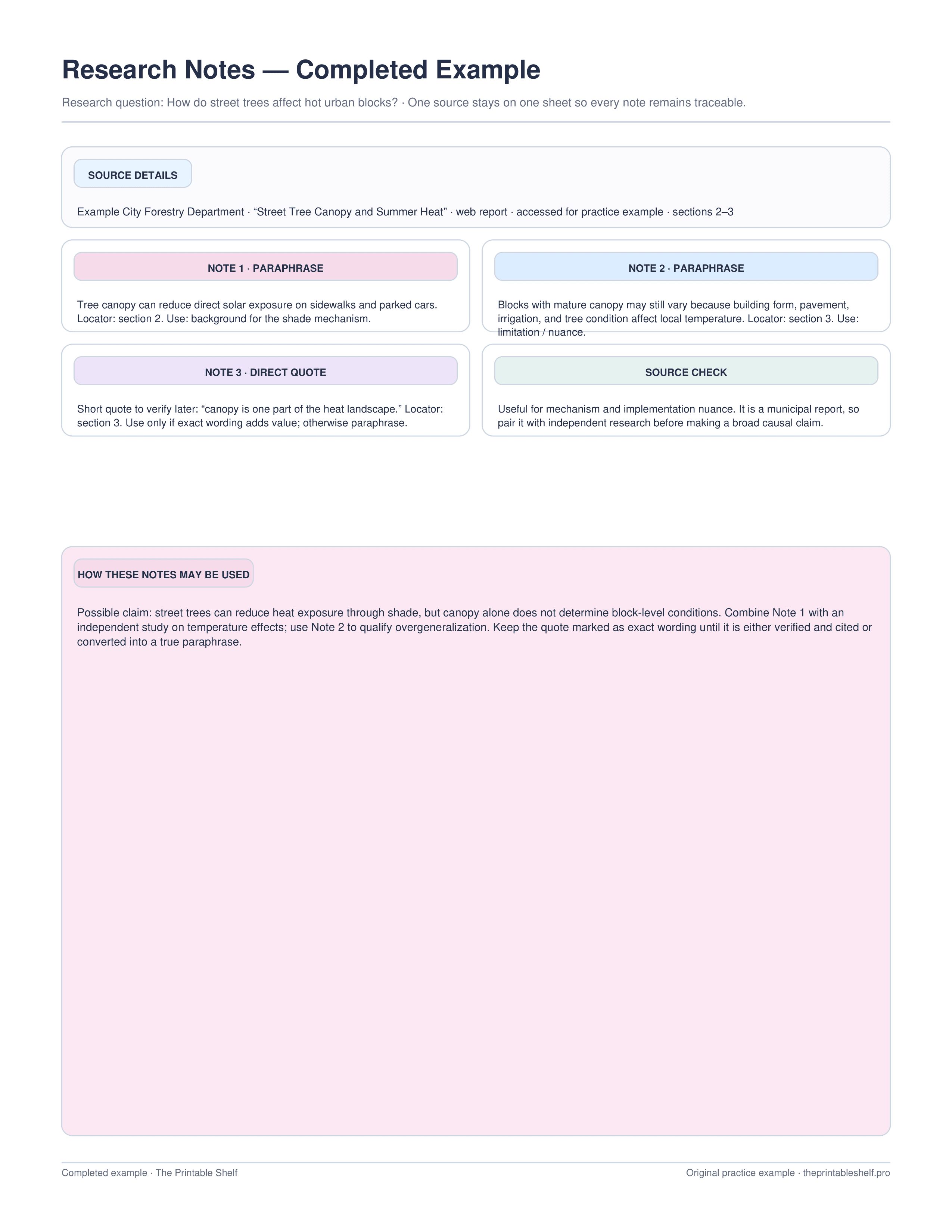
This example keeps one fictionalized practice source traceable across paraphrases, a marked quotation, locators, a source check, and a use plan. It models attribution habits before notes are reorganized into a draft.
Best uses for this template
Ways to use it
Keep one source traceable
Record identifying details and locators on the same page as the notes so information can be checked later.
Separate paraphrases from quotations
Mark the note type at collection time so exact source wording is not accidentally blended into the writer's own draft.
Collect notes with a purpose
Connect each source to the research question and decide whether it supplies evidence, background, contrast, data, or another useful role.
Common mistakes to avoid
Mixing several sources on one page
Use one source per sheet so each note has a clear origin.
Copying source wording without marking it
Check the direct-quote box and preserve an exact locator whenever source wording is copied.
Treating collected notes as the final paper order
Regroup notes by the paper's claims or sections during outlining while keeping the source attribution attached.
Classroom fit
Suggested grades, use modes & standards
Suggested grade bands
These are practical use ranges, not hard limits. Text complexity and the amount of teacher modeling matter more than the worksheet alone.
Good fit for
Scaffold level: Advanced.
Common Core crosswalk
- W.6.7 · Conduct short research projects to answer a question
- W.6.8 · Gather relevant information from multiple sources and assess credibility
- W.7.8 / W.8.8 · Gather, evaluate, quote or paraphrase source information while avoiding plagiarism
These codes are a practical crosswalk for skills this organizer can support. They are not a claim that the worksheet alone fully teaches or assesses the standard.
Frequently asked questions
Should I use one sheet per source?
Yes. One source per sheet makes it easier to preserve attribution and locate the original passage later.
What is the difference between a paraphrase and a direct quote?
A paraphrase restates the source meaning in your own wording and structure. A direct quote preserves the source's exact wording and should be clearly marked as a quotation.
Does this sheet create a citation automatically?
No. It helps you preserve source details, but you should format the final citation using the style guide or instructions required for the assignment.
Helpful guides
See where this organizer fits, when a different layout works better, and how to turn the completed page into a useful next step.
Keep organizing
You might also like
Free printable
Printable Cornell Notes Template
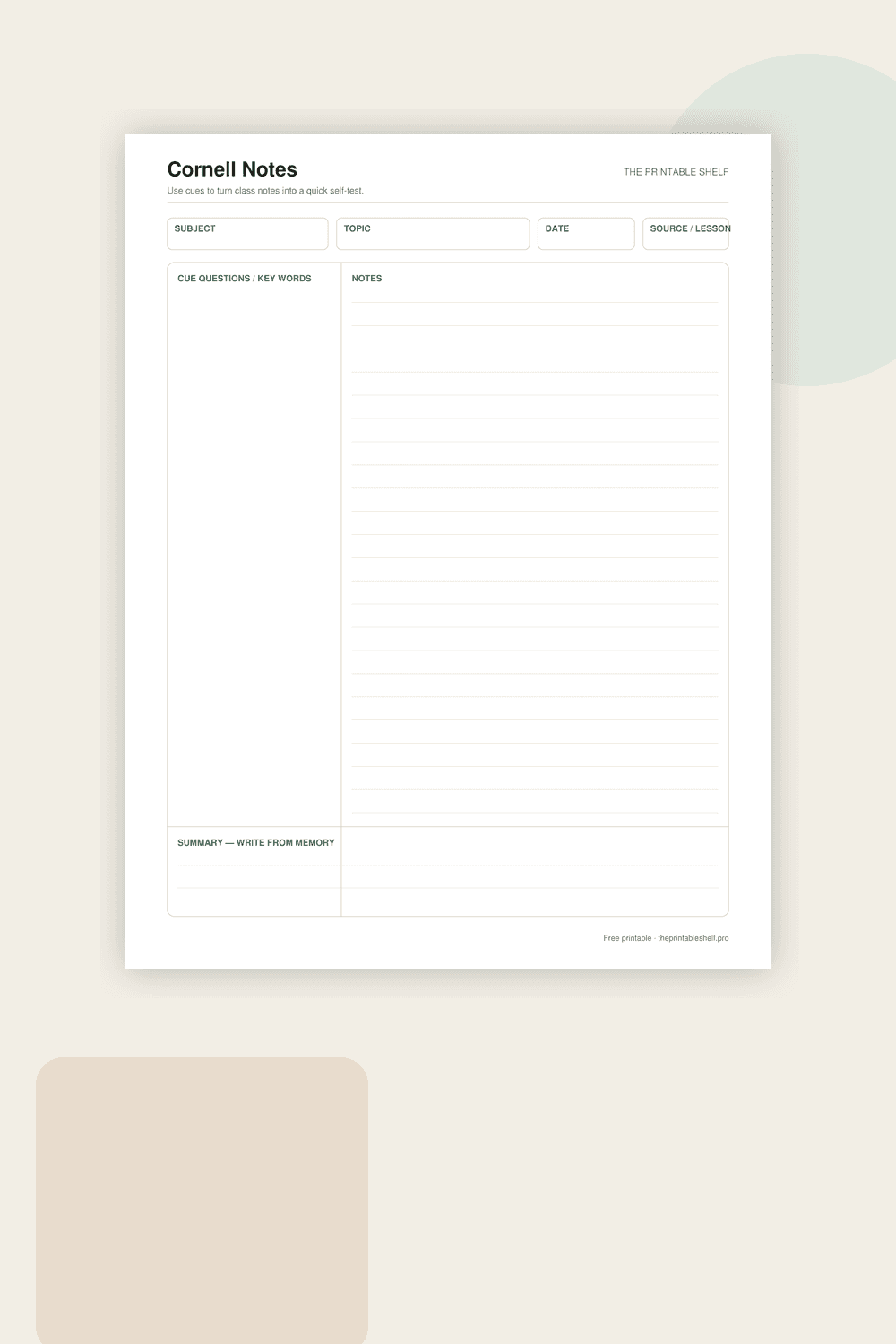
A one-page Cornell note-taking sheet designed for classes, lectures, reading, and self-study. The narrow left column is for cue questions and key words, the wide right side is for the main notes, and the bottom summary box gives you a built-in review step instead of leaving the page as passive notes.
Free printable
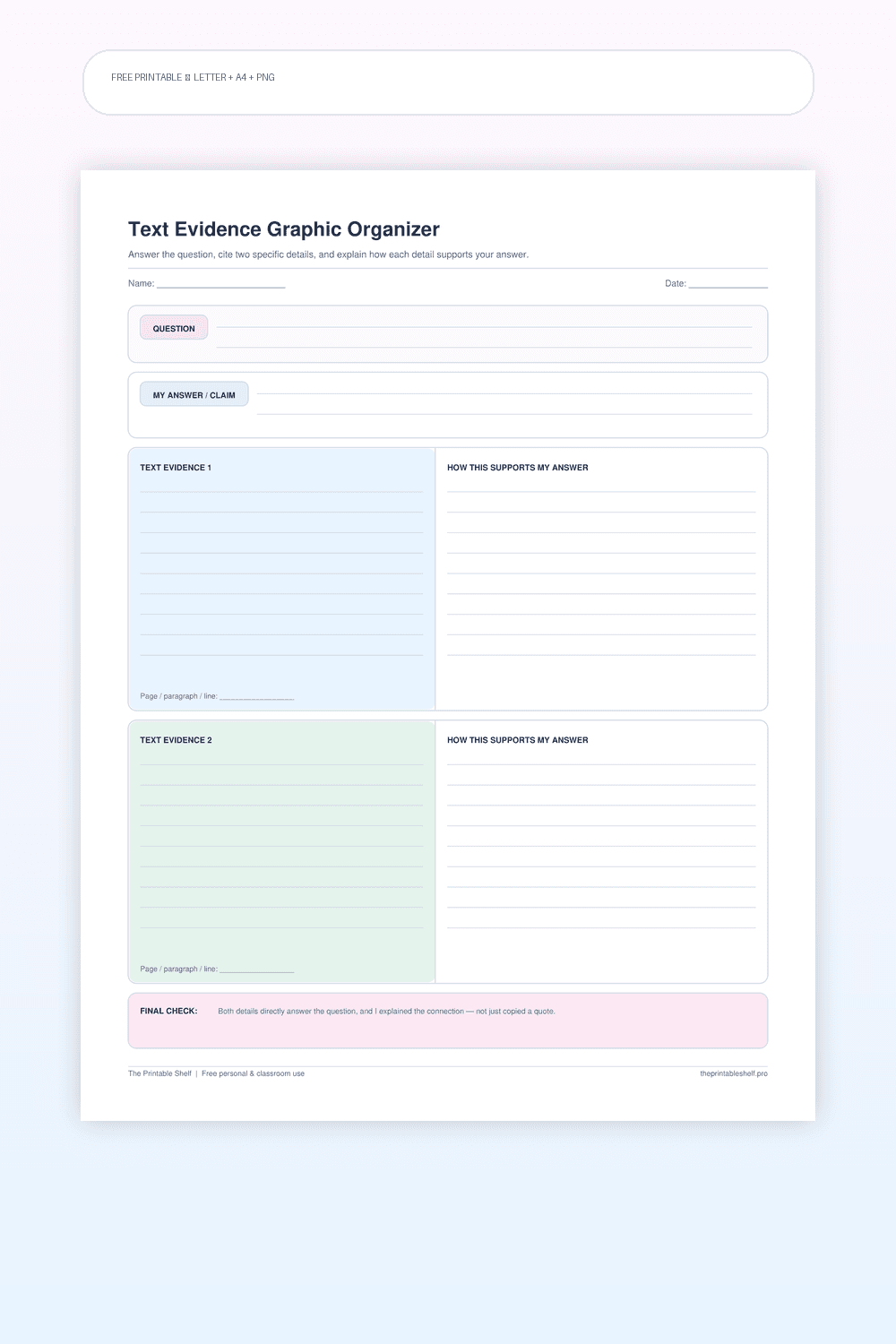
Text Evidence Graphic Organizer
A compact evidence-to-explanation organizer for reading responses and source-based writing. The page deliberately separates evidence from the explanation of evidence. That separation helps expose a common gap: a learner may copy a strong quotation or detail but never show why it supports the point being made. The organizer can be used with direct quotations, paraphrased details, page or paragraph references, and other text-specific evidence allowed by the assignment.
Free printable
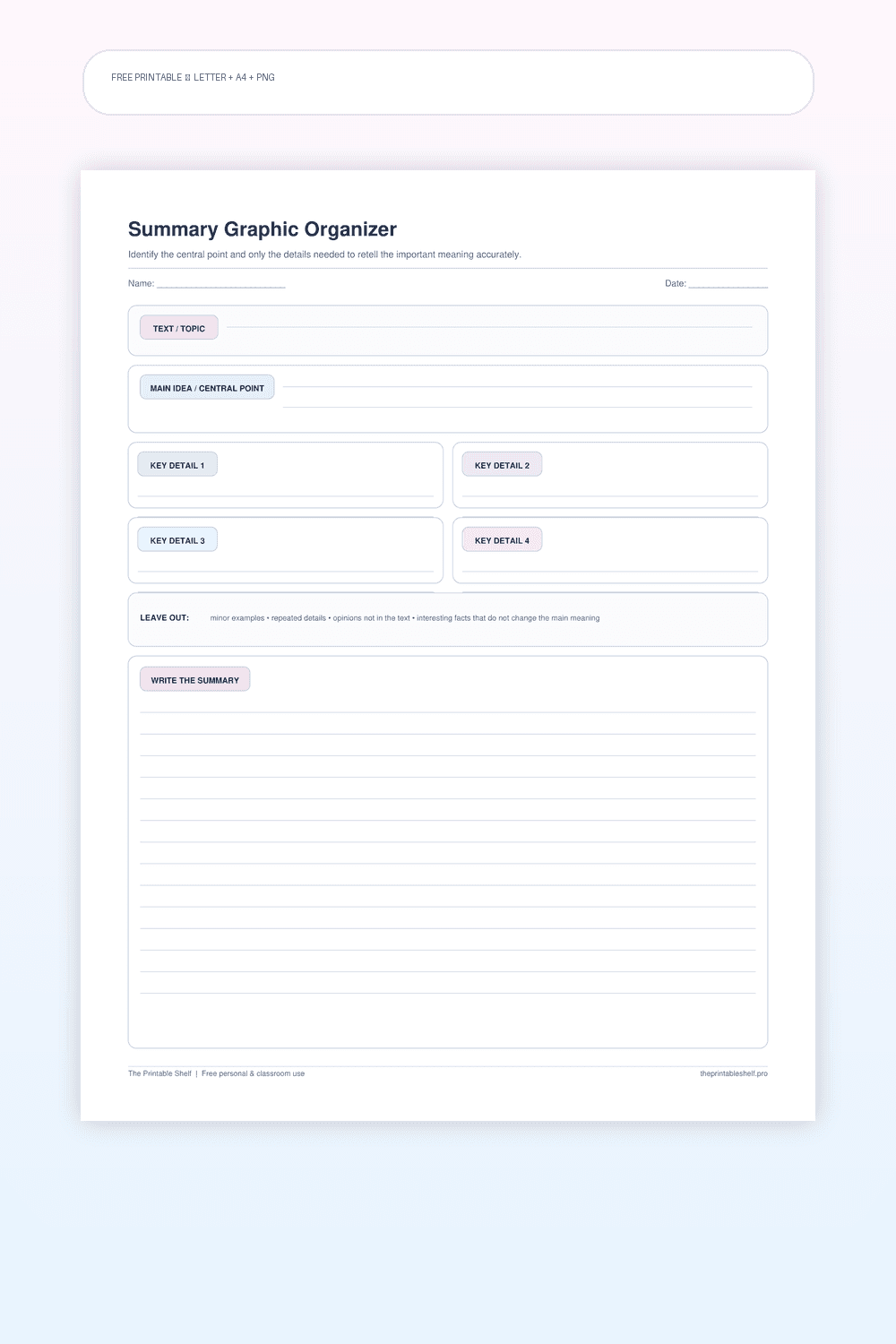
Summary Graphic Organizer
A reading-to-writing scaffold for compressing a text around its most important ideas. The page combines a main-idea box, a small set of key-detail slots, a deliberate 'leave out' check, and a final writing area. It is especially useful when learners can locate details but struggle to rank their importance. Unlike a beginning-middle-end retell, this organizer does not require every event to appear and can be used with nonfiction as well as narrative texts.